Thursday 28 May, 2026
[email protected]
Resilience Media
  • News
    • Events
    • Interview
    • Startups
    • Venture
    • Weekly Digest
  • Resilience Conference
    • Resilience Conference Warsaw 2026
    • Resilience Conference Copenhagen 2026
    • Resilience Conference London 2026
  • About
  • Guest Posts
    • Author a Post
  • Subscribe
No Result
View All Result
  • News
    • Events
    • Interview
    • Startups
    • Venture
    • Weekly Digest
  • Resilience Conference
    • Resilience Conference Warsaw 2026
    • Resilience Conference Copenhagen 2026
    • Resilience Conference London 2026
  • About
  • Guest Posts
    • Author a Post
  • Subscribe
No Result
View All Result
Resilience Media
No Result
View All Result

Orbital Industries, an “AlphaFold” for materials science, raises $50M

The startup's AI-based platform Orb is being used to build more resilient and efficient data centres and materials for GPUs

Ingrid LundenbyIngrid Lunden
May 28, 2026
in News
a computer chip with the letter a on top of it
Share on Linkedin

A startup called Orbital Industries believes it can make meaningful, less resource intensive, breakthroughs in materials science using AI to accelerate research and development. Now it has picked up $50 million to expand its business. 

You Might Also Like

The defence tech boom is creating a cybersecurity industry for machines

UK’s intelligence chief eyes Russia and China as the major cyberthreats of our time

Quaze deal gives Red Cat wireless power for drones and robots

Founded in London with a second base in San Francisco, Orbital Industries is currently working on products that may well serve Orbital Industries itself and companies like it first (fulfilling the famous YCombinator adage: build something to solve your own problems). It is developing cooling technology intended for use in GPUs, the processors that power AI models; and a new “modular” data centre product, also driven by the demands of AI computing. 

Plural, the London-based VC with a heavy resilience tech focus, is leading the round, which appears to have closed earlier this month, per PitchBook data, but is only being announced today. Other backers in the round include NVentures (the strategic investment arm of the GPU giant NVIDIA), Radical Ventures, Compound and Fly Ventures. 

Orbital Industries first launched three years ago. Headed by CEO Jonathan Godwin, a DeepMind alum, it originally started out with a wider remit under the name Orbital Materials. This funding announcement coincides with the startup doubling down on industrial tech hardware with the launch of a new brand, Orbital IT. It has now raised $71 million in total and is not disclosing valuation. 
From a resilience perspective, Orbital Industries is worth watching.

It is one of many technology companies converging on the challenges of building and running critical industries in a way that is less dependent on scarce materials and components, precarious third parties, long supply chains and environmental strains. (It’s a big challenge and others in this wide field include the likes of chip maker Fractile, factory disruptor Isembard, and alternative fuel companies.)

Materials science is a complicated field full of research bottlenecks; and seemingly like the rest of the world right now, Orbital is focusing on the silver bullet of AI to fix that. Specifically, it is building AI models (and its “Orb” platform) for developing materials and systems using those materials that are less resource-intensive than the products that are on the market today. 

Its claims are lofty. Orb — which you can think of as a kind of large physics model — “can simulate 100,000 atoms on a single GPU” and run “ten times faster than the nearest alternative”, outperforming models from Microsoft, Meta and academic labs, it says, and “turning week-long quantum simulations into coffee-break computations.”

Orbital is well aware of the many assumed pitfalls of AI and is quick to counter them, claiming that it has tested its predictions and found they do not “drift” and hallucinate — that is, start to deteriorate in their thinking and make up data.

Orbital’s first two efforts, if they work as intended, would represent efficiency and resource leaps on products that exist today.

Its two-step immersion cooling tech for GPUs is aiming to be PFAS-free and non-toxic; and the Nova Array data centre can be taken, it claims, from purchase order to “power on” in just 24 weeks. For context, that is not atypical for modular data centre systems, but current hyperscaler data centres can take years to get off the ground. (It’s not clear if the Nova Array is intended to complement or fully replace the latter.)

This is assuming that the products work and sell as it and its investors hope. 

The Nova Array is on the market now, the company tells me. It is “in active commercial conversations” but has no signed customers yet. The cooling technology meanwhile is “currently in development”; the aim is to start its first pilots later this year. This makes the startup pre-revenue at present. 

However, it does have some very key relationships that could see some interesting deals materialise (pun intended). Not only is Nvidia an investor, but Orbital also has had a partnership with Amazon’s AWS since 2024.

The AlphaFold example

Orbital is the brainchild of CEO Jonathan Godwin, who was working at DeepMind when it launched AlphaFold.

“That day we had a feeling that a turning point for human health had been reached as a result of AI,” he wrote three years ago.

As AlphaFold was unfolding, Godwin writes that he was starting work on applying large-scale machine learning to materials science, which he describes as “the foundational physical science problem of the twenty-first century.” 

That research led to Godwin leaving DeepMind to form his startup. The AlphaFold example was instructive in another way, too. “Incredibly, this 50 year old problem had been solved by a comparatively small team, some of whom had no biology background – a testament to the huge leverage AI brings to human creativity and intelligence,” Godwin recalled. Notably, neither Godwin nor his other two co-founders, CTO James Gin-Pollock and COO Daniel Miodovnik, had direct materials science experience going into Orbital.

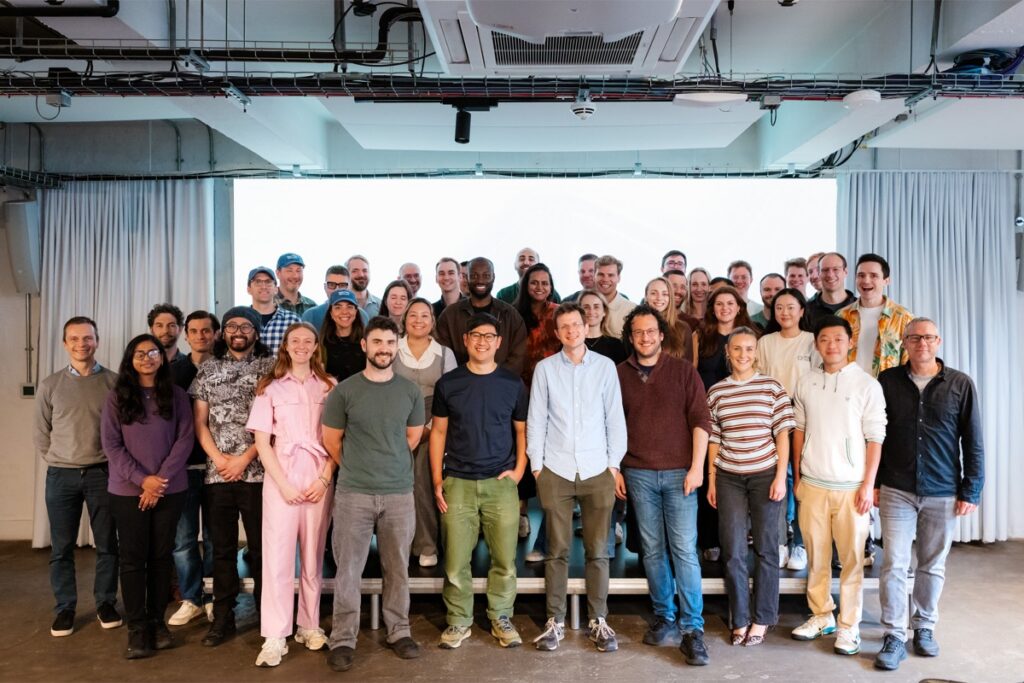
Is that a blessing or a curse? In the most optimistic reading, this could give the company just the right measure of audacity to try new things at a scale that existing materials science researchers have yet to be able to do. And as with AlphaFold and wider medical research, that work, if it holds, can in turn feed into materials science researchers finding their own breakthroughs. Now, Orbital has 50 employees, and now $50 million more, to prove this out.


Tags: AIDataindustrial technologymaterials scienceNvidiaorbital industriesPlural
Previous Post

The defence tech boom is creating a cybersecurity industry for machines

Next Post

Weekly Digest: Odd Systems’ new camera, RevEng.ai raises $15M Series A, Germany goes with ChapsVision over Palantir

Ingrid Lunden

Ingrid Lunden

Ingrid is an editor and writer. Born in Moscow, brought up in the U.S. and now based out of London, from February 2012 to May 2025, she worked at leading technology publication TechCrunch, initially as a writer and eventually as one of TechCrunch’s managing editors, leading the company’s international editorial operation and working as part of TechCrunch’s senior leadership team. She speaks Russian, French and Spanish and takes a keen interest in the intersection of technology with geopolitics.

Related News

text

The defence tech boom is creating a cybersecurity industry for machines

byCarly Page
May 28, 2026

The defence tech boom is quietly spawning an entirely new category of cybersecurity startup, one less concerned with phishing emails...

UK’s intelligence chief eyes Russia and China as the major cyberthreats of our time

UK’s intelligence chief eyes Russia and China as the major cyberthreats of our time

byIngrid Lunden
May 27, 2026

While Russia continues its assault on Ukraine, it’s also developed an aggressive posture on the frontlines of a different war:...

Quaze deal gives Red Cat wireless power for drones and robots

Quaze deal gives Red Cat wireless power for drones and robots

byJohn Biggs
May 27, 2026

Red Cat Holdings has acquired Québec-based Quaze Technologies, adding wireless charging capability to its growing portfolio of autonomous systems. The...

New cameras from Odd Systems are making drones faster, smarter, and more accurate

New cameras from Odd Systems are making drones faster, smarter, and more accurate

byJohn Biggs
May 27, 2026

https://youtu.be/-uqLiaA65Pk   Ukrainian defence startup Odd Systems is building a line of mission-specific camera systems designed for drones operating in...

turned on monitor displaying programming language

RevEng.AI lands $15M to defend against the unintended risks of AI

byCarly Pageand1 others
May 27, 2026

Organisations are ramping up their AI adoption, with more than two-thirds of respondents in a McKinsey survey noting pilots or...

Germany chooses EU analytics company over US-based Palantir

Germany chooses EU analytics company over US-based Palantir

byJohn Biggs
May 22, 2026

Germany's Bundesamt für Verfassungsschutz (BfV) has chosen the French company ChapsVision over Palantir for its analysis tools, pushing the American...

Ukraine unveils first domestically developed guided aerial bomb

Ukraine unveils first domestically developed guided aerial bomb

byJohn Biggs
May 22, 2026

Ukraine's DG Industry has built the country's first guided aerial bomb. Defence Minister Mykhailo Fedorov announced the bomb, called the...

Britain turns on Borealis orbital defence network amid growing space threats

Britain turns on Borealis orbital defence network amid growing space threats

byCarly Page
May 22, 2026

Britain has activated a new military orbital surveillance platform six months ahead of schedule as the government warned that “space...

Load More
Next Post
Weekly Digest: Odd Systems’ new camera, RevEng.ai raises $15M Series A, Germany goes with ChapsVision over Palantir

Weekly Digest: Odd Systems' new camera, RevEng.ai raises $15M Series A, Germany goes with ChapsVision over Palantir

Most viewed

InVeris announces fats Drone, an integrated, multi-party drone flight simulator

Uforce raises $50M at a $1B+ valuation to build defence tech for Ukraine

Auterion, the drone software startup, eyes raising $200M at a $1.2B+ valuation

Palantir and Ukraine’s Brave1 have built a new AI “Dataroom”

Twentyfour Industries emerges from stealth with $11.8M for mass-produced drones

Senai exits stealth to help governments harness online video intelligence

Resilience Media is an independent publication covering the future of defence, security, and resilience. Our reporting focuses on emerging technologies, strategic threats, and the growing role of startups and investors in the defence of democracy.

  • About
  • News
  • Resilence Conference
    • Resilience Conference Copenhagen 2026
    • Resilience Conference Warsaw 2026
    • Resilience Conference 2026
  • Guest Posts
  • Subscribe
  • Privacy Policy
  • Terms & Conditions
  • Mission Statement & Code of Practice
  • Press

© 2026 Resilience Media

No Result
View All Result
  • Home
  • About
  • Subscribe
  • Events
  • Guest Posts
  • Interview
  • News
  • Resilience Conference London 2026
  • Resilience Conference Copenhagen 2026
  • Resilience Conference Warsaw 2026

© 2026 Resilience Media

This website uses cookies. By continuing to use this website you are giving consent to cookies being used. Visit our Privacy and Cookie Policy.