The war Ukraine has changed the face of defence in Europe. But ironically, when it comes to Ukrainian builders, there are actually more innovative ideas being developed and put to use by technologists on the front lines than there are startups in Ukraine productising “systems” and “solutions.” This week, a new fund called Gardar was launched in Norway to tap into that gap.
Targeting “defence technologies operational at the front of Ukraine,” Gardar is starting its mission with €80 million to back defence tech founders and startups in the country.
There is an opportunity to do something here that investors in Ukraine and outside it have not quite been able to do, partly because they are moving slower than defence tech itself.
“I think the market is moving faster than the VCs in Ukraine and certainly European VCs are,” said Erlend Prestgard — a managing partner at Gardar and Munkene, one of the partners in Gardar — speaking on stage at the recent Resilience Conference in Copenhagen. “I would actually say [they are] quite bad at moving… I think we have a a big job to do, to increase our own speed and hence even increase the Ukrainian startup speed even further.”
(You can watch the whole session on the New Defence Playbook here.)
Relatively speaking, €80 million sounds downright modest in the scope of defence tech.
Consider the hundreds of millions — even billions — of dollars that several later-stage startups are raising to build hardware and software right now. Yet when it comes to spreading bets across early-stage companies, €80 million is actually a realistic sum to get started with.
On the other hand, there are defence tech operators already profitable in Ukraine on far less VC funding — sometimes, none at all — a product of the uniquely tight ecosystem in Ukraine where equipment is bought and used, right away.
But for every Fire Point (which might actually have raised some outside funding, for all we know: it does keep very quiet on that front).
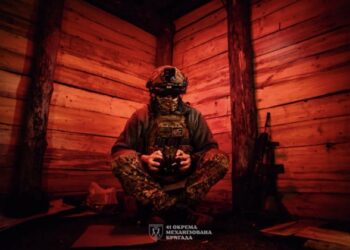
Gardar is anchored in the war playing out right now in Ukraine against Russia, and specifically in the opportunity for talented Ukrainian technologists to turn into founders as a result of it.
Take a pitching event Resilience Media covered back in October 2025.
The Combat-Driven Innovation Showcase definitely lacked a snappy title like “Slush” or “Disrupt”, but it made up for it with urgency: what is being built is a matter of life and death; and these builders and ideas, already in use, were possibly missing big opportunities for scaling (and building businesses that could outlast current war-time use) by not having what they need to convert into founders and startups.
“We realised there were a lot of engineering projects, innovation and R&D going on at the front lines, but they are all paying for it from their own pockets, no one has been funding them,” Larysa Visengeriyeva, one of the showcase organisers, said at the time.
The triangle of investor-founder-user was what the showcase aimed to solidify. “Defence tech investors need to have access to the real customers, the real end users, and right now it’s the Ukrainian military,” she continued.
Gardar — which will focus on rounds from seed stage to Series B — appears to have identified the same triangle.
The fund brings together three players in Noway’s investor world. Munkene is a self-described ‘volunteer’ organisation of investors and others set up to support Ukraine. Ferd is a family fund. And Sandwater is an early-stage fund that focuses mainly on areas like climate, energy and resilience. Sandwater is also providing platform support for Gardar.
Gardar as a concept has a double meaning and both are fitting here. Gardariki is the Old Norse name for the area that includes modern Ukraine (the area and name also covers modern Belarus and the western part of Russia). And gardar is also the Old Norse word for stronghold or settlement.
Gardar the fund meanwhile leans into Norway’s position as a supreme financier.
Silicon Valley in California is typically thought of as the epicentre of tech, and by association investment in tech. But when it comes to the power of nations, Norway punches well above its weight.
The country is home to the world’s largest sovereign wealth fund, with some $2 trillion of assets under management, and there is a disproportionately strong current of private investment activity that follows down from that.
That also plays out in Ukraine, where Norway has stepped in as one of the country’s biggest supporters relative to its own GDP since the full-scale war with Russia broke out in 2022.
Norway’s government also directly supplies defence equipment valued in the hundreds of millions of euros while facilitating partnerships with Norwegian companies like the Kongsberg. A year ago, the prime announced that it would work with Ukrainian companies to develop missiles that integrate with its NASAMS air defence system.
Norway has also set up facilities in its own country to enable the production of Ukrainian drones. Finally, as you are seeing with other European countries, Norway is providing a lot of money for reconstruction and operational groups, funding the salaries of teachers, hospital workers and other civic roles to keep the country going.
Given all of that, it’s not surprising to see the emergence of a startup fund focused directly on boosting Ukrainian defence businesses.
“The founders and startups in Ukraine demonstrate ingenuity, persistence, innovation and integrity that has inspired us – and our investors – to raise this fund,” said Prestgard in a separate statement. “Being able to invest in the community is a privilege in itself. It is underfunded, and delivering impact every day. It is also an investment in Europe’s security architecture that we strongly believe needs to be strengthened.”