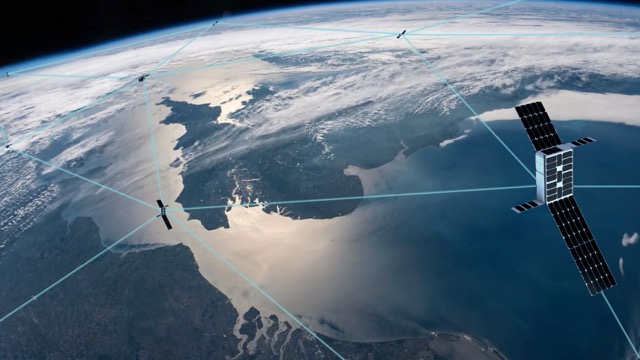
Ubotica, the Irish space tech firm developing orbital AI for satellites, has raised $11 million to scale the commercialisation of its maritime intelligence platform, Live Maritime Intelligence (LMI).
This is one of a few funding announcements that has come from Irish companies working in the defence space of late. In January 2026, Equal1, the Irish quantum semiconductor company, announced a $60 million round and last year VRAI, a data and analytics platform, raised a €5 million round.
This latest injection of capital is coming ahead of a bigger fundraise, Fintan Buckley, CEO of Ubotica, told Resilience Media.
Some in Ireland have criticised the country for lacking a defence investment strategy, but seems to be shifting.
“We are at the forefront of something here in Ireland, which is the recognition that Ireland does need to invest more in its defence technology,” said Buckley. “There are some great tech companies here in Ireland, which have developed technology that can be used in the resilience and security domain.” He said that this is starting to get recognised more.
“For startups and SMEs like ourselves, they are evolving with us, and right through to government helping to change the landscape to make it easier within ourselves to succeed,” he added.
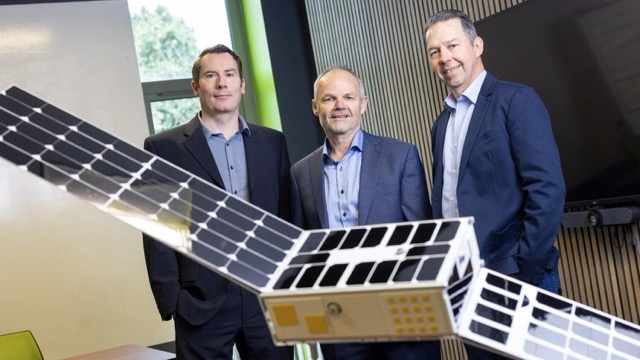
- Aubrey Dunne (CTO), Fintan Buckley (CEO) and John Bourke (co-founder & CFO) with a satellite model of CogniSant-6, of Ubotica. Image credit: Fergal Phillips
On 1 July 2026, the Presidency of the Council of the European Union falls to Ireland and this could have a positive impact on how it views its growing defence sector.
“There are opportunities here for us to actually showcase our technology during, during the EU presidency,” said Buckley.
Ubotica is already eight years in the making. What started as a company with a vision to take AI at the edge and prove it could be deployed on satellites has now grown into a firm that detects emerging threats across vast maritime territories in real time.
Buckley tells us that Ubotica’s system stands out as it is using Earth observation (EO) satellites “in a dynamic manner.”
It can switch modality on the fly, rather than using static imaging, like using SAR (Synthetic Aperture Radar) at night or in bad weather and optical when conditions are good. Images are analysed on orbit and only insights or down‑selected data come down which reduces risk assessment time from hours to minutes.
“Resilience is a key topic for Europe in the coming years. Securing critical infrastructure in harbors and off-shore is crucial. Ubotica’s edge AI technology enables satellite constellations to detect threats and anomalies early, anywhere across vast ocean areas, creating both a strategic security capability and a compelling commercial opportunity,” said Terhi Vapola of Greencode Ventures.
Ireland’s maritime vulnerabilities include the underground cables that stretch to the US, its shared energy infrastructure with the likes of Scotland and France and its offshore wind farms.
Greencode Ventures led the $11 million funding round alongside Act Venture Capital, with follow-on funding from existing investor Atlantic Bridge.
Ireland has a vast maritime domain, and that makes for a large threat landscape, but Buckley said the more immediate threat was drone-based disruption to civilian life, alongside the higher profile and risks that come with taking on the EU Presidency.
The funding will fuel the commercialisation of the product which has been part of paid and unpaid pilots and hiring will begin in each of its locations in Ireland, The Netherlands and Spain across roles in cybersecurity, space engineering and sales, the company said.