The war in Ukraine has put a spotlight on innovation in defence, not just how it can be used to significant effect, but also on how defence technology is developed. Now a European venture capital firm is announcing a new fund that speaks to that momentum.
Expeditions, the Warsaw VC set up to invest specifically in defence and resilience technology, has closed its second fund at €197 million ($225 million), making it one of the biggest in Europe to focus specifically on bets in the sector.
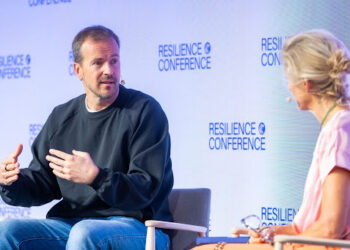
Dr Mikolaj Firlej, who co-founded the firm with Stanislaw Kastory, told Resilience Media that the fund was very oversubscribed: it was originally intended to be capped at €75 million, he said. Get ready for more diverse “resilience” investments and M&A, he predicted.
“The first investment wave in European defence tech was about rebuilding Europe’s arsenal for the battlefield (drones, loitering munitions, air defence systems), while the next wave will be more about security the supply chain and addressing critical capability gaps,” he said. “The first defence tech companies have become much larger and they are starting to consolidate the market.”
The fact that Fund II ended up being more than double that amount underscores not just how Expeditions itself has been performing, but how heated up the market is for defence tech right now and how investors see opportunities specifically out of Europe.
Expeditions has over the last several years become one of the more prolific defence and resilience tech investors in Europe. Its portfolio taps both into companies that have been playing a strong role in Ukraine, but also those that are setting up to help improve European resilience beyond that war.
The 40 companies out of its first fund include Ukraine/UK unicorn UForce, Orqa, Cambridge Aerospace, Frankenburg Technologies, Orasio, Alpine Eagle, ComandAI, Blackwall, Horizon Quantum, and Nu Quantum — several of which, we understand, are in the process of raising and closing major rounds of funding right now on the back of strong activity in the market. Expeditions cites data from Cambridge Associates that places its first fund’s performance among the top 0.01% of all venture funds globally.
Firlej said that at least half of this latest fund will be dedicated to follow-on funding with tickets of up to €20 million. “There are still opportunities for early-stage defence tech companies but they are less obvious than, say, two years ago,” he said.
As for where those new bets will be made, research he said Expeditions has run identified 10 “serious capability gaps” in areas like ISR, data fusion, “and capabilities broadly classified within the term ‘deterrence by punishment.’” He added in industrial/manufacturing capability to the list.
News of the fund is coming at a time when Europe itself is making more of an effort to re-arm itself and improve its resilience — a move triggered in part by the war in Ukraine and the spectre of adversarial nations like Russia, but also by other geopolitical forces.
This week, NATO is holding a summit in Turkey where the US is largely expected to once again make the case for other member states to make more investment in their own defence and not rely on the US to play the role it has done since the end of the Second World War.
Last year’s summit in The Hague saw a pledge from NATO allies to each put at least 5% of their countries’ GDP towards defence tech. Not every country in NATO has been able to deliver on that, however. That potentially opens the door to more economies of scale from regional collaborations.
That is already playing out at the startup level. Expeditions is co-headquartered in London, but it’s notable that the two founders of the fund are based out of Warsaw, Poland. This is an example of how development and financing are more decentralised in defence tech compared to traditional tech, where latter has a strong centre of gravity out of Silicon Valley in the US.
“Europe does not lack ideas but smart capital with the conviction to scale them,” noted Patrick Schneider-Sikorsky, a partner at the NATO Innovation Fund, in a statement. “Expeditions has built their entire thesis around closing that gap for European defence tech – finding founders early and staying with them through the growth that follows as they turn innovation to real world capabilities. That’s exactly the kind of conviction NIF wants to back, and exactly what Europe needs more of.”
Indeed, the decentralised aspect is also reflected in the limited partners in this fund. Firlej said that about half of the fund is foundations, major companies, and government-related organisations. The other half is made up of individual private investors.
New LPs in this round include the European Investment Fund by way of its InvestEU programme; the UK-based prime BAE Systems; US software developer Keysight Technologies; the Polish Development Bank; the Kosciuszko Foundation and Our Future Foundation. Existing LPs that are also backing Fund II include the Polish Development Fund (PFR); NATO Innovation Fund; other unnamed institutional investors; and early industrial family offices, Expeditions said.
BAE’s participation is one to call out specifically here.
The UK has been one of the countries struggling on defence spend, as evidenced by the controversial Defence Investment Plan that it unveiled on 30 June that fell well below recommended targets. It’s notable that one of the country’s top defence prime contractors is increasingly looking at using some of its weight and money to invest directly in startups as well as in defence tech funds to tap into a wider range of startups regionally. (We covered its participation in both this Expeditions fund and in Lakestar back in June.)
“[Expeditions’] focus on rapidly scaling innovative defence technologies closely aligns with the ambitions of our Launchpad initiative to help bridge the gap between early-stage innovation and real-world capability,” said David Ewing, head of technology commercialisation at BAE Systems, in a statement. “By working together, we can support founders in bringing forward the next generation of technologies that will be critical to Europe’s future security. This partnership reflects our belief that collaboration across the defence and start-up ecosystem is essential to accelerate innovation and deliver meaningful impact.”
Overall, investors beyond those already working in defence tech making strategic bets are getting more interested in backing defence tech, not just dual-use or no-use startups. Firlej said that this was the biggest shift he’s seen between its first and second funds.
“We managed to convince various institutional investors to invest in defence-first companies in Europe,” he told Resilience Media.
“The defence sector is attracting growing interest from LPs, who see a direct connection between Europe’s rearmament needs and the business potential of deploying new, deep tech technologies,” said Aleksander Mokrzycki, deputy CEO, PFR Ventures, in a statement. “For the same reasons, we invested in Expeditions Fund II. We believe this is a team with the expertise to identify the most promising projects and support them in their growth.”
It’s worth watching how the next stage of how defence and resilience tech take shape as the sector matures in Europe.
“VC investors often tend to follow the wisdom of the crowd and put money behind companies that raised the most capital, even if there might be better, more sustainable yet dynamically growing businesses. They are often overlooked… and could become greater longer-term outcomes than the currently most popular ones.”
Note: Individual partners at Expeditions back Resilience Media in an individual capacity. This does not impact any editorial decision regarding story selection.