100 investors to watch 2026 100 investors to watch 2026 100 investors to watch 2026
Sunday 22 November, 2026
[email protected]
Resilience Media
  • News
    • Events
    • Interview
    • Startups
    • Venture
    • Weekly Digest
  • Resilience Conference
    • Resilience Conference London — Oct 2026
    • Resilience Conference Copenhagen — May 2026 (PAST)
    • Resilience Conference Warsaw — Apr 2026 (PAST)
  • Launch
  • About
  • Guest Posts
    • Author a Post
  • Subscribe
No Result
View All Result
Resilience Media
No Result
View All Result

UK-based Kraken and US-based Capewell successfully test rapid, repeated autonomous boat drops from a cargo aircraft

John BiggsbyJohn Biggs
July 9, 2026
in Drones & UAS, Startups
Share on Linkedin

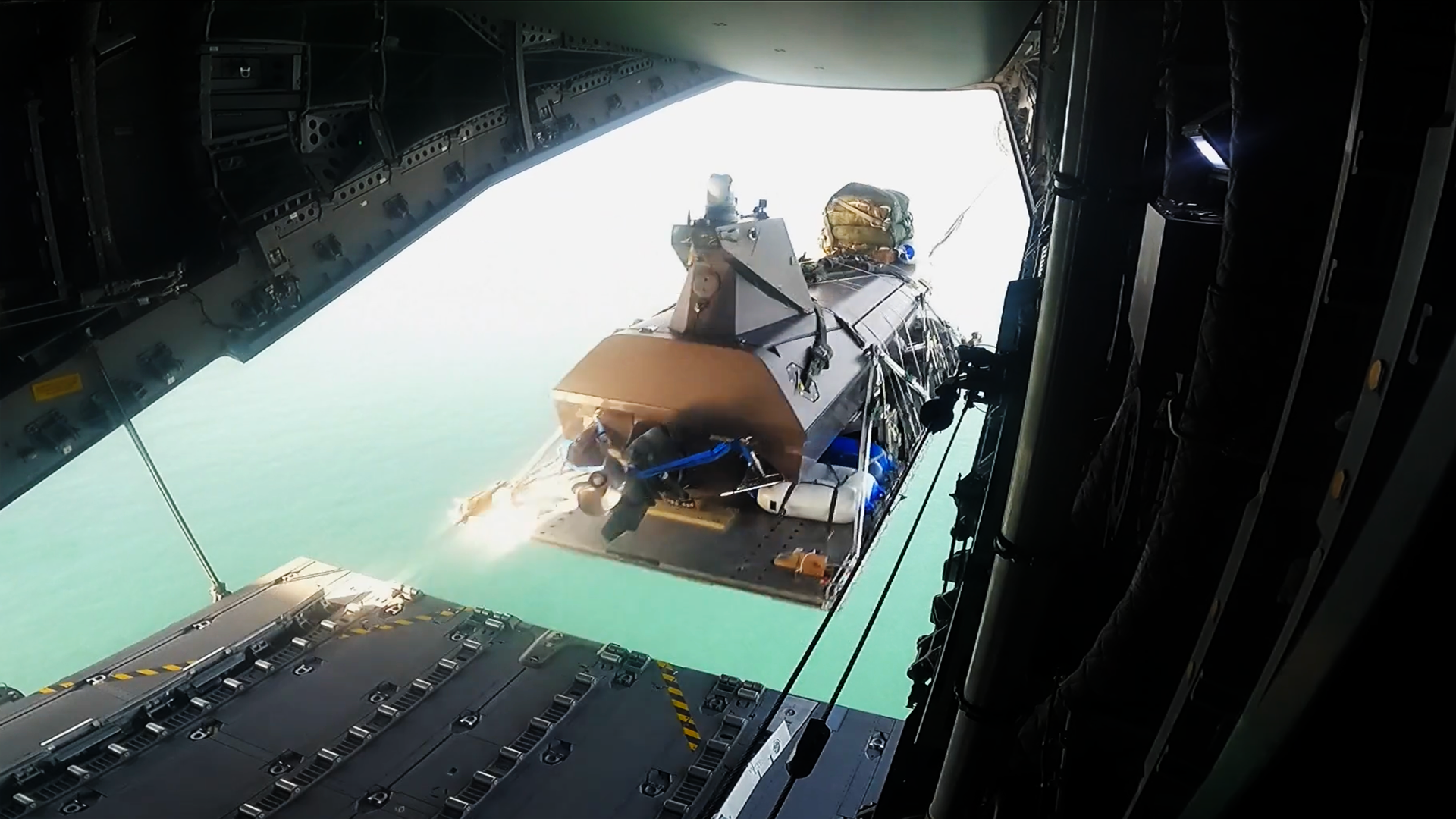
UK-based Kraken Technology group has partner with US-based Capewell to perform the “world’s first extracted-load airdrop of an uncrewed surface vessel (USV) from an A400M military transport aircraft.” The tests were run with the Royal Navy under Project Beehive, a £12.3M procurement program run by UK Defence Innovation to acquire and test up to 20 uncrewed surface vessels (USVs) aka autonomous boats.

You Might Also Like

USIL Therapeutics passes initial NATO procurement assessment as it develops radiation exposure treatments

Auterion and SkyFall plan German drone factory to boost Ukrainian production

Michigan wants to turn its automotive manufacturing power into a defence industry advantage

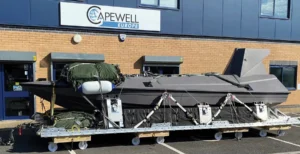
Less precisely, Kraken and Capewell dropped Kraken’s K3 Scout USV, an 8.4 meter long unmanned boat from 400 meters into waves of up to 2.5 meters. The team used a large A400M transport aircraft to drop the boat on one of Capewell’s  Universal Maritime Craft Aerial Delivery System (UMCADS), essentially a smart sled designed to control the deployment of equipment at altitude.

Capewell’s Universal Maritime Craft Aerial Delivery System, or UMCADS is a parachute-based system designed  that reduces the risk of damage on deployment. The test used the team’s new IN-Release system, an “electro-mechanical release mechanism which enables reliable, synchronised load disconnect across a wide range of aerial and maritime applications.”

“Working in partnership with Capewell and the Royal Navy, we have demonstrated that K3 SCOUT can be rapidly deployed directly from a military transport aircraft into contested or difficult-to-access waters ready for operation,” said Mal Crease, Founder and CEO of Kraken Technology Group. “Kraken, alongside its partners and the Royal Navy, will continue to push boundaries to deliver novel and enhanced operational capabilities with our resilient, modular platforms.”

For Kraken, the test shows that the K3 Scout can work as a platform for the UK’s Hybrid Navy initiative. The ability to airdrop USVs directly into the water changes the deployment model for these sorts of systems, reducing the need for infrastructure or a potentially vulnerable carrier craft designed to place the Scouts into position.

Kraken also made the news recently with a $175M raise that placed the company in European unicorn territory.

Capewell said the trial also showed the adaptability of its delivery system. The company conducted four live airdrops in six working days using the same boat and platform, while showing that UMCADS could be reconfigured for different maritime or land payloads. That pace demonstrated both the robustness of the system and the speed with which it can be prepared for further missions.
““In collaboration with Kraken we were able to validate the integration of a complex payload with our UMCADS platform while demonstrating the ease with which the system can be reconfigured for alternative mission essential equipment be they maritime or land applications,” said Mark Lavender, Director of Business Development and Training at Capewell.

The team did four airdrops in six days using the same craft, displaying the resilience of both the craft and the delivery system.


 

Tags: capewellDronesKrakenUSV
Previous Post

Project Q unveils open source defence integration platform HYDRIS

Next Post

Taiwan takes aim at IP theft as it sharpens its defence stance

John Biggs

John Biggs

John Biggs is an entrepreneur, consultant, writer, and maker. He spent fifteen years as an editor for Gizmodo, CrunchGear, and TechCrunch and has a deep background in hardware startups, 3D printing, and blockchain. His work has also appeared in Men’s Health, Wired, and the New York Times. He has written nine books including the best book on blogging, Bloggers Boot Camp, and a book about the most expensive timepiece ever made, Marie Antoinette’s Watch. He lives in Brooklyn, New York. He runs the Keep Going podcast, a podcast about failure. His goal is to share how even the most confident and successful people had to face adversity.

Related News

USIL Therapeutics passes initial NATO procurement assessment as it develops radiation exposure treatments

USIL Therapeutics passes initial NATO procurement assessment as it develops radiation exposure treatments

byJohn Biggs
November 20, 2026

Luxembourg-based USIL Therapeutics has passed the initial vendor registration assessment of the NATO Support and Procurement Agency (NSPA), giving the...

Auterion, the drone software startup, eyes raising $200M at a $1.2B+ valuation

Auterion and SkyFall plan German drone factory to boost Ukrainian production

byCarly Page
November 20, 2026

Auterion and Ukrainian drone manufacturer SkyFall are planning to establish a joint venture in Germany to increase production of first-person...

Michigan wants to turn its automotive manufacturing power into a defence industry advantage

Michigan wants to turn its automotive manufacturing power into a defence industry advantage

byJohn Biggs
November 20, 2026

  Michigan has spent decades building cars, trucks and industrial equipment. Now the state wants to use that manufacturing capacity...

Atmos space cargo visual

Atmos and MBDA link up to give Europe deep strike capability from space

byPaul Sawers
November 18, 2026

The ability to transport payloads into orbit and return them to precise locations on Earth could give European armed forces...

‘We are using it all’: minister talks about how Ukraine is offsetting Starlink dependency

‘We are using it all’: minister talks about how Ukraine is offsetting Starlink dependency

byIngrid Lunden
November 18, 2026

This week, NATO’s Communications and Information Agency announced during the NATO Edge conference that it was unlocking procurement totalling a...

Tekever raises $580M at a $6.8B valuation to give flight to more drones

Tekever’s €200 million France plan: new factory, contract with French army

byStanislaw Naklicki
November 17, 2026

In the 1960s and 1970s, Portugal’s workers would migrate to France for manufacturing jobs. Half a century later, the Portuguese...

Finland’s Kelluu delivers an airborne passive radar system for NATO’s Eastern flank

Finland’s Kelluu delivers an airborne passive radar system for NATO’s Eastern flank

byJohn Biggs
November 16, 2026

Finnish defence technology company Kelluu has introduced HALO, a passive radar system built into an airship that was designed to...

Tiberius says it’s successfully tested Sceptre munitions that behave like more costly missiles

Tiberius, the munitions startup, becomes the latest defence tech unicorn, raising $85M at a $1B valuation

byIngrid Lunden
November 16, 2026

A startup building a munitions business on what its CEO calls “the Apple playbook” is the latest defence tech to...

Load More
Next Post
Resilience Media’s top stories from 2025

Taiwan takes aim at IP theft as it sharpens its defence stance

Satellites become a growing target for grey-zone warfare

Satellites become a growing target for grey-zone warfare

Top stories

Tiberius says it’s successfully tested Sceptre munitions that behave like more costly missiles
European Defence

Tiberius, the munitions startup, becomes the latest defence tech unicorn, raising $85M at a $1B valuation

November 16, 2026
Atmos space cargo visual
European Defence

Atmos and MBDA link up to give Europe deep strike capability from space

November 18, 2026
OpenAI, facing a cybersecurity lawsuit in the US, is working with NATO… on cybersecurity
Cyber

OpenAI, facing a cybersecurity lawsuit in the US, is working with NATO… on cybersecurity

November 17, 2026
Satellites become a growing target for grey-zone warfare
News

ICEYE lights a rocket under its satellite business, offers €2.05B for launcher company Avio

November 17, 2026

Resilience Media is an independent publication covering the future of defence, security, and resilience. Our reporting focuses on emerging technologies, strategic threats, and the growing role of startups and investors in the defence of democracy.

  • About
  • News
  • Resilence Conference
    • Resilience Conference Copenhagen 2026
    • Resilience Conference Warsaw 2026
  • Guest Posts
  • Subscribe
  • Privacy Policy
  • Terms & Conditions
  • Mission Statement & Code of Practice
  • Press

© 2026 Resilience Media

No Result
View All Result
  • Home
  • About
  • Subscribe
  • Events
  • Guest Posts
  • Interview
  • News
  • Resilience Conference London 2026
  • Resilience Conference Copenhagen 2026
  • Resilience Conference Warsaw 2026

© 2026 Resilience Media

This website uses cookies. By continuing to use this website you are giving consent to cookies being used. Visit our Privacy and Cookie Policy.