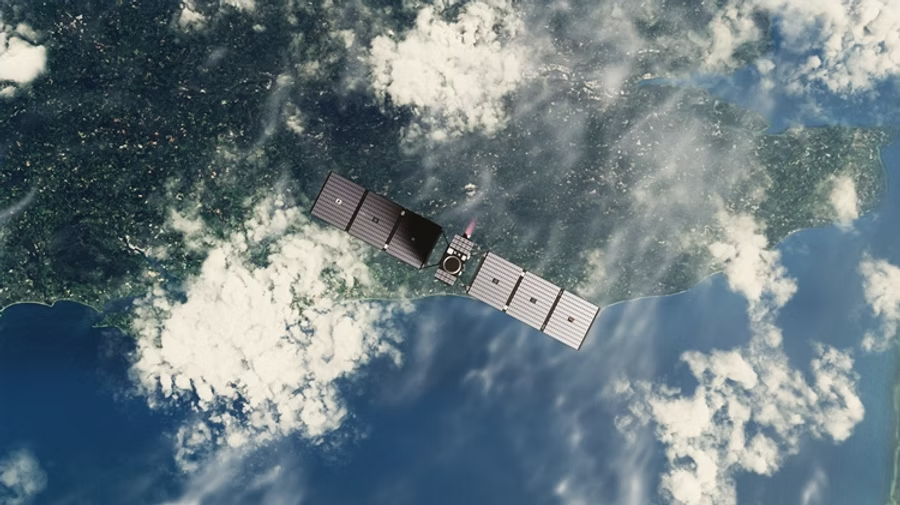
The UK satellite manufacturer NewOrbit has secured a Q3 2028 launch slot for NEO-1, a commercial rideshare satellite designed to operate between 200 and 300 kilometers above Earth in Very Low Earth Orbit, or VLEO. If the mission goes as planned, NewOrbit says it will be the first commercial flight at those altitudes that allows outside companies to bring their own payloads. Only two missions have sustained operations below 300 kilometers: ESA’s GOCE and JAXA’s Super Low Altitude Test Satellite, better known as Tsunami.
The company is building NEO-1 specifically for VLEO and says its propulsion system can keep the spacecraft operating there for five years. More importantly, NEO-1 will be a rideshare mission. Companies can put their own cameras, communications hardware, sensors, and other systems aboard without having to build a VLEO satellite themselves. Once in orbit, the systems will transmit back to their respective owners thereby allowing multiple streams of data to come through one satellite.
The value of a VLEO device like the NEO-1 is obvious. Other companies can piggyback on the satellite, allowing for anything from camera models for sovereign surveillance services to ground connectivity with drone and other communications systems.
Further, the VLEO orbit is helpful because it can produce better results from the same hardware. NewOrbit says a camera capable of 50-centimeter resolution at 500 kilometers could approach 25-centimeter resolution aboard NEO-1 without changing the instrument.
Japanese optics company Genesia has booked a spot aboard NEO-1. The company built the telescope used by JAXA’s Tsubame, which captured images from an altitude of just 167.4 kilometers and holds the record for the lowest orbital altitude achieved by an Earth observation satellite.
Two additional customers have booked payload slots but have not yet been named.
NewOrbit’s also recently announced a $18.5 million Series A earlier this summer.
“Only two missions in history have stayed in VLEO,” said Anatolii Papulov, CEO and co-founder of NewOrbit. “Today, the people behind both come together on one mission: the engineers who built and flew GOCE sit on our technical board, and Genesia, whose telescope imaged Earth from Tsubame’s record altitude, joins NEO-1 as our first announced payload partner.”