Amsterdam-based Fortaegis Technologies has raised $50 million to take its silicon-rooted security technology into mass production, as the company eyes deployments spanning military networks, drone fleets and NATO systems.
The oversubscribed Series A was led by Serendipity Capital and will fund commercial production and global deployment of Fortaegis’ Secure Compute architecture, which says its technology embeds security into hardware and silicon to complement software protections. The company did not disclose a valuation.
Fortagegis is targeting defence and autonomous systems, alongside AI infrastructure, telecommunications, critical infrastructure, advanced manufacturing and automotive.
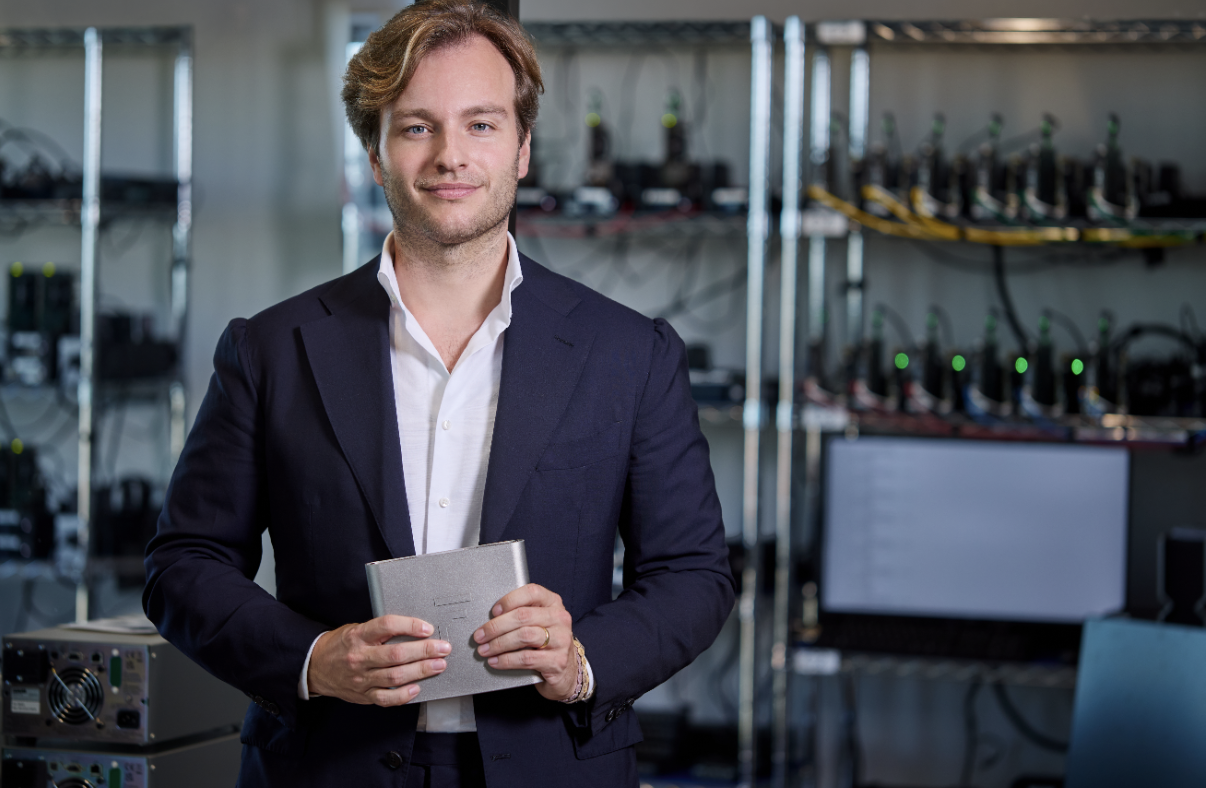
For CEO Boudewijn Wijnands, who founded the company in 2023, the funding marks the point at which the startup moves from proving its technology across industries to deploying it at scale.
“The key thing is that we want to deploy secure compute,” Wijnands told Resilience Media. “The whole thesis that we have is embedded security not on the software layer, but on the hardware and the silicon itself.”
Fortaegis’ first commercial products use field-programmable gate arrays, or FPGAs, which can be added to existing infrastructure. Wijnands said the company can currently manufacture these devices only in small numbers, but expects the Series A to allow it to produce them in the thousands, and eventually tens of thousands, from around mid-2027. Longer term, it is developing ASICs intended to bring the same technology into lower-cost, higher-volume systems.
Defence is emerging as one of the most immediate applications. Wijnands said the technology could secure communications between nodes ranging from drones to satellites while allowing armed forces to use existing communications infrastructure.
“Imagine you have 1,000 boxes for countries that want that connectivity and the ability to use different networks,” he said. “Even within a country – between special forces, drones, the Marines, you name it – you can have one box handling all that connectivity, rather than needing 20 boxes, a software layer and very complex key management. The management and orchestration of those nodes is all done through our platform.”
Fortaegis will also take part in NATO’s Digital Backbone eXperimentation, or DiBaX, programme this year, though the startup declined to disclose where or when it will participate because of operational sensitivities.
DiBaX is used by NATO to test technologies intended for its digital backbone in operationally relevant conditions, with a focus this year on secure, interoperable and resilient networks supporting multi-domain operations.
The attraction for defence, according to Wijnands, is not simply securing individual devices but being able to manage trust across much larger networks. He pointed to drone swarms as an example, where policies could automatically determine whether an individual system remained trusted.
“You can then add 10,000 or 20,000 drones up in the air, swarms of drones, but you can ensure policies on the platform like: a drone has left this specific network for 20 seconds, so it’s not allowed to come back anymore,” he said. “If you’re managing thousands, or even millions, of nodes in a network, that orchestration is what the platform does.”
At the heart of the system is a technique that takes advantage of tiny physical variations created during silicon manufacturing. These effectively give individual chips a unique fingerprint, from which Fortaegis derives cryptographic keys. Wijnands said the company can change those keys dynamically and connect the hardware-rooted identity directly to its software platform.
“We believe that layer should go into hardware – in this case, the silicon itself,” he said. “Our breakthrough is being able to extract keys from that silicon fingerprint, change them on the fly to the power of 256, and then translate that physical fingerprint into something you and I can use at the software layer.”
The company says it is already working with more than 25 enterprises and governments, with some customer-funded programmes moving beyond technical validation towards production qualification and commercial deployment.
Wijnands said Fortaegis has signed non-recurring engineering contracts worth millions of dollars as customers prepare for the higher-volume products enabled by the latest funding round. The company has previously put its wider commercial pipeline at $2.6 billion, although that figure does not represent $2.6 billion in signed orders.
“Some have been investors, some have been doing NRE contracts in anticipation of the products that the Series A allows us to make on volume,” he said, adding that Fortaegis is already looking beyond the Series A, with “a lot of soft commitments” in place for a future Series B round.
The Series A raise will also support Fortaegis’ attempt to build resilient regional supply chains across the US, Europe and Asia. Rather than arguing that European digital sovereignty requires technological independence, Wijnands said the company is betting on interdependence between allies.
“We are believers in interdependency, because we believe that for the West and its key allies to be prosperous, we need to use the best LLMs from the US together with the best technology of secure compute that we’re building from this unique ASML ecosystem, together with the best supply chain of the Japanese, for example.”
Fortaegis is therefore establishing regional supply chains for its FPGA products and plans to do the same for its ASICs, aiming to make production more resilient if one geography cannot meet demand.
“We don’t know how geopolitics is changing,” Wijnands said. “Maybe one region needs to supply, step up to the plate to do a certain supply chain increase if another one cannot deliver it for whatever reason or another.”
For Fortaegis, that uncertainty is also part of the case for pushing security deeper into the computing stack. As militaries connect more autonomous systems, sensors and computing resources across national and organisational boundaries, the challenge is increasingly not just securing each device, but deciding which machines can be trusted, what they can access and whether that trust can survive at battlefield scale.
The $50 million raise is intended to turn Fortaegis’ answer to that problem from a technology demonstrated in relatively small numbers into infrastructure that can be deployed by the thousand – and, eventually, built directly into the silicon powering those systems.