The annual NATO Digital Backbone Experiment (DiBaX) was held for the fourth time in Latvia’s Ādaži Military testing grounds, and the event just keeps getting bigger.
“Last year I was standing on the floor giving a speech, this year I’m on a stage, so that must say something,” the Minister of Defence of Latvia, Andris Sprūds, said to amused chuckles from the gathered Observation Day audience.
The overarching goal of DiBaX is digital infrastructure – specifically, proposing and trying out new systems that promise more flexiblity, scalability, and interoperability. That’s essential for the next generation of defence hardware, where militaries have more digital demands, for example connecting sensors and affectors and putting them easily and securely into the hands of soldiers across NATO countries.
The event has grown to 15 demonstrated use cases over the years, compared to two in just four years ago, with an increasing number of NATO nation participants and – crucially – industry collaborators that provide their tech to military to trial. The military in turn provides instant feedback for necessary improvements.
“We know that in the war in Ukraine, partnership between military and industry is extremely important so that they can have a rapid cycle of innovation. So we’re starting that now, that partnership in a better way,” said Warren Low, Digital Backbone Programme Manager and Experimentation Director.
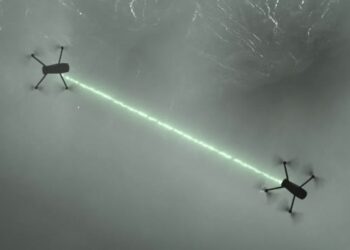
Tech moves fast, however, and even in just four years concepts that seemed more like theories have become widely-used cornerstones of Ukraine’s resistance. Digital backbone must-haves now include the ability to incorporate not just AI, autonomous systems, fibre options, laser optics and 5G, but a way to handling any other technologies and applications that use them that might emerge now or in the near-future.
“There is a sense of urgency at the moment,” said Major General Arnoud Stallmann of NATO ACT (Allied Command Transformation). “Our adversaries are innovating rapidly as well. So in response, ACT is accelerating work to solve a range of operational problems, including defense from unmanned aerial systems, as we are doing here.”
What happened at DiBaX

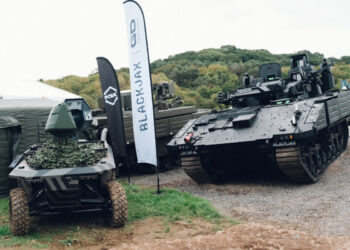
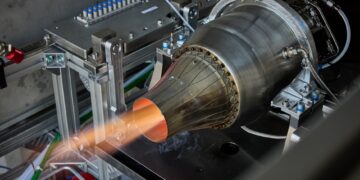
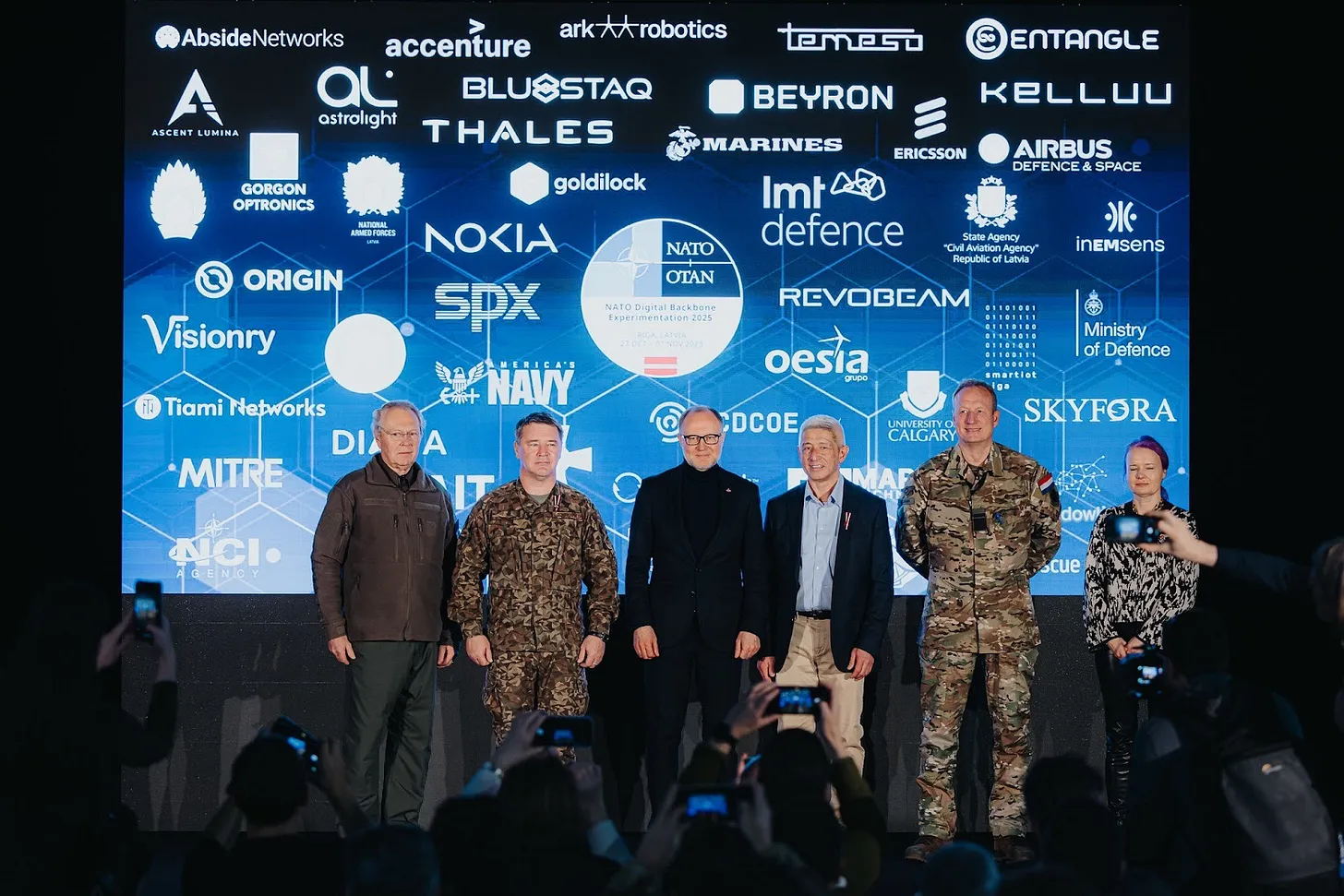
The Digital Backbone Experiment set out to integrate multiple vendor technologies – including networks, unmanned systems, sensors, AI, and more – into a common architecture and test its resilience in various operational scenarios. The participants used technologies from companies such as Ark Robotics, Ascent Lumina, Ericsson, JET Connectivity, KELLUU, LMT, Marduk Technologies, Nokia, Origin Robotics, Rescue Dynamics, Thales, and others.

The experiment was held over the course of two weeks that were mostly cold, wet, and dark, as it was the late autumn in Latvia. Yet that didn’t seem to impact the camaraderie and spirit of innovation during the event.
“What I found most exciting was the response to failure,” shared Low. “It was amazing. There are many instances where problems had occurred, and they just saw it as an opportunity to overcome it as a team and make it better. That was my proudest moment. Because if you can overcome adversity, then I don’t think there’s anything you couldn’t do.”

But it wasn’t all failure. Overall, the experiment was considered a resounding success. Organizers were keen to point out that during the experiment, the Armed Forces, with the new technology at hand, were able to neutralize a drone in just one shot.
“It’s important that the solutions that are presented here are usable for the soldiers in the field. After a few days of training, they can use the weapon system and the whole system presented to them here in the normal field by normal soldiers,” said Major General Stallmann.
The event was concluded by an operational demo, which simulated a counter-UAS operation with a following explosive ordnance disposal mission.
Industry collaboration seen as the key to success
A repeated theme in discussions with DiBaX officials was the emphasis on the need for stronger industry collaboration – one that they believed DiBaX was playing a crucial role in addressing.
“The pace of the industrial revolution is data centric, which makes it really relevant to collaborate with industry,” said Major General Stallmann. “We can sit in our laboratories and think for a long time, but the reality is that it’s already out there. We need to just connect, make use of it, and build partnerships.”
Low shared that what was necessary was a more open-minded approach towards collaboration with industry, adding that this is a transition happening right now:
“It took some years to show the military that they could trust the whole, let’s say, innovation apparatus, the platform, to provide value to them and to listen to them. It does take time to change minds and provide that innovation mindset.”

Warren Low, DiBaX Director.
He went on to explain that DiBaX has been proactive in inviting observers to participate in the demo, and to experience the impact these innovations have, first-hand.
Aivars Krjukovs, Brigadier General at the Latvian National Armed Forces, echoes the sentiment.
“The foundation of this event is that industry, science, innovation, and practical users can come together to share their experience and needs,” he said. “For example, from the military perspective I see where technologies are going, I see opportunities for improved decision making that is faster and safer, and the industry can see if their solution needs improvements – because we need things to be easily and quickly used, understood, and repaired. When all of these components come together, that’s where the development happens.”
Mivy James, CTO of the UK MoD, indicated that the UK would deepen its future participation.
“I’m really happy this year that the UK has been able to participate in DiBaX,” she said. “The Strategic Defense review that was published earlier this year makes it very clear that the UK MoD is NATO first.”
She outlined interest in the role of telecommunications, particularly 5G, in military applications, and also added recommendations for future development of the programme.
“What I’d like to see is a bit more bringing to life of how we share sovereign data in a secure manner,” she said. “That’s going to be really important when NATO nations are working together, and that’s one of the biggest technical challenges that we still face – how we protect that sovereignty, control, access that others have, but yet also have free flowing sharing of information to enhance our situational awareness and, of course, to have greater UK participation, building on what we’ve done this year and following through from our SDR commitment.”
The event has been successful in driving demand from the military side.
“Many soldiers at this experiment have gained knowledge as to what’s available, and there are some things they want to get their hands on immediately,” said Brigadier General Krjukovs. “For example, we saw the unique case where a drone was shot down on the first shot. This is impressive, because for a soldier it requires a lot – identifying, targeting, breathing, shooting. But this identifies the target, and with the first shot, destroys it,”.
But the transition to a greater readiness for industry partnership could be caused by other factors, as Warren Low pointed out.
“I would also say that perhaps the threat is much more real now,” he said. “It’s always something that motivates people and militaries to come into action, and I see that now, that they’re wanting to find answers to challenges that they have, and certainly having a unifying force to the threat is a very big contributor to that.’’
Regardless of the driving factor, one thing is clear: NATO can look forward to an increased collaboration with industry.
Building blocks for future collaboration
Those present at the DiBaX event were looking at it as a glimpse into the future.

Minister for Defence of Latvia, Andris Sprūds, shared that it was part of a logical process in maintaining competitive national defences.
“The armed forces cannot be imagined without technology,” he said. “We see from Ukraine that these combined skills, system integrations, command and control, AI, are an integral part of security. And with this Digital Backbone Experiment we’re looking toward the future that will arrive sooner or later, and taking steps towards it – not only through experimentation, but through testing, establishing collaborations, ordering test batches. It’s clear that this must be done, and we’re doing it.”
Meanwhile, Major General Stallmann was also paying close attention to lessons learned during the experiment to supplement NATO ACT’s LCI-X initiative – NATO’s response to a united counter-drone infrastructure, which could lay the foundation for the EU’s proposed drone wall.
He shared that he believes that there will be more such events in the near future to further collaborate on developing this technology that is particularly needed in light of the increasing frequency of European airspace incursions.
When asked about the likelihood of a new digital backbone actually deployed beyond the experimental stage, Major General Stallmann was confident, if uncommitted.
“The likelihood is 100%,” he said. “It’s a question of when.”