Estonian space tech company Golbriak Space has raised €4 million to expand its production capacity as the firm prepares to move to a new office and lab space in Tallinn. Golbriak builds laser communications systems for satellite and non-terrestrial networks.
Laser communications can send greater amounts of data per transmission and laser beams are more difficult to intercept or jam signals compared to wide-beam radio frequencies. The challenge is developing terminals that can be manufactured economically at scale and readily integrated and operated by customers. Golbriak is solving that.
It’s two main products are the ERMESAI+ terminal for space applications and the ARES optical telecommunication terminal for drones and high altitude platforms. Both are built on a common, software-defined architecture designed to make high-capacity optical communications easier to integrate, operate and deploy across different platforms and networks.
The Seed funding round was co-led by Join Capital and PhotonVentures, and includes funding from Takeoff, the acceleration program of the CDP Venture Capital National Accelerator Network for aerospace and advanced hardware startups, managed by Plug and Play.
“Golbriak already has functioning technology, paying customers and clear demand from operators planning the next generation of satellite networks. Years of specialised engineering have created a significant technological and commercial lead. This investment accelerates the company’s ability to manufacture at the scale its customers will require,” said Jan Borgstädt, Founding Partner at Join Capital.
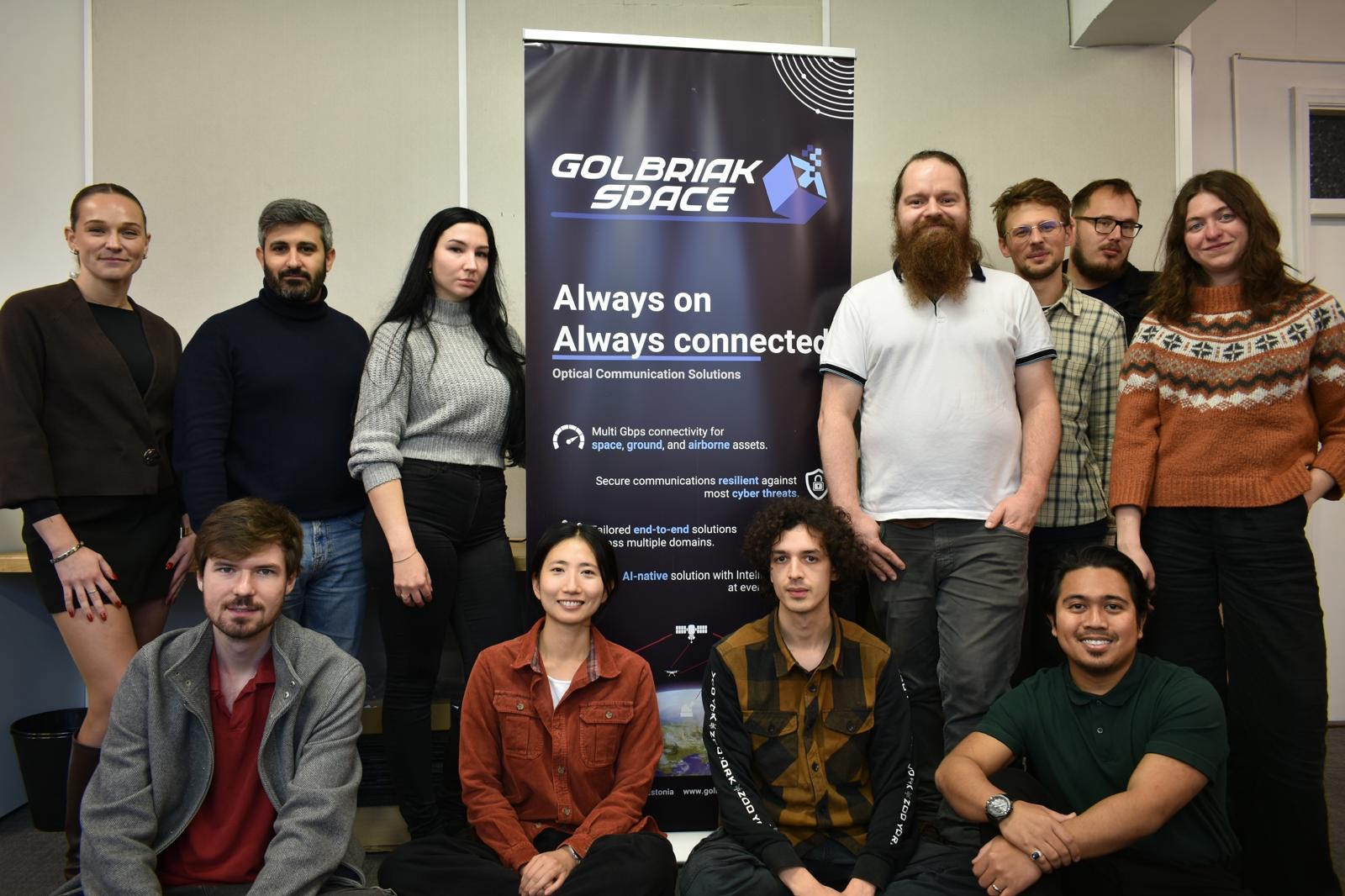
The startup was founded by Nicola Garzaniti (CEO) and Simone Briatore(CTO) after the pair met during a PhD the company was born after winning a Copernicus Masters challenge in 2017. Golbriak started off life in Tehnopol business park in Tallinn, but as they expanded they landed in the Nomme area. They have just picked up keys to a new lab and office space in the Mustamäe area of the city.
“Closing this round marks a turning point for Golbriak,” said Garzaniti. It designs, manufactures and assembles their systems fully in house; only the semiconductors are supplied. Garzaniti told Resilience Media that it has not just been working on the product this year but also on the manufacturing and assembly integration process. “Now the pipeline is ready and validated, it’s just a matter of scaling.”
Garzaniti spoke about how important it was to them to find a VC who understands the company’s vision and technology, with Briatore adding that investors need to understand the long timelines involved in bringing space missions to market.
Solving large-scale deployment of optical communications
Golbriak’s terminals reduce their dependence on the pointing capabilities of the satellite, drone or other host platform, easing integration and allowing multiple terminals to operate on the same spacecraft or aircraft. Common hardware can also be configured through software for different networks and communications standards, including SDA, ESTOL and CCSDS where wavelength requirements are compatible.
Its production-ready systems currently support data rates starting at 2.5 Gbps, with a 10 Gbps system planned for 2027.
Hiring in Tallinn
The expansion to the new facility will bring new jobs to the sector, they will be recruiting space systems engineers, embedded software engineers, and production technicians.
Already eight years in the making the startup has scaled to this capacity without funding, until now, as it has been built with costumers from day one. Garzaniti highlights how “impressive” that is for a company building both hardware and software for space.
Looking to the future, the company is targeting 200 terminals per month, with a long term goal of increasing that number to 300–400. It is currently producing double digit terminals per year.