Friday 6 March, 2026
[email protected]
Resilience Media
  • About
  • News
  • Resilience Conference
    • Resilience Conference Warsaw 2026
    • Resilience Conference Copenhagen 2026
    • Resilience Conference London 2026
  • Guest Posts
    • Author a Post
  • Subscribe
No Result
View All Result
  • About
  • News
  • Resilience Conference
    • Resilience Conference Warsaw 2026
    • Resilience Conference Copenhagen 2026
    • Resilience Conference London 2026
  • Guest Posts
    • Author a Post
  • Subscribe
No Result
View All Result
Resilience Media
No Result
View All Result

Commcrete Connects With $29M to Reinvent Satellite Communications

The startup is building a revolutionary approach to making satcoms mobile, opening the door to devices that can evade Electronic Warfare

Resilience MediabyResilience Media
September 30, 2025
in News, Startups
Share on Linkedin

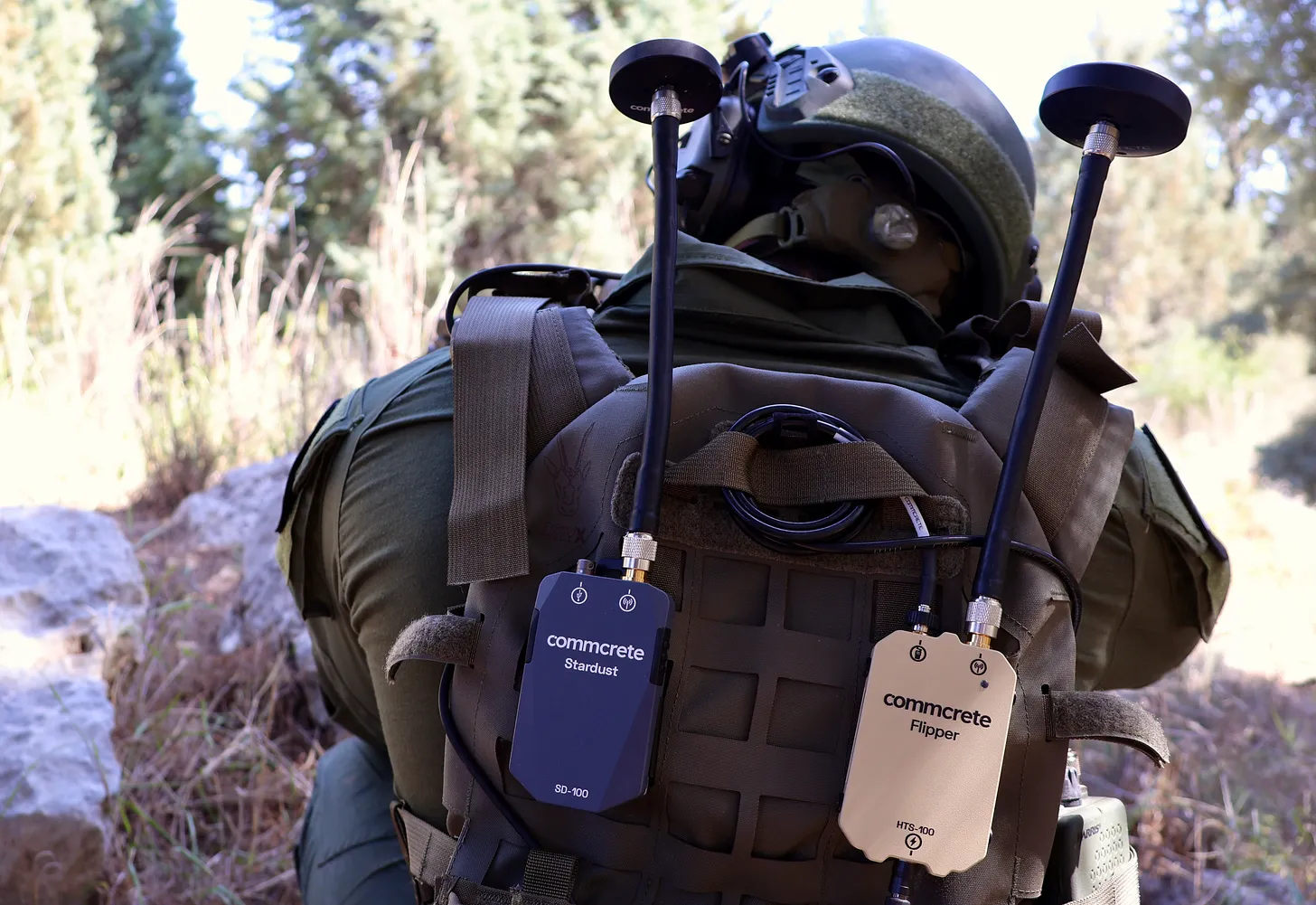
A startup building a much more agile way to set up and run satellite communications on the move is today emerging from stealth armed with $29 million in funding. Commcrete, which has built hardware and software that compress the functionality of clunky and expensive satellite packs into handheld boxes that weigh just 150 grams, has raised $29 million in funding as it ramps up dealmaking with defence and other customers and partnerships with satellite providers and others.

You Might Also Like

Ukrainian autonomy company The Fourth Law unveils an anti-Shahed drone

Ukraine’s autonomous weapons makers push for industrial scale

MSC got the urgency right. The hard part comes next

The funding is coming in two tranches: Greenfield Partners is leading a $21 million Series A, with Redseed Ventures and existing investors participating. Prior to that, Tel Aviv-based Commcrete raised $8 million from Mobileye founder and head Professor Amnon Shashua, Q Fund and unnamed private angels.

Sources tell us that the Series A values Commcrete at over $100 million.

Commcrete partners with companies like Viasat, Thuraya and Gilat, who in turn are major providers to defence and other industries. The plan is to continue expanding the partnership list of satellite networks and to ink direct customer deals in defence, security and emergency services in Europe, North America, East Asia, Australia and the Middle East.

The startup is the brainchild of CEO Itzik Daniel Michaeli, CTO Josh Yedidia, and COO Michael Mor — all well-regarded veterans of tactical communications in the Israeli defence forces. The three saw first-hand the shortcomings in how in-the-field satellite communications (satcom) worked, which Michaeli summed up:

“We dealt with satcom on the move or not on the move for decades. and most of the time, it wasn’t really working on the move,” he told Resilience Media in an interview. “Manufacturers would say, ‘this is satcom on the move,’ but you needed a full Humvee that weighs three tons just to move it around.” On top of that, satcom generally can be tricky to manoeuvre when the terrain has lots of trees or any other kinds of obstructions.

So the three of them set themselves a challenge to make satcom truly movable and usable on a human scale, wherever those humans happened to be.

“If it needs to be tactical and critical for the end user, it needs to be super, super light and it needs to perform,” he said. Commcrete’s three primary products — the Flipper, the Stardust and the Bittel — plus a series of antennas that can be mounted on other equipment are all small enough to fit into a backpack, or even a jacket pocket.

The other key priority Michaeli and his team wanted to address was how usable its technology is.

“For the first time, the end user doesn’t need to be a full, educated communication officer, with 10 years of training just to know how to set up satcom on the move,” he said.

Evading Electronic Warfare

As the situation in Ukraine has demonstrated, as warfare has become more digital, Electronic Warfare has become a key battleground: disrupting how one’s opponent uses electromagnetic spectrum has huge communications implications, but also weaponry implications, given the surging use of autonomous and uncrewed aircraft. By building out systems that expand the range of spectrum used, the variety of channels used on that spectrum, and the architecture of how packets of data are transmitted on those channels, Commcrete gives its customers an advantage over its adversaries on that EW frontline.

Michaeli notes that its tech can already be plugged into drones. He said the startup already is working with at least one drone manufacturer (and maybe more) under NDA, which it can do by small adjustments in its software. “Our API can do whatever the manufacturer wants us to do,” he said.

The fact that satcom does not need to work with “keep alive” signalling, and that location can be changed for those spying on activity, means that overall it’s harder for adversaries to track and scramble communications.

“Our equipment is not transmitting unless you want it to transmit some kind of order or some kind of data package,” he said. A quarter of a second of transmission means it’s just that much harder to track or scramble or interrupt.

“Resilient communications will define the next decade of defence and public safety,” said Raz Mangel, a partner at Greenfield Partners, in a statement. “Commcrete has developed technology that works where others fail, proven in combat, disaster response, and environments where conventional systems go dark. What makes them extraordinary is not just the technology, but the team of innovators and operators with battlefield experience behind it. We are proud to back Commcrete as they set a new global standard for mission-ready connectivity.”


Tags: Amnon ShashuaCommcreteGreenfield PartnersItzik Daniel MichaeliJosh YedidiaMichael MorRaz Mangel
Previous Post

Aspichi Is Building A Virtual Front for Soldiers in Ukraine

Next Post

Stratis, a Mysterious Icelandic Startup, Emerges from Stealth to Build a ‘Palantir for Europe’

Resilience Media

Resilience Media

Start Ups. Security. Defense.

Related News

Ukrainian autonomy company The Fourth Law unveils an anti-Shahed drone

Ukrainian autonomy company The Fourth Law unveils an anti-Shahed drone

byJohn Biggs
March 6, 2026

Ukraine-based autonomy company The Fourth Law has unveiled Zerov, an autonomous interceptor drone built to engage long-range strike UAVs in...

Ukraine’s autonomous weapons makers push for industrial scale

Ukraine’s autonomous weapons makers push for industrial scale

byLuke Smith
March 6, 2026

In the past five months in Ukraine, Major Maksym Gromov's unit launched 608 autonomous Lupynis drones against Russian adversaries. Four...

asphalt road between trees

MSC got the urgency right. The hard part comes next

byRobin Dechant
March 6, 2026

A few weeks on from the Munich Security Conference, something many of the Resilience Media community no doubt attended, I...

NATO Innovation Fund appoints a president, Ari Kristinn Jónsson

NATO Innovation Fund appoints a president, Ari Kristinn Jónsson

byIngrid Lunden
March 5, 2026

The NATO Innovation Fund, the VC formed out of the strategic alliance of NATO countries that counts most (but not...

SkySafe Wants to Be the Air Traffic Control for Drones

SkySafe partners with major energy sector player to build out drone defence

byJohn Biggs
March 5, 2026

Southern States LLC and SkySafe announced a partnership to integrate real time drone detection and airspace intelligence into Southern States’...

Uforce raises $50M at a $1B+ valuation to build defence tech for Ukraine

Uforce raises $50M at a $1B+ valuation to build defence tech for Ukraine

byIngrid Lunden
March 5, 2026

The United Kingdom and Ukraine look like they may have minted their first defence tech ‘unicorn’. Uforce (stylised ‘UFORCE’) —...

Anthropic, OpenAI, and the new rules of Defence AI

Anthropic, OpenAI, and the new rules of Defence AI

byCarly Pageand1 others
March 3, 2026

Anthropic is facing the prospect of being frozen out of US government work after refusing to relax safeguards on how...

Periphery CEO Toby Wilmington

Periphery and Midgard partner to secure robots against capture and reverse engineering

byPaul Sawers
March 2, 2026

Modern conflict has pushed autonomous machines into some of the most hostile operating environments. Drones are intercepted mid-flight, ground robots...

Load More
Next Post
Stratis, a Mysterious Icelandic Startup, Emerges from Stealth to Build a ‘Palantir for Europe’

Stratis, a Mysterious Icelandic Startup, Emerges from Stealth to Build a ‘Palantir for Europe’

Frankenburg CEO: A Flood of Funding for European Defence Tech is Disrupting the Days of ‘800 Pages of Spec’

Frankenburg CEO: A Flood of Funding for European Defence Tech is Disrupting the Days of ‘800 Pages of Spec’

Most viewed

InVeris announces fats Drone, an integrated, multi-party drone flight simulator

Twentyfour Industries emerges from stealth with $11.8M for mass-produced drones

Senai exits stealth to help governments harness online video intelligence

Harmattan AI raises $200M at a $1.4B valuation from Dassault

Palantir and Ukraine’s Brave1 have built a new AI “Dataroom”

Uforce raises $50M at a $1B+ valuation to build defence tech for Ukraine

Resilience Media is an independent publication covering the future of defence, security, and resilience. Our reporting focuses on emerging technologies, strategic threats, and the growing role of startups and investors in the defence of democracy.

  • About
  • News
  • Resilence Conference
    • Resilience Conference Copenhagen 2026
    • Resilience Conference Warsaw 2026
    • Resilience Conference 2026
  • Guest Posts
  • Subscribe
  • Privacy Policy
  • Terms & Conditions

© 2026 Resilience Media

No Result
View All Result
  • About
  • News
  • Resilence Conference
    • Resilience Conference Copenhagen 2026
    • Resilience Conference Warsaw 2026
    • Resilience Conference 2026
  • Guest Posts
  • Subscribe
  • Privacy Policy
  • Terms & Conditions

© 2026 Resilience Media

This website uses cookies. By continuing to use this website you are giving consent to cookies being used. Visit our Privacy and Cookie Policy.