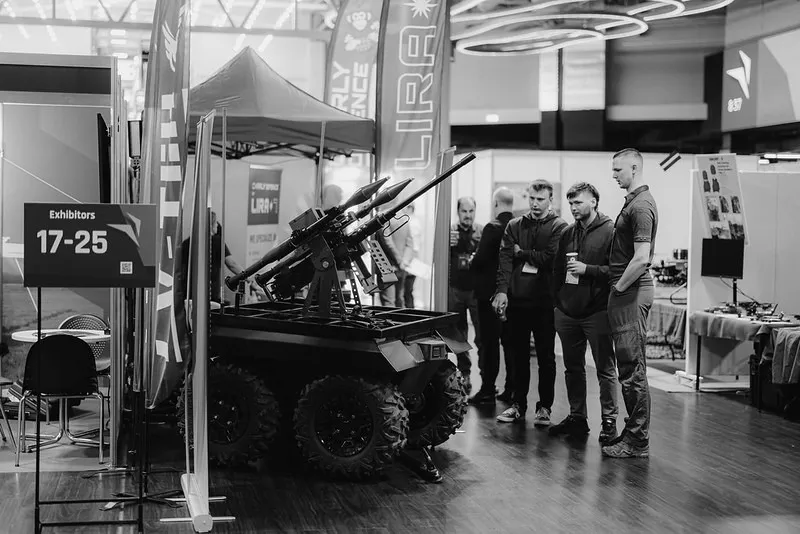
To reach Riga’s Drone Summit, we’re driven to a military training area by the Ādaži Military Base, a paved area surrounded by fields and sand dunes. Half of the attendees are in military fatigues, and our conversations are interrupted by the occasional sound of explosions and gunfire not too far away. It makes this drone demonstration feel all the more real, and all the more urgent.
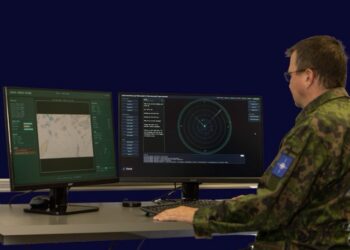
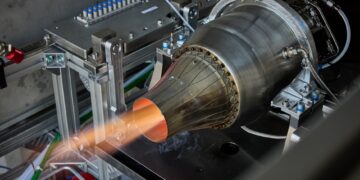
Seven drone companies from Latvia demonstrate their technologies, they showcase AI-targeting capabilities, dropping payloads on targets, fiber optical cables, and even landing and driving under a vehicle. The demonstration is opened with remarks from Major General Kaspars Pudāns, who stresses the importance of the gathering: “War is about the speed we can integrate and innovate. But we need to be ready in peacetime, before conflict starts.”
The Drone Summit in Riga marks the first anniversary of the Drone Coalition, an international coalition of 18 member states to provide Ukraine with drones. The event is packed, with 1,500 people in attendance from more than 20 countries, and 97 companies exhibiting their products – many of which are part of the coalition network, and many that want to be. A Canadian team hae flown out from Montreal just for this event. While they’re not part of the drone coalition yet, they hope to sign procurement contracts and test their drones in Ukraine.
The Prime Minister of Latvia can be seen strolling through the expo stands talking to the startups about their products. Decorated military personnel are milling about and chatting to CEOs of major corporations, academics take the stage, and even kids in volunteer youth guard uniforms cluster around the tables of the drone building workshop, hosted by the Drone Aid Collective, European Defence Tech Hub, and and Riga Technical University.

The event is opened with a sobering speech from Valerii Churkin, Deputy Minister of Defence of Ukraine, stating “Russia has surpassed us technologically, and, more dangerously, it has surpassed us in terms of speed and scale.” He emphasized that we’re playing catch-up, and what we need is innovation and manufacturing at speed, on the ground in Ukraine, with decisions made based on real-life, lived experience on the battlefield. “Not on spreadsheets,” Churkin added.
Throughout the day, the war in Ukraine is often referred to as ‘the Drone War.’ Yaroslav Filimonov, CEO & Co-Owner of Kvertus, one of Ukraine’s largest drone and counter-drone manufacturers, stated in a panel on counter-drone technology that “before the war, drones could fly 5km, 10km. Now we see 50, 100km and more.“ The speeds are faster, the cameras are better, the payloads are heavier. And more recently, fiber optical drones are dominating the battlefield. “The frontline is littered with kilometers of fiber-optical cables now”, said a speaker. Filimonov also shared that drone warfare and electronic warfare are not just Ukraine’s problem. “All future wars will be fought on the NATO side with drone technologies developed in Ukraine, and on the other side, with technologies developed by Russia.”
Since its inception, the Drone Coalition has sent over 100,000 drones to Ukraine. The Drone Coalition Fund has amassed 1B EUR in contributions in 2024, and has received pledges of over 2.75B EUR for 2025. The UK is responsible for managing the fund, and organises joint procurement processes to shorten the time to equipment delivery to Ukraine and Drone Coalition nations. “We can get drones to Ukraine in days,” said Minister of Armed Forces of the UK, Luke Pollard.
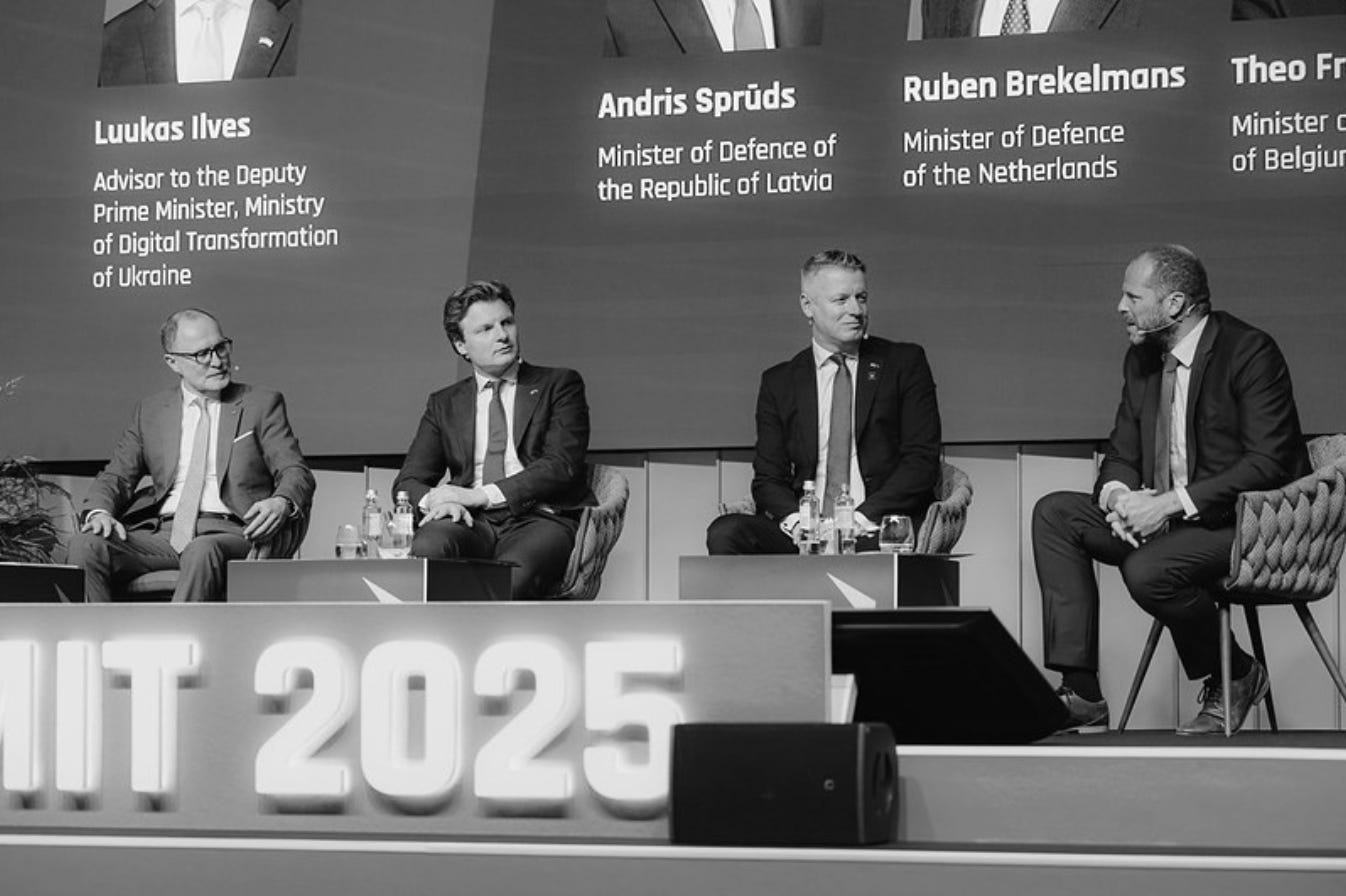
The Minister for Defence of Latvia, Andris Sprūds, emphasizes that in addition to the main goal – supporting Ukraine – the platform has yielded other unexpected benefits. “It has served as nuclear fuel that has fueled innovation, cooperation, and the willingness to contribute.” Case in point – on this day, Belgium and Turkey announced that they would be joining the Coalition, bringing up the number of partner nations to 20. Pollard expanded on Sprūds’ sentiment:
“The reason that we have nations wanting to join is because they can see the effectiveness of what the drone coalition is delivering. My measure of success of Drone Coalition is not how many flags we can put on a block to show the members. It’s that every single member of the Coalition is contributing, both in terms of funding and in industrial innovation.”
A sense of urgency is not shared by all. The Minister for Defence of Belgium, Theo Francken, touched on the topic of an asymmetry in awareness in some European countries, including his own. He shared how difficult it was to achieve even 2% of defence spending in Belgium, a decision that was recently passed after controversial societal debate.
On a panel with Defence ministers from Latvia, the UK, Belgium, and the Netherlands, Francken said, “We’re ministers, we know why this is important. But society looks at their pensions, that they have to work longer before retiring, and what, so we can buy arms? It’s not so easy. But we see this is important, that’s why we’re joining the drone coalition today. And I will go to Ukraine to consult ministers there. But this is three years later. It is our job to educate society.”
Latvia, the host country, is sandwiched between Estonia and Lithuania, and shares a border with Russia and Belarus. To say that the country feels a sense of urgency is an understatement. It has recently stepped up national defence spending to 5% of GDP, and announced new military testing grounds for maritime and air drone testing to be shared with NATO Partner countries, including at the largest military testing range in the Baltics, with over 24,000 hectares available. They have already made full use of the 5G military testbed, one of the few in the world, in the Ādaži military training area. The test grounds contributed to NATO choosing to hold their Digital Backbone Experiment (DiBaX) in Latvia in October 2024, where NATO Partner countries tested next-generation mobile technologies in military scenarios.
During the Drone Summit, Startup House in Riga held their DefenceTech meetup. At the event, investors had a frank discussion on the realities and challenges of backing defense tech startups. An undisclosed speaker shared that while there is massive interest in European defence tech spending, the region has its downfalls. “To be honest, as an investor, I look at a fragmented market and I wouldn’t touch it with a ten-foot pole. Europe has to do a lot more to consolidate the market. But the good news is that Europe doesn’t want to be left behind, and that is a massive opportunity for startups.”
The general sentiment of the event can be summed up in one phrase by Defence Minister Andris Sprūds: “There is one EU. One NATO. There is no one country that is more secure than another.”