In 2025, we reported on the complexities of defence, technology, and geopolitics. Our journalism came to readers from conference halls, factory floors, bootcamps, and sometimes from much closer to the front lines. We bring our readers a look back at some of our most-read stories from the year, and at the journalism we’re proud to have published from both our editorial staff and guest authors.
From spending a day inside Helsing’s first-ever press event, to sitting down with Ukrainian officials shaping the use of AI on the battlefield, to unpacking how Taiwan’s drone industry is scaling up in response to global demand, these pieces reflect the range of reporting we aim to do.
We followed the money flowing into European defence tech, covered the most pivotal questions and defence news at Resilience Conference, and examined what failure looks like when startup-built military technologies are put to the test.
This collection offers a snapshot of how we report: grounded in real people and places, and focused on helping readers understand how today’s defence and resilience decisions are being made.

1. The Long Read: How Helsing Sees the World
During its first-ever press day, Helsing offered an inside view into its technologies, team, and perspective on the threat landscape. Resilience Media was there, gaining rare access to the company’s domain rooms dedicated to land, air and maritime operations.
We saw Helsing’s core drone frame, the SG-1 Fathom deep-sea glider, a demonstration of Lura – the company’s AI-enabled software platform for underwater battle – and watched two retired fighter pilots compete in a simulated dogfight against an AI-piloted jet. The team also introduced Area 9, its new internal incubator where much of the work with Mistral is taking place.
Since that first press day in June, co-CEO Torsten Reil joined us on stage at Resilience Conference to discuss European sovereignty, what it takes to build a software-defined company, and the push to gain supply chain independence from China.
At the same time, Helsing has been accelerating its own expansion. The company acquired Blue Ocean, an Australian firm developing autonomous underwater vehicles and other submarine technologies that had previously been a partner. Helsing also opened its first UK Resilience Factory, where it will develop and manufacture the SG-1 Fathom for naval forces.
On the manufacturing front, Helsing signed a memorandum of understanding with automotive supplier Schaeffler, which will handle manufacturing and procurement of key electronic components for Helsing’s drones while helping secure access to critical semiconductors and raw materials. The company has also partnered with Kongsberg, the Norwegian prime best known for space software and hardware, to develop a new AI-based satellite system focused on how space can be more effectively leveraged in modern defence capabilities.
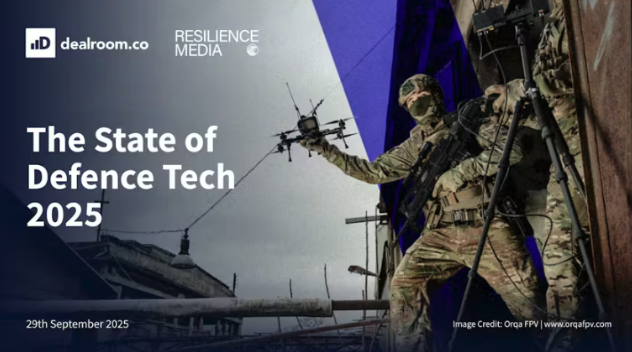
2. Funding for European defence startups surpasses $2 billion
The US has accounted for the lion’s share of defence tech VC funding among NATO allies, capturing 85% since 2019. But 2025 marked a record year for Europe in carving out its own space. In September, our State of Defence Tech 2025 report – co-published with Dealroom and presented at Resilience Conference – found that European investment into the defence sector doubled over the past year, with a record $2 billion raised in 2025, up from $1 billion last year.
Defence startups were projected to net more than double the VC cash in 2025, outpacing all other sectors. New data points crowned defence as the fastest-growing category in European venture capital. The funding spike can be attributed to a handful of mega deals, including the €600 million Helsing has raised.
At year’s end, Dealroom confirmed that while European defence investment surpassed $2 billion, it came in shy of the $2.3 billion projection. A record year, nonetheless.
3. The Long Read: At Haraka Storm, Failure is a ‘Feature, Not a Bug’ for Stark
It was a story making the rounds with all the right buzzwords. Drones. Startup. Peter Thiel. Crashed. Specifically, one of the hottest defence tech startups in Europe flamed out during an important military exercise using its tech.
At Haraka Storm, the British Army’s annual training exercise in Kenya, the military tests equipment ahead of buying and deploying it, including vehicles, weapons, and technology from third parties. This year, the list included three of the biggest startups currently operating in European defence tech: Anduril, Helsing, and Stark. As it turned out, the results were not quite the slam-dunk many had expected. Leslie Hitchcock writes that what might appear to be a catastrophic failure can instead catapult a startup into wildly unexpected success. Perhaps the more important conversation is about the urgency of war, rather than money, investors, and highly capitalised startups.
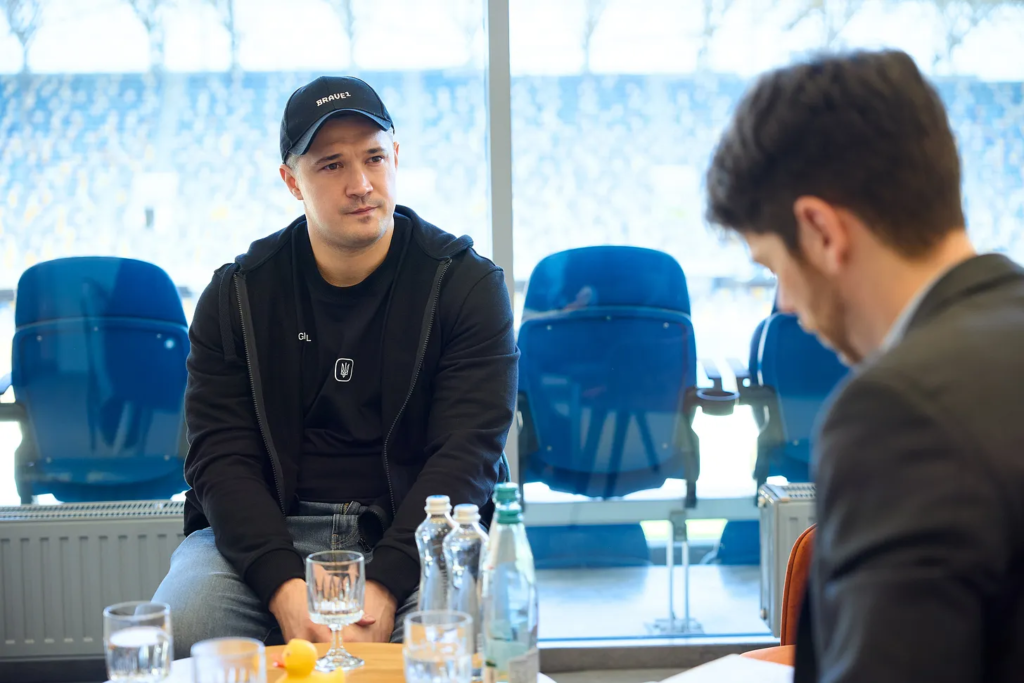
4. Face to Face with Mykhailo Fedorov: Ukraine’s Plan for AI on the Frontline
Two months after his promotion to First Deputy Prime Minister and Minister of Digital Transformation of Ukraine, Mykhailo Fedorov took the stage at a tech conference in a Lviv football stadium. Resilience Media guest reporter Thomas Macauley sat down with Fedorov and discussed Ukraine’s battlefield adoption of drone swarm technology, the pixel-lock technique, and other AI innovations Ukraine is using on the battlefield. Fedorov said that Ukraine provides a frontline laboratory for defence tech companies, he said, as well as “priceless” warfare data.
“We already see drones flying over Europe, and we understand that if Russia realises that Europe doesn’t know how to deal with that – because there are some difficulties with detection, with shooting down these drones – that is going to be very risky for the region,” he said.
That very night, his warning echoed from the skies. Air raid sirens rang through the darkness, heralding one of the heaviest bombardments since the start of the full-scale invasion. The attack followed several reports of Russian drones and fighter jets violating European airspace.
“That is why it is so important to strengthen Ukraine,” Fedorov said earlier that day, “because at the same time, you’re reinforcing Europe.”

5. Taiwan’s drone industry: vertical take-off
Taiwan, the centre of the world’s advanced semiconductor industry, has often frustrated external military analysts for failing to translate that technological manufacturing prowess into defensive capability. Its military has long been seen as old-fashioned, with some justification: only last year did the Defence Minister announce an end to bayonet training.
Taiwan wants to become a major dual-use drone supplier to the democratic world. But before it can play a global role, it faces a more urgent task: scaling up the production capacity it needs for its own defence.
In this deep dive, Paddy Stephens details Taiwan’s evolving position in the “non-red” drone supply chain. Taiwan has gone from maintaining a small, outdated drone fleet to launching a government backed “Drone National Team,” where it has expanded its production and testing capabilities. President Lai’s administration has a bold aim for Taiwan to become the Asia-Pacific hub for democratic drone manufacturing.
Since mid-2023, drone exports have surged, driven by strong demand from Europe – particularly Poland – where buyers are willing to pay a premium for secure alternatives to Chinese-made drones. Taiwan’s electronics manufacturing expertise has given it an advantage in producing smaller, lightweight drones, now a key focus of its export strategy.
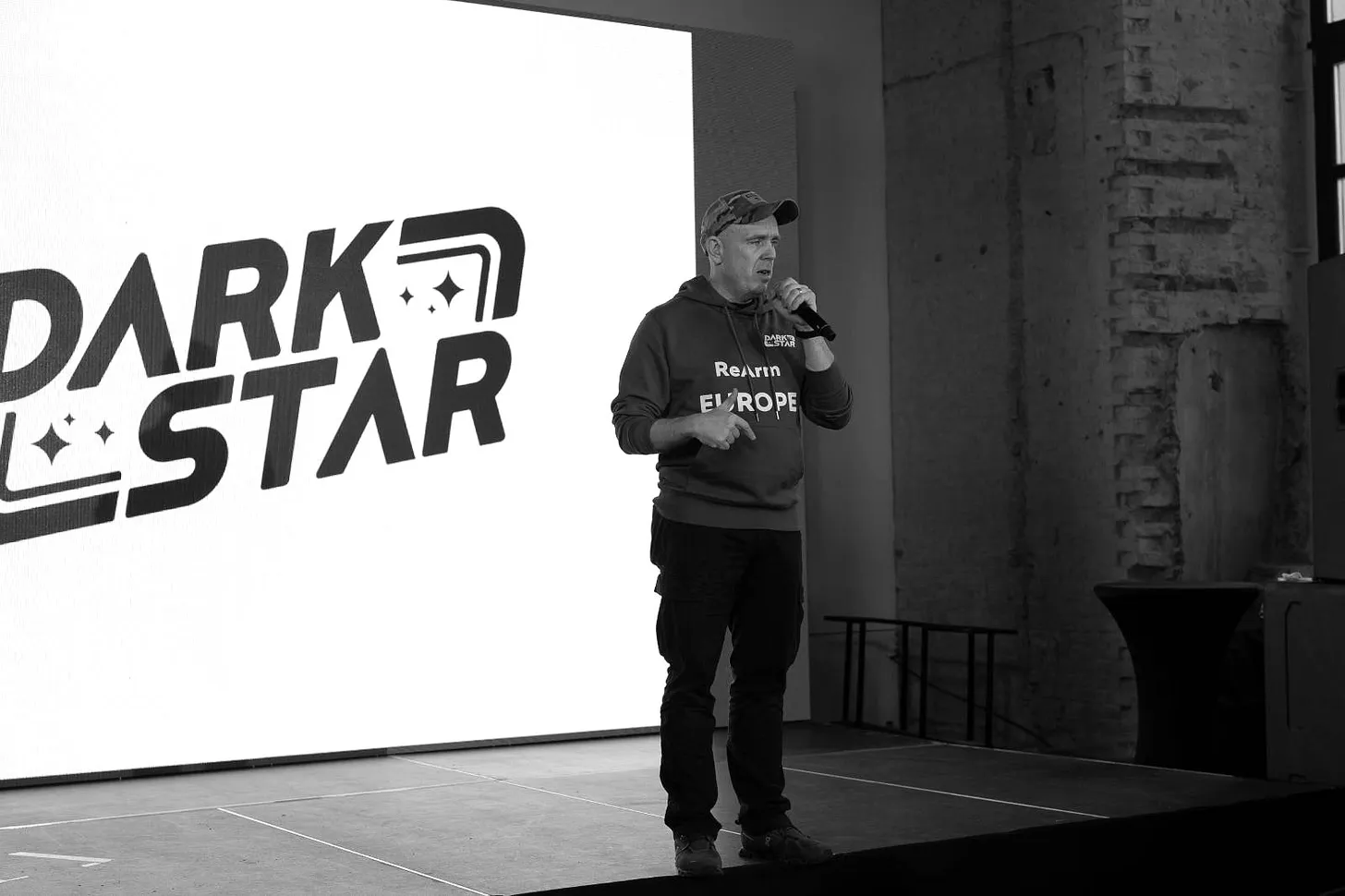
6. Inside the Darkstar Bootcamp in Kyiv: Unorthodox Comms, Underwater Operations, and Building a Community
Under the dark cloud of ongoing fighting with Russia, the Darkstar Coalition ran its fourth bootcamp in Kyiv in the search for innovative approaches to defend Ukraine. Resilience Media attended the bootcamp, where across five days, 17 participating startups demonstrated their products, receiving feedback from both military personnel and investors.
We spoke with Denys Yermolenko, the teen co-founder of Xnet. Out of his pocket, he casually pulled out a shotgun cartridge with a Kevlar net folded inside it. The product is a scalable instrument to counter drones. When shot, the mesh extends in front of the UAV and traps the rotor blades.
Spectrator, a Ukrainian team that participated in the bootcamp, demonstrated a system that scans and identifies the communication frequencies being used by drones and jams the signals accordingly by using low-energy attacks.
We met Submerge Baltic, an autonomous underwater drone producer working on products for scenarios playing out in the Baltic Sea. Darkstar enabled the company to come to Ukraine and test their drones in the Dnipro river.
We met COALAS::Systems, a Ukrainian startup producing radio equipment which allows drones to cover long distances using unorthodox radio frequencies.
Darkstar’s most immediate aim and focus, in the words of co-founder Ragnar Sass, is quite singular. The “one mission” of Darkstar, he said introducing the event in Kyiv, is helping Ukrainians “kill the enemy and win the war.”

7. A Deep Dive Into the Unique Finnish Defence Cluster Riihimäki
In this deep dive into a regional defence tech cluster, we look at a small Finnish town embracing open innovations and partnerships.
Situated 69 kilometres north of Helsinki and 109 kilometres southeast of Tampere, Riihimäki was long defined by its railway junction connecting Finland’s major cities, historically all the way through to Saint Petersburg in Russia. But amid growing caution of its eastern neighbour, the small Finnish town drawing attention as a home to a fledgling defence cluster.
Jouni Eho, a retired professional basketball player who has been Riihimäki’s mayor since 2022, has driven this transformation against the backdrop of Russia’s war in Ukraine and Finland’s closer alignment with NATO.
His aim: to build a coordinated ecosystem that taps existing local strength — Riihimäki has been a garrison town since the beginning of the twentieth century, and is now home to strategic units such as the Electronic Warfare Training Centre, as well as defence companies, including significant rifle manufacturing and military maintenance facilities — but also draws in external talent to strengthen both Finland and NATO’s wider security capabilities.

8. Leaked Knownsec Files Expose China’s Cyber Arsenal, Forcing Global Defence Rethink
In November, a massive data leak from Chinese cybersecurity firm Knownsec unveiled the tools, tactics, and datasets underpinning Beijing’s state-aligned hacking operations.
Carly Page writes that for Western intelligence and defence agencies, the fallout is significant. The leak’s technical breadth – spanning mobile, hardware, and cloud environments – made it a rare and valuable intelligence asset for defenders, but also a sobering reminder of how extensively state-aligned firms have embedded offensive capabilities into the global digital fabric.
“The Knownsec breach doesn’t just reveal tooling, it reveals doctrine,” said Richard Blech, founder and CEO of XSOC CORP.
9. ‘Drone Wall’ Concept Gathers Pace, but Baltics and Startups Still Wait for Funding
The idea of a “drone wall” – a networked defence system designed to detect, track, and counter hostile drones along NATO’s and the EU’s eastern front – is gaining political momentum after repeated incursions by Russian drones across European airspace, writes Julia Gifford.
High-level support has come from EU leaders and defence officials advocating for coordinated Counter-Unmanned Aerial Systems (C-UAS), while some sceptics question its effectiveness and the broader strategic value of such a system. Debate persists about what exactly a drone wall would entail. Would it serve as a monitoring tool to simply jam the frequencies the drones are flying on, or if it would trigger interception activities?
Despite growing interest and ready-to-deploy technologies from Baltic startups – including partnerships like Estonia’s DefSecIntel Solutions working with Latvia’s Origin Robotics to integrate surveillance and interceptor drones – funding and procurement remain elusive. The EU’s drone wall initiative still needs formal backing from the European Council, a clear technical roadmap, and substantial financial commitment before implementation could begin. Some leaders estimate early deployment might not happen until the next EU budget cycle in 2028. Meanwhile, national efforts and inventive local solutions are advancing, but bureaucratic divisions and funding delays could hamper widespread rollout, leaving eager startups and frontline states waiting on support.

10. The Case for Strategic Autonomy in the UK and Europe
Author Hugo Jammes writes that Europe’s traditional security and economic umbrella has long rested with the United States. Since World War II, the transatlantic alliance, embodied in NATO and strengthened through economic partnership, has provided Europe with a sense of stability and protection – the so-called ‘peace dividend’. However, the rise of new spheres of power, most notably China and a resurgent Russia, has complicated the global order.
The potential for policy shifts in Allied and non-Allied countries underscores the risks of dependency. Simultaneously, the conflict in Ukraine and increasingly sophisticated hybrid threats in the digital domain have highlighted the limitations of our current deterrence posture. China’s rapid technological advancements and assertive foreign policy further complicate this picture, especially in areas such as critical infrastructure, digital networks, and supply chains.
The concept of ‘strategic autonomy’ has emerged as a central theme in United Kingdom and European discourse, shaping debates in foreign policy, security, economics, and technology. At its core, strategic autonomy refers to our ambition and ability to act independently in support of our economic and national security. It has become an imperative for the UK and Europe.
11. Ukraine’s Drone Economy and the Fight for a Secure Supply Chain
Resilience Media’s John Biggs speaks with Denys Gurak, COO and Chief Investment Officer at MITS Capital in Kyiv. MITS – short for “might” in Ukrainian – is an investment group backing Ukraine’s fast-growing defense technology sector, with a special focus on drone warfare and supply chain independence from China.
The conversation covers MITS’s hands-on incubation and acceleration model, the challenges of scaling hardware startups in wartime, and the urgent need for institutional capital from the US and Europe to fuel growth. Gurak also shares the story of a Ukrainian unmanned ground vehicle company that scaled production faster than all Western competitors combined, driven by direct feedback from the front lines.
This is a deep look at how Ukraine’s innovation ecosystem is adapting to war — and why its success matters for global security.

12. In it to swim it
One of the primary ways that younger defence startups scale to win major deals is by teaming up with bigger legacy players that want to incorporate more cutting-edge technology into its own stack.
Kraken Technology, a UK startup building autonomous and uncrewed maritime defence systems, and Germany’s NVL (one of the oldest names in naval shipbuilding) formed a joint venture to develop a new wave of autonomous marine defence systems.
Ingrid Lunden reports how the deal intends to supercharge how the naval prime will tap into autonomy and AI to build a new generation of maritime vessels.

13. Militaries want to tap startup innovation: Tiberius has built Grail to get them on track
Tiberius is a UK startup developing a new class of weapons and launchers that it believes will extend the targeting and range capabilities of what the military uses today.
At the DSEI defence exposition in London, Tiberius announced a separate product aimed both at helping governments and other large organisations buy in the future and net startups into the mix.
Grail, as the platform is called, underscores a significant trend in the world of defence, propelled largely by startups, which is seeing the sector launch and adopt tools from the enterprise as it slowly modernises.
Just as enterprises in tech have seen a wave of “consumerisation” — where B2B products have borrowed user experience and design from the world of consumer tech to make their products more palatable and adopted by business users (bringing in smartphones, app stores, gamification, social networking and other traditionally consumer tools) — defence has effectively made a turn to “enterprisation.”
Resilience Conference returned to London
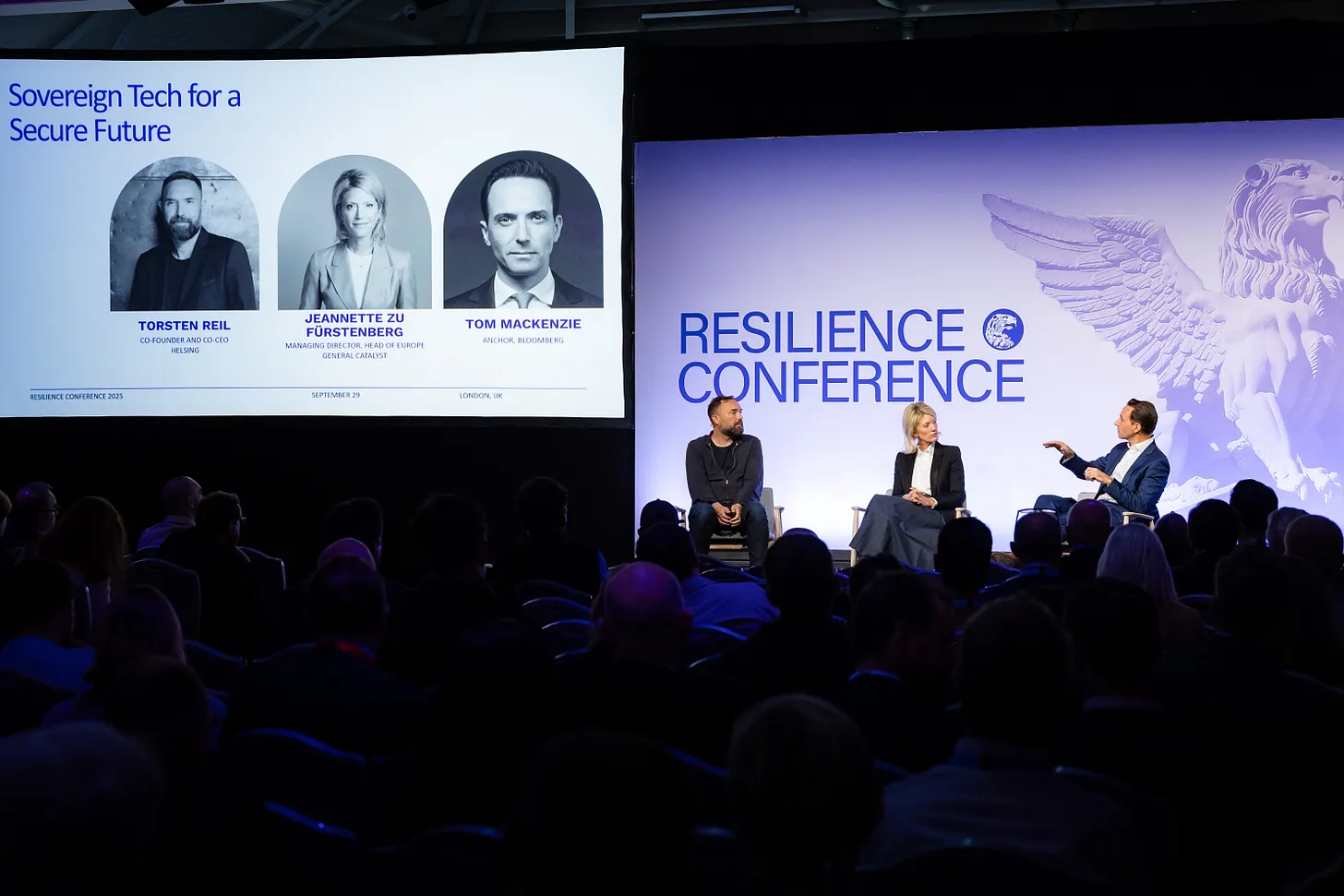
We’d be remiss not to mention Resilience Conference in any look back at 2025. In September, Resilience Conference returned to London for its second year, drawing 500 attendees across two days of stage interviews, panels, and fireside chats featuring leading figures in European defence. The program included 103 speakers, 32 panels and fireside conversations, and seven startup pitches, alongside extensive networking. Speakers spanned the military, government, nonprofit, and investment sectors, as well as startup founders and the press. Some of the key headlines to emerge from Resilience Conference stage included:
- The launch of Stratis Intelligence, an Icelandic startup that wants to build a ‘Palantir for Europe.’ Stratis is backed by Estonian defence-tech fund Darkstar. It has since secured seed funding.
- Expeditions announced €100 million for its second fund.
- Auterion, the European drone software start-up, has raised €130 million in one of the largest defence tech rounds in Europe this year. The company discussed its long range strike drone on stage at Resilience Conference.
- Commcrete emerged from stealth armed with $29 million in funding
- Cambridge Aerospace disclosed it has raised $136 million across three funding rounds and confirmed that Never Lift, the US-based investment firm, has been backing the company since its inception.
- Kusti Salm, CEO of missile company Frankenburg Technologies, spoke about how the pool of capital getting deployed into resilience startups is leading to faster dealmaking.
- Helsing’s Torsten Reil and General Catalyst’s Jeannette zu Fürstenberg joined Bloomberg’s Tom Mackenzie on stage for a wide-ranging discussion. They discussed among many things, the company’s core success metric: the safety of democracy itself.
Taken together, these stories show a continent under pressure – and still moving too slowly. While war in Ukraine has been reshaping Europe’s security environment, many of the decisions that matter most are being delayed, underfunded, or deferred.
In 2026 we aim to keep our reporting close to where that gap is most visible: on factory floors, in startup test ranges, inside ministries, and near the front lines.