A reliable energy system underpins Europe’s efforts to deter further Russian aggression, develop defence tech and build up advanced industrial capacity. But keeping it online is not easy.
Faced with hybrid threats and climate change, Europe’s power grids have to find ways to adapt to maintain their resilience. Increasingly, grid companies and energy institutions are looking to EU space infrastructure to manage these challenges.
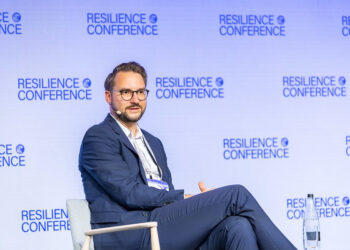
“There is a whole system that goes from Portugal to Ukraine, from Norway to Athens, that is connected, that needs to work every second, in order to supply to Europe. So resilience is a very, very foundational thing for us,” said Damian Cortinas, the chair of the board of Europeean grid association ENTSO-E, addressing the Space Summit for a Resilient Future (SSRF) in Toulouse.
Existing EU space assets offer a broad range of capabilities that could be used to help run energy systems. These include Position Navigation and Timing (PNT) from Galileo and earth observation from the Copernicus programme. Galileo could offer a resilient time signal for the grid, while Copernicus could support grid infrastructure monitoring and more accurate predictions around renewable energy generation. However, at present, actual use of these seems to be limited.
Why look up?
Grid companies, energy generators and other players within the energy system are starting to make use of satellite data in their operations.
“I think that space technologies maybe will not replace our system tools; [they] will be a complement, help[ing] us to anticipate risk earlier, to monitor much larger areas in a very same manner, and respond faster when something happens,” noted Isabel Gómez Bernal, a senior analyst at renewable-focused energy utility Iberdrola, speaking at SSRF. The company is working with Synthetic Aperture Radar (SAR) satellite company ICEYE so as to better predict, and respond quickly to, damage to the grid from extreme weather.
The European energy industry’s turn to space is about boosting resilience in areas of existing dependence on space while also leveraging space to boost resilience in areas such as monitoring and communication.
The existing dependence is on GNSS satellites – predominantly GPS, though Galileo has been used in pilots at least – which Europe’s grids rely on to provide the accurate timing source needed to synchronise across the grid and therefore maintain grid stability.
But as GNSS interference – jamming and spoofing of signals – becomes increasingly common, ENTSO-E hopes that grid operators will be able to integrate Galileo Public Regulated Service (PRS) into their existing hybrid timing architecture. The association’s March overview called for Transmission System Operators (TSOs) to be recognised as critical users of space-enabled services, allowing them priority access.
An EU-funded research project is developing a PRS-based network synchronisation service.
Space also offers novel ways to monitor and manage an increasingly complex and rapidly growing terrestrial energy system. As Europe shifts to renewables, its power grids are becoming more complex and dispersed. That makes environmental monitoring a greater challenge.
Satellite imagery is a particularly promising area with a broad range of applications for the energy sector. Gómez Bernal of Iberdrola highlighted how the company uses this kind of imagery to detect vegetation growth close to the grid.
Stéphanie Limouzin, president of CLS, a provider of space-based services, noted at SSRF that this kind of data allows the energy system to prepare for shocks.
“You can have the full picture of the environment around, and you can get very well prepared and answer the question: What if?” she said. “What if a wildfire is around my grid? What if I have an extreme event?”
That full picture is extremely useful for grid operators who have to monitor the physical security of thousands of kilometres of infrastructure.
“Our power networks… they go everywhere. We have thousands of [substations] all across Europe” says Cortinas. “We cannot defend every one of them.”
It’s not just in times of crisis that such imagery is useful. Satellite data allow operators to “mov[e] from reacting to events to continuously understanding how conditions around our assets are changing,” said Fabien Gilbert, head of remote sensing at TotalEnergies, at SSRF. “From space, we can observe changes: land, water, vegetation … and if we combine that historical perspective with current observations and models, it becomes a very powerful tool for risk assessments.”
Assessment of risks and preparation are becoming increasingly important for an energy system grappling with the growing impacts of climate change.
The most obvious challenge for grid operators and other parts of the energy system is the threat to their infrastructure. “Catastrophic weather usually has catastrophic consequences for the power network because everything is out in the open and exposed to the elements,” said ENTSO-E’s Cortinas.
Wildfires, which have been more widespread in recent years, also impact how much electricity can be transported in the power lines above them.
Additionally, as renewables become increasingly important to Europe’s energy supply, accurate predictions of generation from different renewable sources is increasingly important for balancing electricity generation and demand in each second, as grids must do to maintain stability. Cortinas specified that satellite data is particularly useful for making more accurate predictions of generation from wind, which is more complicated to forecast than solar.
The increased availability of data, and emergence of AI analytical tools to analyse it in large quantities, have significantly increased the value that space offers to energy providers. Where more than five years ago “energy operators [were] telling us that space was not reliable enough because of the continuity of data… now it’s not true anymore”, said Limouzin.
Alongside GNSS and earth observation, satellite communications are another promising use case for the energy sector, such as in offering connectivity to offshore wind farms. However, IRIS2, the European satellite constellation, is not due to begin offering services until 2030. Until then, companies may have to rely on private sector providers such as Starlink.
Among European grid operations, what is used much more these days is GPS for timing synchronisation. EU-funded research projects have demonstrated alternatives: the RESPONDENT project completed a pilot in 2025 that showed how Galileo could be used for timing synchronisation for the grid instead.
Similarly, RESPONDENT is among the research showing how European grids can apply Copernicus data to predict renewable generation more accurately and monitor conditions around the grid. However, despite clear indications of interest from several European grid operators, it remains unclear how widespread such use is at present.
ENTSO-E – the association of Europe’s 40 Transmission System Operators (TSO) which together transport electricity across the continent – published an executive overview in March 2026 of how EU Space Programme capabilities could be integrated into the grid to boost resilience.
One key emphasis was that satellites should complement existing capabilities rather than become a new dependency. Space infrastructure – including satellites like Copernicus as well as associated ground stations – has its own vulnerabilities. This reality is perhaps why ENTSO-E’s paper stresses that “space-based capabilities are… intended to reinforce, not replace, existing monitoring, timing and communication systems, thereby reducing systemic vulnerability rather than introducing new dependencies.”
Other previous technical challenges with applying space to the grid, such as signal lag, have largely been overcome in recent years.
But what Europe’s grid operators lack right now, says Cortinas, is the analysed satellite imagery and insights gleaned from that. “Raw data is not what we need. We need a way to make sense of the data”.
In any crisis, speed is of the essence.
Resilience for ENTSO-E is based on an “n-1 rule” that if “at any moment you need to be able to lose your most critical part of the system, nothing happens”, says Cortinas. And if more than one link goes down, “resilience is to recover as fast as we can.”