
Anyone who has been caught in a bar fight knows the worst defence is to flail wildly instead of focusing on those actually attacking you. That, roughly speaking, is how The Daily Show’s Jon Stewart described Iran’s response to the recent US-Israeli strikes. But what may look like a poor exit strategy is, in fact, governed by rigorous tactics, aimed at the real guys throwing the punches, the US Treasury.
Luke Gromen put it succinctly: “Iran does not have to defeat the US military; it just has to defeat the UST market.” This point has far-reaching implications for any deal that may ultimately be reached.
What appears to be military disorientation (attacks on shipping routes, drones over the Gulf, proxies from Gaza to Yemen) follows a precise logic: those who sow uncertainty in bond markets raise their opponents’ financing costs. And when financing costs rise, the capacity to wage war falls. It’s one of geopolitics’ oldest truths, rarely played as openly as it is today.
What we call “capital markets” are, in truth, credit markets. And credit has decided the outcome of wars since antiquity.
After the Persian Wars, Athens founded the Delian League not primarily as a militia, but as a collective financing instrument. History’s first multilateral defence architecture was a budget.
The most instructive example, however, is the Russo-Japanese War of 1904. A David v Goliath scenario: Japan had one tenth of Russia’s economic output. It initially paid higher interest on its bonds (6% versus 5%). Yet with every military victory, Japan’s risk premium fell. By 1905, Tokyo was issuing new war bonds at 4%. With every Russian defeat, Moscow’s refinancing costs rose until its credit collapsed entirely. Put differently: the Russian Empire did not lose the war merely in the naval battle of Tsushima. It lost it on the London Stock Exchange, where collapsing prices drove the effective yield on Russian bonds, until investors could no longer be found.
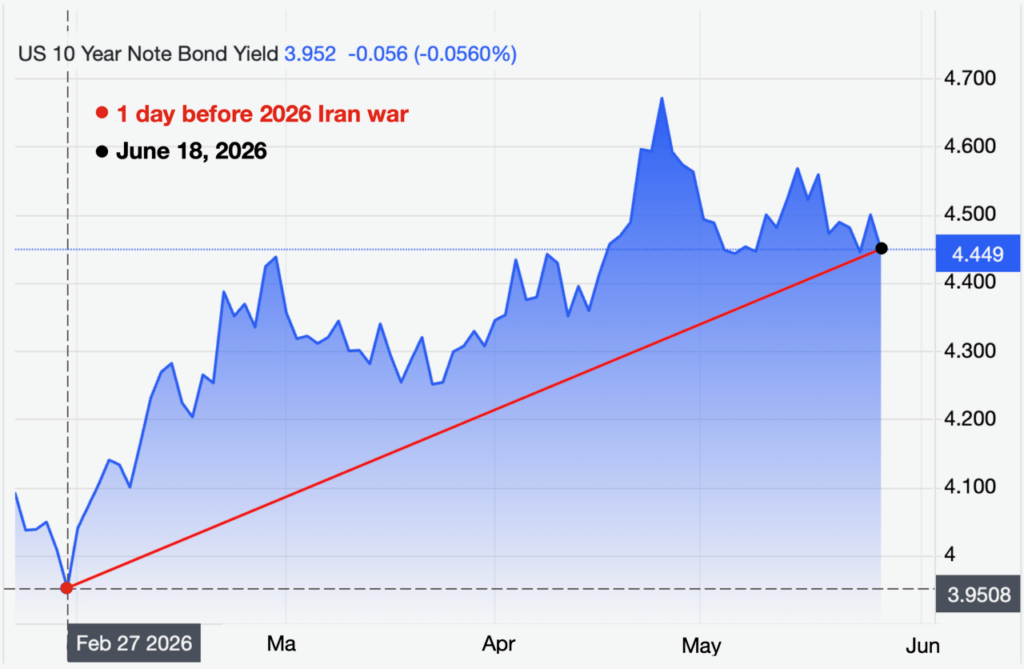
- U.S. borrowing costs climbed after the Iran war began: the 10-year Treasury yield rose roughly 50 basis points from its pre-war level to 18 June.
Before the global rise of neoliberal agendas, theorists of maritime strategy reached a similar conclusion. For Julian Corbett, the defining mind behind Royal Navy doctrine, sea power was never primarily about fleet engagements.
“Command of the sea,” he wrote, “means nothing but control of maritime communications, whether for commercial or military purposes.”
US Navy strategist Alfred Thayer Mahan argued in parallel: sea power was the compound of merchant shipping, colonial reach, and the capacity to protect both – thus, a strategic trinity of capital, logistics, and force. The lesson neither man needed to spell out: whoever can sever an adversary’s lines of supply, physical or financial, need not defeat him. They need only wait until his credit runs out.
In Ukraine, we are seeing the same principle unfold in real time. The war is not, and not merely because of drone technology, a simple war of attrition. It is a financing race. The side that can maintain access to capital markets, transfer payments and credit lines for longer will determine the outcome. This explains why Péter Magyar’s victory in Hungary could prove strategically more relevant than an isolated shift at the front: it cleared the way for ninety billion euros in frozen EU funds.
Iran is pursuing a variation of this strategy. No missile must hit its target to be effective. It is enough for oil prices to rise, insurance costs to become unpredictable, inflation expectations to climb, interest rates to follow, and bond vigilantes to put Europe under pressure. The crisis in the Strait of Hormuz is also a crisis of Europe’s fiscal architecture, including its physical value chains.
Is the Western financial order fading? The question is not new. The British Empire did not collapse for lack of regiments, but because its credit lines had been overstretched.
Gold reserves dwindled, debts accumulated, the sterling area eroded. Comparing the metrics reveals parallels with the United States today: rising public debt, waning attraction of the dollar as a reserve currency, and early signs that US Treasuries are losing their status as a risk-free anchor. A piece of staircase-wit today might be this: in the twentieth century, the Bank of England defended a monetary power long after the industrial base needed to sustain it had faded.
Yet, as Mark Twain reminds us, history does not repeat itself, it rhymes. It is therefore too soon to write the obituary.
For decades, the United States has used a unique advantage: it has allowed the rest of the world to finance it. This mechanism is not a weakness. It is a strategic strength – for as long as it holds. And it holds longer than most sceptics assume, because alternatives are scarce. Whoever sells UST also harms themselves. China knows this too.
More acutely dangerous than the retreat of the United States, therefore, is Europe’s instability. The monetary union has design flaws that bond vigilantes exploit with every geopolitical tremor. In the UK, John Healey cited the inadequacy of the current Defence Investment Plan as the reason for his resignation as the country’s secretary of defence earlier this month, saying it “falls well short of what is required for defence and the country at this dangerous time.”
The risk of rising populism + high debt + absent fiscal coordination = an equation that drives risk premia and hollows out defence investment. Neither the EU, nor the UK, are paying for the Iran war in blood, but they may be paying for it in interest, and compound interest.
What follows from this? An insight as old as Athens: collective defence requires collective financing. National budgets are not enough. They are too slow, too politically vulnerable, too exposed to inflation. What is needed are broader, multilateral financing architectures, institutions that pool capital, lower risk premia and give the West capacity for strategic endurance. Such institutions are not mere balance sheets. They signal to citizens, allies, and adversaries alike that we are prepared: not for a season, but for the long game.
President Clinton’s adviser James Carville (The Economy, Stupid) once said that he would like to be reincarnated as the bond market, because it could intimidate everybody. This statement also contains an inverse lesson: democracies that understand the logic of bond markets can help write the rules of peace. But peace without strength is fragile. Strength without financing is impossible. Financing without architecture, meanwhile, is little more than gambling – often the trigger for a bar fight.
David Marks is Senior Adviser at the investment bank Alantra in London. He spent 38 years at J.P. Morgan, most recently as Chairman of Debt Capital Markets EMEA, and was Deputy Chair of the International Capital Market Association (ICMA).
Said Werner is Affiliate Director at the MIT Murray Lab for Deep Tech & Geopolitics, and Mercator Fellow on International Affairs. As a strategic adviser, he focuses on multilateral finance, economics and security policy.