Good afternoon from the team at Resilience Media
This week marked the fourth anniversary of Russia’s full scale invasion of Ukraine. While Resilience Media is not a publication about Ukraine, we were founded because of Ukraine, and to focus on the role Ukrainian founders play in defence. This is a lesson we think the rest of Europe and NATO needs to understand and is at the heart of our work. On this fourth anniversary of Russia’s war of aggression, we acknowledge two of the Ukrainian founders who are our archetypes: tech entrepreneurs who have turned their talent towards the defence of their country, and of our way of life.
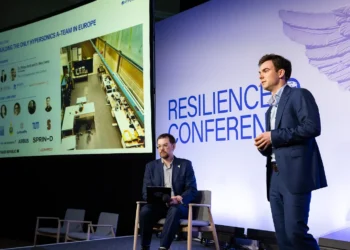
Farsight Vision CEO Viktoriia Yaremchuk appeared on the Resilience Conference 2024 stage in a panel about how Ukrainian technology is upending modern warfare doctrine. We admired her so much that we featured her in our first founder profile, and we are thrilled that she just announced Farsight Vision’s €7.2M Seed Round earlier this month.
Following the full-scale invasion by Russia in 2022, Yaroslav Aznhyuk was part of the tech sector response in Ukraine that led to the launch of Brave1, Spend with Ukraine, and of D3 Ventures, as well as lobbying the US to release its first aid to Ukraine. He then used his skills, experience, and time in Silicon Valley to found the AI-startup The Fourth Law, and then Odd Systems. He was the subject of our second founder profile, a deeply personal interview that still resonates. So we were also thrilled to cover the strategic investment by Axon into The Fourth Law earlier this month.
In other news, IQM Quantum Computers, a Finnish defence company, is going public via a SPAC merger on Nasdaq in the US at a ~$1.8 B valuation. Ingrid Lunden explored the listing for Resilience Media and it is excerpted below in our Start Watch section.
As more startups announce funding, there are more deals to watch so we’re going to dissect them in our new weekly Deals section. This week we revisit our scoop about Frankenburg Technologies, and look Resilience Media exclusive FlyFocus and Tytan. Got a tip about upcoming investment? Send it our way.
Elsewhere on Resilience Media:
- Germany set to formally announce Stark and Helsing strike-drone contracts this week
- Group 14 Technologies is betting on silicon batteries for super fast charging
- How First Parsec plans to outproduce Moscow with cheap engines
- UK announces a £500 million defence package for Ukraine
Resilience Conference Warsaw
Expeditions’ Mikolaj Firlej, PFR Ventures’ Aleksander Mokrzycki, and Patrick Schneider-Sikorsky of NIF will speak at Resilience Conference Warsaw. Tickets are already going fast, so get yours today before Early Bird prices end. I’ll be back in your inboxes next week. Thanks for reading.
-Leslie Hitchcock, co-founder and Publisher, Resilience Media

Frankenburg confirms €30M funding to build more EU-made rockets
Nearly a month after Resilience Media broke the news that Frankenburg Technologies had raised more funding, today the Baltics-based startup officially confirmed details: it has closed a Series A of €30 million (around $35 million) led by Plural with participation from SmartCap, the Estonian publicly-funded VC. More.
EXCLUSIVE: Poland-based FlyFocus raises €4.5 million to build European UAVs
FlyFocus, a Poland-based unmanned aerial systems company, has raised €4.5 million in its first institutional funding round. The round was led by ffVC with participation from the NCBR Investment Fund, the venture arm of Poland’s National Centre for Research and Development. The capital will fund a new manufacturing facility in Poland, expand international sales, and support the development of two new drone platforms planned for release later this year. More.
Tytan raises €30M for drone defence, sources say at a ~€150M valuation
Drones have quickly become a cornerstone of modern warfare, and so has building better tools for those times when drones are used by adversaries. Tytan Technologies, one of the defence tech startups building drone interceptors, is rising to that challenge, and today it’s announcing a Series A of €30 million ($35 million) to expand its business. Sources tell us the round values Tytan just over €150 million (likely around $180 million). More.

IQM, the quantum startup from Finland, plans US listing on Nasdaq at $1.8B valuation
Ingrid Lunden, Managing Editor
IQM, the Finnish startup that has raised more than $570 million over the years to fuel its big ambition of building the world’s first scalable quantum computer, is kicking off a new scaling chapter of its own.
Today, the company announced that it will be going public, in the US, by way of a SPAC deal. The Real Asset Acquisition Corporation, a blank check company that listed on Nasdaq last year, plans to merge with IQM.
The deal will value IQM at $1.8 billion, the companies said — a bump up from the $1.2 billion valuation it achieved last year when it raised $320 million. This will make IQM the most valuable quantum business in Europe, and the first one from the region to move to a public listing.
European startups moving operations to the US has to scale has been a regular issue in the region, with each move seen as an erosion of tech sovereignty. But although IQM’s listing is in the US, IQM said it plans to remain a Finnish company headquartered in Finland, according Jan Goetz, IQM’s co-founder who took on the role of “sole” CEO last month.
(Co-founder Mikko Välimäki, who previously shared the role with Goetz, is transitioning out of the company by the end of March, remaining an adviser.)
Goetz also said that the company is also considering listing in Finland alongside Nasdaq in the US.
As with other SPACs, IQM’s deal is a move to give it more cash to continue building, since while quantum computing remains in the realm of deep tech, the race to build it requires equally deep pockets, and IQM made just $35 million in revenues last year.
The merger and listing will give IQM a cash balance of $450 million: $175 million from RAAC (which will get a 10% share of the company); a PIPE loan of $134 million “from leading new and existing and institutional investors” (which will close with the business combination, subject to conditions); $24 million in exercised IQM warrants; and IQM’s existing cash, which was $172 million at the end of 2025. And once it’s listed, IQM will potentially be able to use that status to raise more.
The deal has already had the unanimous approval of both IQM and RAAC boards, the pair said, and is expected to close in June 2026.