
Monday 14 September, 2026
[email protected]
Resilience Media
  • News
    • Events
    • Interview
    • Startups
    • Venture
    • Weekly Digest
  • Resilience Conference
    • Resilience Conference London — Oct 2026
    • Resilience Conference Copenhagen — May 2026 (PAST)
    • Resilience Conference Warsaw — Apr 2026 (PAST)
  • Launch
  • About
  • Guest Posts
    • Author a Post
  • Subscribe
No Result
View All Result
  • News
    • Events
    • Interview
    • Startups
    • Venture
    • Weekly Digest
  • Resilience Conference
    • Resilience Conference London — Oct 2026
    • Resilience Conference Copenhagen — May 2026 (PAST)
    • Resilience Conference Warsaw — Apr 2026 (PAST)
  • Launch
  • About
  • Guest Posts
    • Author a Post
  • Subscribe
No Result
View All Result
Resilience Media
No Result
View All Result

BAE backs Oxford Dynamics to bolster UK defence autonomy with AI

Fueling 'sovereign innovation’ is the name of the game

Paul SawersbyPaul Sawers
August 8, 2025
in News, Startups
Share on Linkedin

BAE Systems has made a strategic investment in Oxford Dynamics, a UK startup building agentic AI and embedded systems for the space, security and defence sectors.

You Might Also Like

Open Cosmos fires up its satellite ambitions with €300M

Isembard puts critical manufacturing minutes from Whitehall

Finland’s Creoir gets backing from Gungnir Capital for its on-device speech tech

The British aerospace giant becomes the first external investor in Oxford Dynamics, with initial plans to embed the startup’s AI smarts into Prophesea – a platform that pulls together data from different systems to monitor assets like warships and armoured vehicles, and keep them ready for action.

Co-founder and director Shefali Sharma said that while the funding supports integration with BAE’s own systems, it also strengthens Oxford Dynamics’ ability across broader defence and national security applications.

“It’s fuel for sovereign innovation, wherever the mission leads,” Sharma told Resilience Media.

‘A very intelligent system’

Founded in 2020 by Sharma, Mike Lawton and Edward Jackson, Oxford Dynamics’ business is built around three core products. Avis (“A Very Intelligent System”) is the brains of the operation: a generative AI search and analytics platform that processes and interprets data across multiple formats in real time. Complementing this is SR-1, a sensor fusion system that embeds AVIS to speed up the military decision-making cycle known as OODA: Observe, Orient, Decide, Act. In short, it helps operators respond faster to complex threats by shrinking the time between sensing and action.

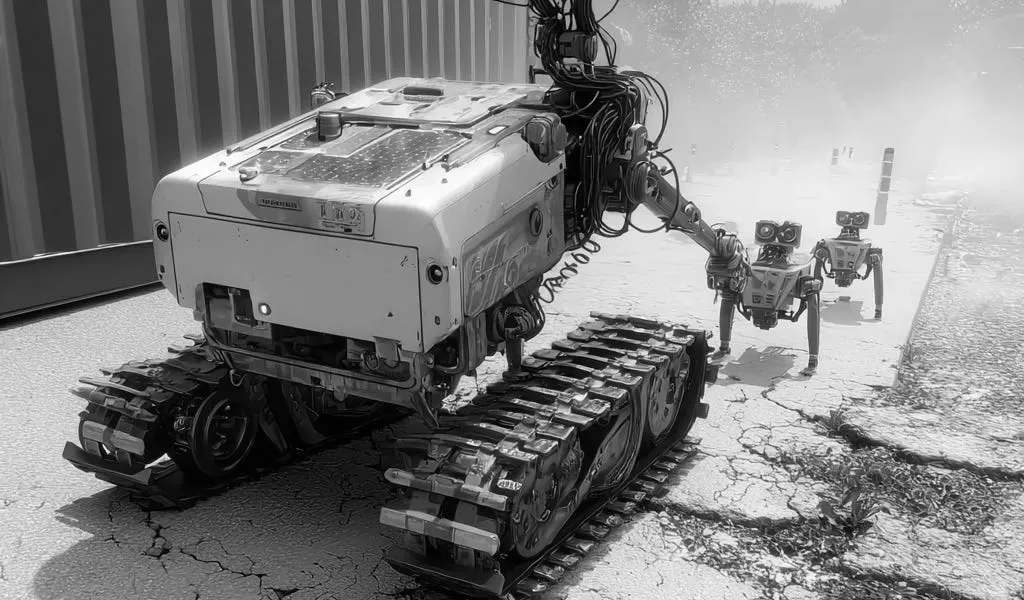
And then there is Strider, a semi-autonomous robotic system that combines rugged hardware and Oxford Dynamics’ embedded AI, built for missions in hazardous environments. So rather than sending a human in to deal with a potentially lethal situation, the operator would send Strider instead.

Combined, Oxford Dynamics’ technology meets the need for on-device AI that works reliably in harsh conditions, where connectivity is restricted. And it does so by making sense of data gleaned from sources such as drone footage, battlefield reports, and sensors to help operators respond more effectively in high-risk situations.

Today’s announcement comes a year after Oxford Dynamics secured a £1 million contract with the Ministry of Defence (MoD) to further develop Strider and get it ready for various terrains, including grass, concrete, gravel, steps and slopes.

With aerospace and defence heavyweight BAE on board as a strategic, minority investor, Oxford Dynamics now has the industrial firepower to turn prototypes into operational systems at scale.

“Our shared mission at Oxford Dynamics is to bring trusted AI to the front line, and working with BAE Systems gives us the platform to quickly scale our technology into systems that will make a real difference to our armed forces,” Jackson added in a statement.

‘Optimizing for deployment’

Up until now, Oxford Dynamics says it has been entirely self-funded (aside from some grant money), with Sharma noting that unlike other defence startups that are “optimising for VC scale,” her company is instead optimising for “speed to deploy.”

“Our focus is on building real capability – not chasing valuations, or raising capital for the sake of it,” Sharma explained. “We’re not here to ride the hype cycle; we’re here to solve hard problems that matter. That means working collaboratively, deploying fast, and ensuring our technology strengthens the resilience of the UK and its allies.”

Having just raised an undisclosed figure from BAE, however, it’s clear that funding is an integral component for any fledgling defence tech startup. Indeed, Sharma notes that Oxford Dynamics remains a “fully independent company” in the wake of BAE’s investment, but it’s now better positioned to bring its technology to real-world applications.

“This strategic investment marks our first external capital – and was a deliberate decision to bring on a partner who aligns with our mission to deliver capability at pace,” Sharma said.

There could be more funding down the road, too, with dedicated defence funds potential suitors.

“While our immediate focus is delivering impact through the BAE Systems partnership, we’re also planning ahead,” she said. “We’re actively exploring what a future funding round could look like – not because we need capital today, but because we know momentum compounds.”

Building battle-ready tech from home soil

The bigger story in all this is Europe’s drive to develop capabilities devoid of Big Tech dependencies. It also demonstrates a prime working differently with a startup. Rather than a contractual relationship, or a straight aquisition, BAE investing sets a new framework with different incentives.

Just last week, Scottish aerospace startup Skyrora became the first U.K. company to secure a rocket launch licence, aiming to both manufacture and launch rockets from home soil. And this trend is visible across sectors, with public sector institutions shifting away from proprietary ecosystems like Microsoft’s in favour of open-source alternatives, seeking greater control and independence.

In the context of defence and security, that same shift is driving demand for home-grown AI systems that offer transparency and freedom from foreign tech influence — something that BAE Systems’ group managing director Andrea Thompson calls “sovereign defence and security.”

“The landscape of warfare is rapidly evolving and embracing emerging technology is vital to keeping the UK safe,” Thompson said. “By working with companies such as Oxford Dynamics, we can help ensure that the nation is ready to unlock the advantages that innovation brings and help strengthen the UK’s sovereign defence and security landscape.”


Tags: BAE SystemsOxford DynamicsShefali SharmaUK
Previous Post

Transatlantic Financial Heavyweights To Fund New European Defence Bank

Next Post

China alleges the US exploited Microsoft Exchange zero-day to target defence sector

Paul Sawers

Paul Sawers

A seasoned technology journalist, most recently Senior Writer at TechCrunch where his work centered on European startups with a distinctly enterprise flavour. At Resilience Media, Paul focuses substantively on the worlds of open source and infrastructure, looking at technology that helps people and society live outside the sticky ecosystems of Big Tech.

Related News

Open Cosmos fires up its satellite ambitions with €300M

Open Cosmos fires up its satellite ambitions with €300M

byIngrid Lunden
September 14, 2026

Open Cosmos, a UK startup founded by three engineers from Spain, made a name for itself in 2015 when it...

Isembard puts critical manufacturing minutes from Whitehall

Isembard puts critical manufacturing minutes from Whitehall

byCarly Page
September 14, 2026

British manufacturing startup Isembard has opened a 160,000 square-feet factory in central London that will produce components for defence, aerospace...

Finland’s Creoir gets backing from Gungnir Capital for its on-device speech tech

Finland’s Creoir gets backing from Gungnir Capital for its on-device speech tech

byFiona Alston
September 14, 2026

Finland's Creoir, a developer of voice interface technology, has raised investment from Swedish VC Gungnir Capital. The funding is part...

NewOrbit is heading lower to get a better look at Earth

NewOrbit is heading lower to get a better look at Earth

byJohn Biggs
September 14, 2026

The UK satellite manufacturer NewOrbit has secured a Q3 2028 launch slot for NEO-1, a commercial rideshare satellite designed to...

Fortaegis raises $50M to scale secure silicon for defence

Fortaegis raises $50M to scale secure silicon for defence

byCarly Page
September 14, 2026

Amsterdam-based Fortaegis Technologies has raised $50 million to take its silicon-rooted security technology into mass production, as the company eyes...

Mach Industries raises $600 million to build weapons at scale

Mach Industries raises $600 million to build weapons at scale

byJohn Biggs
September 11, 2026

U.S.-based defense startup Mach Industries has raised another $600 million as it begins to build its autonomous weapons at scale....

Website interface with text and abstract drawing

Claude AI helped Russia-based threat actors develop autonomous kamikaze drone swarm

byCarly Page
September 11, 2026

A Russia-based threat actor used Anthropic’s Claude AI to help build an autonomous swarm of kamikaze drones capable of selecting...

A dartboard with two green darts and one orange dart embedded in it

A defence tech startup has a target on its back

byEd Hareand1 others
September 11, 2026

Increasingly, defence tech founders have no military or government background. That’s a good thing, because it’s driving innovative, out of...

Load More
Next Post
China alleges the US exploited Microsoft Exchange zero-day to target defence sector

China alleges the US exploited Microsoft Exchange zero-day to target defence sector

BAE Invests in a Startup; US Accused of Chinese Cyberattack; Darkstar Bootcamp returns to Kyiv (quiet week)

BAE Invests in a Startup; US Accused of Chinese Cyberattack; Darkstar Bootcamp returns to Kyiv (quiet week)

Top stories

Resilience Conference London a
News

The Resilience Conference London 2026 Agenda is live

September 2, 2026
The German flag flying above the Reichstag building in Berlin, Germany
Cyber

Berlin launches crisis response after Rhysida dumps 5.79TB of allegedly stolen government data

September 7, 2026
Something new, something BIG at Resilience Conference London
News

Meet the LAUNCH@RC and SCALE@RC 2026 Cohorts

September 11, 2026
The Exploration Company
European Defence

The Exploration Company raises $450M to build Europe’s answer to SpaceX

September 8, 2026

Resilience Media is an independent publication covering the future of defence, security, and resilience. Our reporting focuses on emerging technologies, strategic threats, and the growing role of startups and investors in the defence of democracy.

  • About
  • News
  • Resilence Conference
    • Resilience Conference Copenhagen 2026
    • Resilience Conference Warsaw 2026
  • Guest Posts
  • Subscribe
  • Privacy Policy
  • Terms & Conditions
  • Mission Statement & Code of Practice
  • Press

© 2026 Resilience Media

No Result
View All Result
  • Home
  • About
  • Subscribe
  • Events
  • Guest Posts
  • Interview
  • News
  • Resilience Conference London 2026
  • Resilience Conference Copenhagen 2026
  • Resilience Conference Warsaw 2026

© 2026 Resilience Media

This website uses cookies. By continuing to use this website you are giving consent to cookies being used. Visit our Privacy and Cookie Policy.