Friday 3 July, 2026
[email protected]
Resilience Media
  • News
    • Events
    • Interview
    • Startups
    • Venture
    • Weekly Digest
  • Resilience Conference
    • Resilience Conference Warsaw 2026
    • Resilience Conference Copenhagen 2026
    • Resilience Conference London 2026
  • About
  • Guest Posts
    • Author a Post
  • Subscribe
No Result
View All Result
  • News
    • Events
    • Interview
    • Startups
    • Venture
    • Weekly Digest
  • Resilience Conference
    • Resilience Conference Warsaw 2026
    • Resilience Conference Copenhagen 2026
    • Resilience Conference London 2026
  • About
  • Guest Posts
    • Author a Post
  • Subscribe
No Result
View All Result
Resilience Media
No Result
View All Result

Orqa CEO Srdjan Kovacevic on distributed drone manufacturing and why small factories matter

John BiggsbyJohn Biggs
December 31, 2025
in Interview, Startups
Share on Linkedin

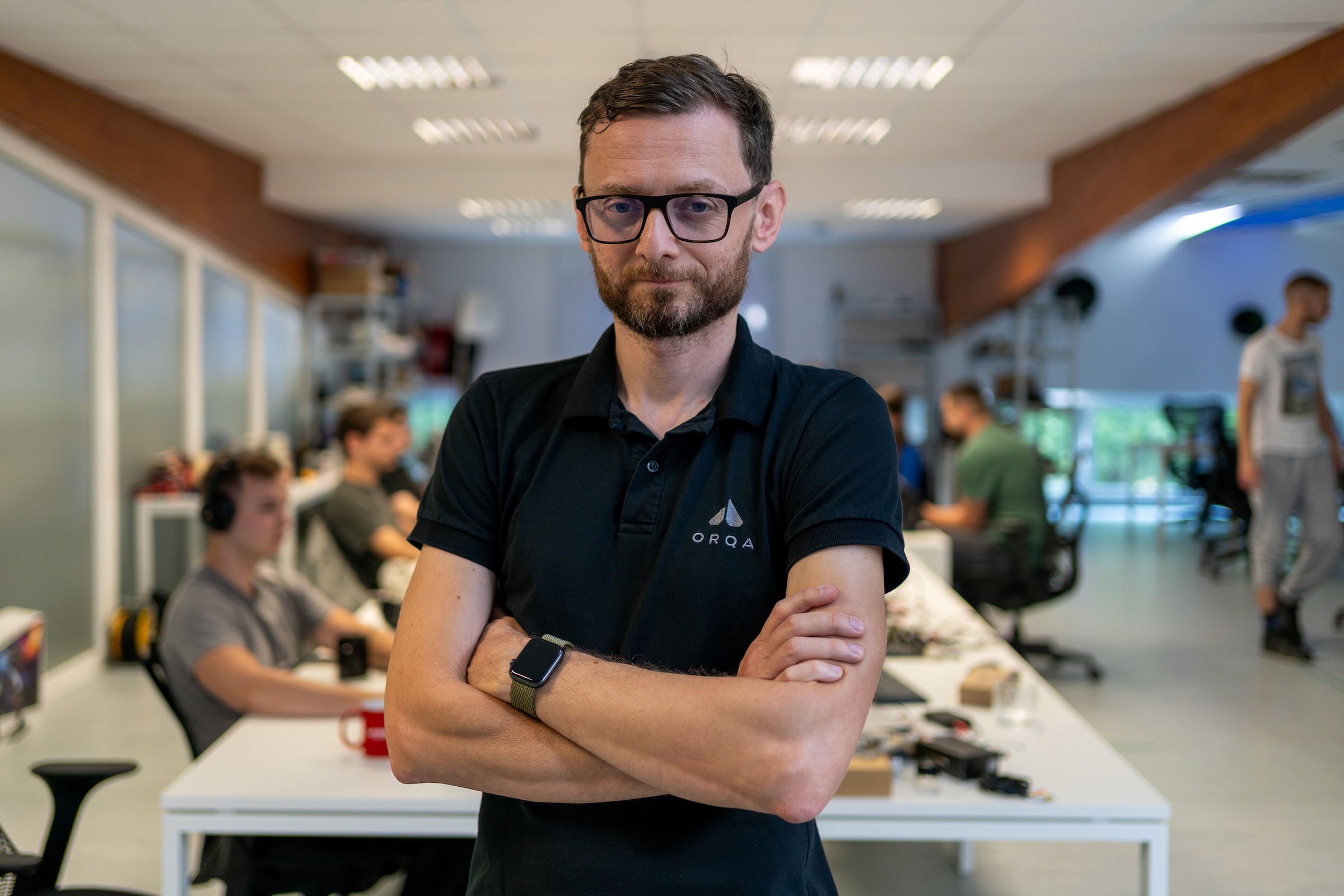
Resilience spoke with Orqa CEO Srdjan Kovacevic about a shift happening in defense manufacturing: distributed manufacturing. Instead of building drones in one big factory and shipping them out, Orqa is teaching trusted local partners to produce its systems in-country. The mission is not assembly itself but the transfer of know-how, tooling, and process, so a small team can build reliable aircraft at scale near the end user. The vision, said Kovacevic is similar to the democratized nature of open source software.

You Might Also Like

Six Robotics raises €12M to help individual drones work as a team

JLR hack attribution turns spotlight on Britain’s offensive cyber capability

UK puts drones at the centre of its next defence investment plan

Kovacevic argues this matters for more than supply chain. In fact, he said, these drones can be produced in small facilities, spread across a network, which changes both survivability and output in a peer conflict. He also lays out where aerial robotics is headed next, more compute on the aircraft, a Linux-class software layer, and a growing need for local integration and customization. It’s a fascinating and timely departure from the traditional monolithic manufacturing model and it Kovacevic and his team are doubling down on the concept in order to spread the gospel of distributed manufacturing at scale.

Resilience: What problem were you trying to solve when you started this global manufacturing work?

Kovacevic: Two problems. End users want sovereign capability, they want manufacturing and customization close to home. At the same time, Orqa is a small startup from a small country. Croatia does not carry the same weight in global markets. If you want global reach, you need a model that works inside a fragmented defense market.

Resilience: So what is the model in plain terms?

Kovacevic: We find a reputable local player in a market. Someone with real relationships with end users and some integration skill. We train their team to build one of our platforms, then we help them set up a small production line locally. It is not about shipping boxes. It is about teaching a team to build reliable flying machines, at scale, in their own country.

Resilience: Where did you prove this worked?

Kovacevic: The Netherlands. We ran a two week training program, then helped set up manufacturing there. I was honestly surprised how well it worked. It looked like a tiny replica of our own production, with their team building drones we designed using components we supplied.

Resilience: Why does this matter beyond supply chain politics?

Kovacevic: Because the production footprint is small. If you want to build a tank, a plane, a rocket, you need massive factories. Those are big targets. With drones, you can produce meaningful volume in much smaller facilities. That changes the industrial logic. In a peer conflict, distribution is resilience.

Resilience: You even floated a number. A million drones a year.

Kovacevic: Yes, and my view is that should be distributed. Not one giant factory. A network of smaller sites. We did not set out to design it this way. We stumbled into it. But it fits the nature of the tech.

Resilience: You are calling this a “global manufacturing program,” right?

Kovacevic: Yes. We piloted for two years with the Dutch partner. This year we signed three more partnerships, one in the Nordics, one in North America, and one with an American company focused on the Gulf and Indo Pacific region. We have more in the pipeline.

Resilience: When you explain this, some people hear “assembly” and shrug. How do you answer that?

Kovacevic: “Just assembly” is a massive understatement. These are not toasters. Small things that fly have dangerous details. And it misses what comes next. If I teach you to build a remotely operated system, you are one step away from building a real flying robot once the brain changes.

Resilience: You guys are based in the Balkans.

Kovacevic: Croatia. We have offices in Osijek and Zagreb, but most of the team is here.

Resilience: You said something that stuck with me. That the threat feels different depending on where you sit in Europe.

Kovacevic: It does. Poland and the Baltic states feel this as real. It is not the same feeling in Spain or Italy. Europe is not one mood right now.

Resilience: Let’s talk about that brain. What changes next?

Kovacevic: Today many systems are still “dumb” in compute terms, mostly microcontrollers. But the direction is clear. More compute on the aircraft, more software driven features. Our next generation flight controller includes a small Linux computer, an SoC. You can run your own image, your own kernel, Yocto or Debian class systems. That opens a permissive user space for software on the vehicle.

Resilience: Why does that matter for partners?

Kovacevic: First we teach them manufacturing. Then we move into developer enablement. When you have compute on the aircraft, you can add more intelligence through software. You also collect more data on the edge, and then you need to move that data into local networks. Integration and customization start to matter more, and that work is best done close to the end user.

Resilience: Orqa also sells components. You are building systems, but you sell the parts too. That can create tension.

Kovacevic: We run a dual model. We sell the components to build a drone, and we also use those components to build complete systems, from ground station to vehicle. Sometimes we compete with our own customers. We try to do it fairly. In the US we were in a program where our partners competed too, and the authority wanted our written sign off that we would keep supporting them even if we competed. We did that gladly. Trust is the whole point if you want partners to build a business on your tech.

Resilience: You also had an interesting way to segment the aerial robotics market.

Kovacevic: A lot of jobs can be handled by a common form factor, maybe 70 to 75 percent. That is where vertically integrated systems in a box win. That is why DJI took so much of the market. But there is a long tail of jobs where you want components and a custom build. We want to compete in the “system in a box” space in the West, and also enable an ecosystem to serve the long tail.

The interview has been edited for clarity.

Tags: DronesManufacturingOrqa
Previous Post

GPS: the first front in electronic warfare

Next Post

Space Forge launches a 1,000°C orbital furnace to make cleaner semiconductor crystals in microgravity

John Biggs

John Biggs

John Biggs is an entrepreneur, consultant, writer, and maker. He spent fifteen years as an editor for Gizmodo, CrunchGear, and TechCrunch and has a deep background in hardware startups, 3D printing, and blockchain. His work has also appeared in Men’s Health, Wired, and the New York Times. He has written nine books including the best book on blogging, Bloggers Boot Camp, and a book about the most expensive timepiece ever made, Marie Antoinette’s Watch. He lives in Brooklyn, New York. He runs the Keep Going podcast, a podcast about failure. His goal is to share how even the most confident and successful people had to face adversity.

Related News

Six Robotics CEO Christian Fredrik Eggesbø

Six Robotics raises €12M to help individual drones work as a team

byPaul Sawers
July 3, 2026

Coordinating a swarm of drones to operate as a single force is one of the harder problems in modern unmanned...

a padlock on a red, blue, and pink background

JLR hack attribution turns spotlight on Britain’s offensive cyber capability

byCarly Page
July 1, 2026

The UK has quietly mounted offensive cyber operations against Russia, according to former British and American intelligence officials cited by...

UK puts drones at the centre of its next defence investment plan

UK puts drones at the centre of its next defence investment plan

byJohn Biggs
June 29, 2026

The UK government will commit more than £5 billion over four years to a major drone and autonomous systems integration...

Estonian forces trial portable drones that prevent RF jamming on the battlefield

Estonian forces trial portable drones that prevent RF jamming on the battlefield

byJohn Biggs
June 29, 2026

Sky Spy and Orqa have demonstrated a drone-based signals intelligence system with the Estonian Defence Forces, a project that adds...

Exclusive: Osney Capital closes £60M cyber fund to back UK’s next generation of security startups

Exclusive: Osney Capital closes £60M cyber fund to back UK’s next generation of security startups

byCarly Page
June 29, 2026

Osney Capital has closed its debut cybersecurity fund at a £60 million hard cap after investors piled in beyond its...

SE3 Labs unveils its spatial AI tools for defence backed by Lakestar and Sequoia Scouts

SE3 Labs unveils its spatial AI tools for defence backed by Lakestar and Sequoia Scouts

byIngrid Lunden
June 26, 2026

Large Language Models are changing how non-technical people engage with AI, and those learnings are permeating into the world of...

Copenhagen-based startup Acodyne lands €2.5 million pre-seed round for autonomous cargo drones

Copenhagen-based startup Acodyne lands €2.5 million pre-seed round for autonomous cargo drones

byJohn Biggs
June 25, 2026

Copenhagen-based Acodyne announced it has raised €2.5 million in pre-seed funding to help build autonomous cargo aircraft designed for "heavy...

Nearfield Instruments

Nearfield Instruments raises $380M to stake Europe’s claim in the global chip supply chain

byPaul Sawers
June 25, 2026

Sovereignty has emerged as one of the defining strategic preoccupations in Europe today, intersecting with almost every aspect of national...

Load More
Next Post
Space Forge launches a 1,000°C orbital furnace to make cleaner semiconductor crystals in microgravity

Space Forge launches a 1,000°C orbital furnace to make cleaner semiconductor crystals in microgravity

Tiberius Aerospace receives “Awardable” assessment in prominent DoD solutions marketplace

Tiberius Aerospace receives "Awardable" assessment in prominent DoD solutions marketplace

Most viewed

InVeris announces fats Drone, an integrated, multi-party drone flight simulator

Uforce raises $50M at a $1B+ valuation to build defence tech for Ukraine

Auterion, the drone software startup, eyes raising $200M at a $1.2B+ valuation

Palantir and Ukraine’s Brave1 have built a new AI “Dataroom”

Twentyfour Industries emerges from stealth with $11.8M for mass-produced drones

Senai exits stealth to help governments harness online video intelligence

Resilience Media is an independent publication covering the future of defence, security, and resilience. Our reporting focuses on emerging technologies, strategic threats, and the growing role of startups and investors in the defence of democracy.

  • About
  • News
  • Resilence Conference
    • Resilience Conference Copenhagen 2026
    • Resilience Conference Warsaw 2026
    • Resilience Conference 2026
  • Guest Posts
  • Subscribe
  • Privacy Policy
  • Terms & Conditions
  • Mission Statement & Code of Practice
  • Press

© 2026 Resilience Media

No Result
View All Result
  • Home
  • About
  • Subscribe
  • Events
  • Guest Posts
  • Interview
  • News
  • Resilience Conference London 2026
  • Resilience Conference Copenhagen 2026
  • Resilience Conference Warsaw 2026

© 2026 Resilience Media

This website uses cookies. By continuing to use this website you are giving consent to cookies being used. Visit our Privacy and Cookie Policy.