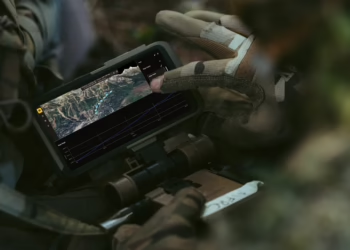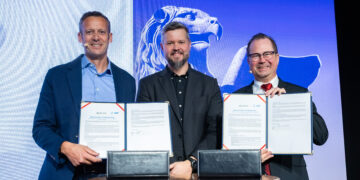
German defence tech startups are seeing a lot of activity at the moment, and one of them is using that momentum to raise funds. Resilience Media has learned from multiple sources that Auterion — the startup co-headquartered in Munich and Arlington, VA that builds software systems for kinetic and other autonomous drones — is profitable and is looking at raising $200 million at a valuation of more than $1.2 billion to continue growing its business.
The defence technology market is very heated at the moment globally, with the war in Ukraine lighting a fire of activity across Europe in particular. That is leading to some major contracts such as the deals that Stark and Helsing are securing with the German government, as well as fundraising activity, with some $8.7 billion raised by European defence and resilience tech startups in 2025.
Multiple sources said that Auterion’s fundraise would likely come out of inbound interest, similar to its last round, based on the fact that it is seeing a lot of business traction.
“They are really humming right now,” said one source close to the company. The timeframe for fundraising is not specific but is understood to be within this year.
We understand that Auterion is already profitable and is currently on track to double revenues based on signed contracts this year to $200 million — the same as what they are looking to raise.
A spokesperson for Auterion responded to a request for comment to say that “in light of the success of the development and growth of the business there has been increased interest from potential and new investors.” He added that it is “not fundraising at the moment.” This lines up with what our sources said.
Auterion has been in the news in the last month for a number of milestones in its development. It’s carried out multi-vendor live-fire tests of its Nemyx swarm system. It’s been providing software to power attack drones being built by a prime contractor for a NATO country.
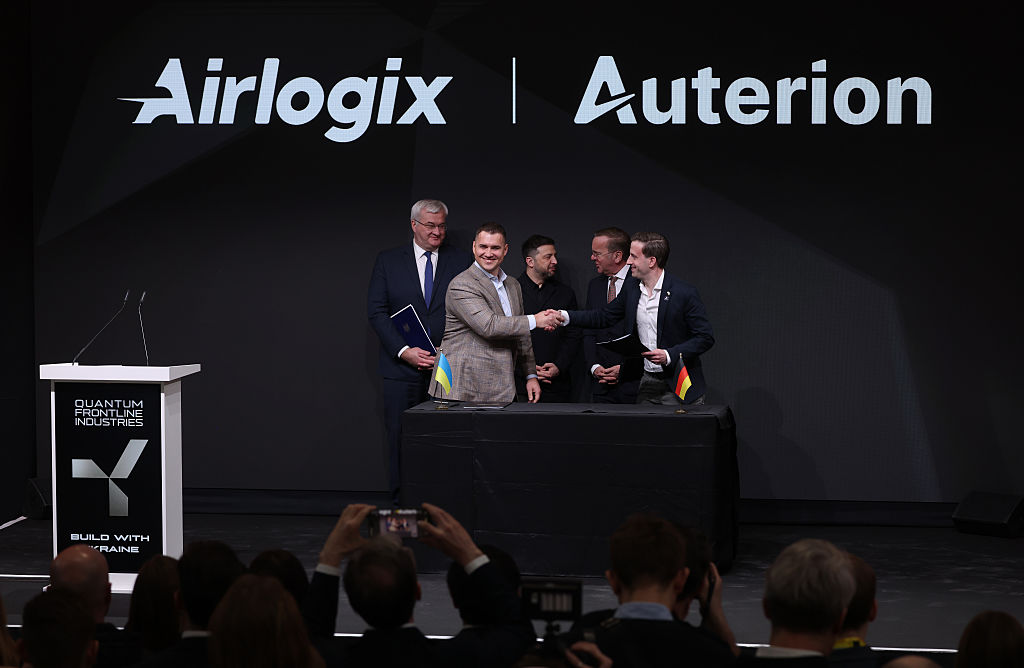
And two weeks ago, at the Munich Security Conference, Auterion signed a joint venture partnership with Ukrainian startup Airlogix to help the latter manufacture its drones in Germany, both for Ukraine and its allies.
A number of Ukrainian defence tech startups are partnering with companies abroad right now as a route to de-risking their manufacturing, and to expand internationally, and the signing, pictured below, took place with Ukrainian president Volodymry Zelensky and Germany’s defence minister Boris Pistorius at the factory set up to fulfil another one of those partnerships, between Quantum Systems and Frontline Industries.
Auterion counts major VCs such as Bessemer Venture Partners as well as strategic backers like the German prime contractor Rheinmetall and In-Q-Tel among its investors. It has also had grants from the US Department of War (also known as the Department of Defense) to develop its technology for the US military.
To date, Auterion has raised just over $167 million, per PitchBook data, including a round of $130 million last autumn at a valuation of around $600 million. Notably, that valuation was reached when the company was not profitable.
“The situation is much, much, much better now,” another source close to the company said. Indeed, the next round is likely going to come in at more than double its valuation, multiple sources close to the company told Resilience Media.
Auterion has been around for almost a decade. It originally got its start as a spinout from ETH Zurich to commercialise a popular open-source system for controlling drones created by its founders. Initial use cases were focused on deliveries and commercial end users.
Auterion over the years has continued its focus on open source and building software platforms that can be used by multiple vendors and OEMs (not unlike the Android model), but its end user vision has changed. Four years ago, after the war kicked into gear in Ukraine, it pivoted to defence; and while it still has commercial customers, that is not its first priority these days.
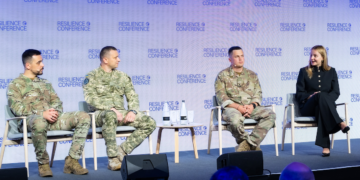
“We see ourselves as a war tech company,” Auterion co-founder and CEO Lorenz Meier said at the Resilience Conference in September 2025. “What we in the West have to make sure is that we are achieving supremacy in autonomy first. And that means on the battlefield in Ukraine today, in Taiwan tomorrow, and in the commercial industry, the day after tomorrow.” That shift has seen the company play a key role in supplying tens of thousands of its systems to power drones used by Ukrainian forces, both for building and defending against drone swarms, a key part of how both sides in the conflict engage in battle.
Although defence tech startups are seeing a lot of attention from investors right now, not all of that is translating into revenues across the board. Ministries in Germany, the Nordics, central Europe and Poland are proactively seeking out and signing contracts to upgrade their defences, a source told Resilience Media. Other countries like the UK have “a high sense of urgency, but no funding,” the source said. “Hopefully that will change.”