Tuesday 7 July, 2026
[email protected]
Resilience Media
  • News
    • Events
    • Interview
    • Startups
    • Venture
    • Weekly Digest
  • Resilience Conference
    • Resilience Conference Warsaw 2026
    • Resilience Conference Copenhagen 2026
    • Resilience Conference London 2026
  • About
  • Guest Posts
    • Author a Post
  • Subscribe
No Result
View All Result
  • News
    • Events
    • Interview
    • Startups
    • Venture
    • Weekly Digest
  • Resilience Conference
    • Resilience Conference Warsaw 2026
    • Resilience Conference Copenhagen 2026
    • Resilience Conference London 2026
  • About
  • Guest Posts
    • Author a Post
  • Subscribe
No Result
View All Result
Resilience Media
No Result
View All Result

How Touchwaves moved from academia into the cockpit

John BiggsbyJohn Biggs
July 6, 2026
in News, Startups
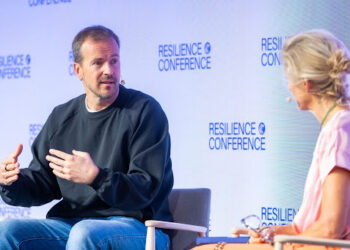
Touchwaves' founders Martin Romero and Charlotte Kjellander

Touchwaves' founders Martin Romero and Charlotte Kjellander

Share on Linkedin

Touchwaves, a Dutch company building wearable haptic systems for aerospace and defence, has been selected by General Atomics Aeronautical Systems through its Blue Magic Netherlands venturing initiative. The company is one of six companies chosen out of a pitch event focused on the Dutch aerospace and defence community. What’s most interesting, however, is their origin story that took them out of academia and into a drone cockpit.

You Might Also Like

Nordic Air Defence demonstrates a super-fast, super-light drone designed to destroy other drones

Software before drones: Dutch defence ministry bets on interoperability

Leading Defence Investors Join Resilience Conference London

The roots of the technology go back more than a decade. Touchwaves co-founder Martin Romero said that the company spun out of the Netherlands Organisation for Applied Scientific Research or TNO, a group focused on health, safety, and digital security.  His cofounder and CEO, Charlotte Kjellander, had been developing wearables at TNO for more than 15 years, and these use cases, essentially haptics to help folks in high-pressure situations understand data more completely. The problem, said Romero, then was that the components and technology were not ready.

The goal was to add haptic feedback to complex data. When a pilot pulled back on their stick, instead of a simple dial spinning in front of them they would feel vibrations up their back. If they dove, the reverse happened. Targeting systems could be wired to shoulder-mounted haptics to warn of incoming aircraft and warnings could be felt and not just heard.

But there was one problem: the tech was too bulky.

“The right technology to integrate into these environments was just not available,” he said. The systems strapped to the pilot’s body and were as heavy as early VR gear, making it a difficult sell in situations where mobility and weight were an issue. Over ten years later, however, things have changed. Today, said Romero, printed electronics, lightweight motors, and stretchable materials make it possible to build the system into garments weighing less than 200 grams.

For Touchwaves, that turns haptics into a wearable battlefield interface. Soldiers and pilots do not need another screen. They need information they can understand instantly while their eyes and ears are already overloaded. The technology adds touch as another channel rather than replacing what pilots already see or hear.

“We are not going to replace the visual or auditory alarms that the pilot already has,” Romero said. “But on top of that, we are going to give them this tactile communication.” In one example, if a drone is being targeted by an interceptor, the operator may see a warning on a screen but not immediately understand the direction of the threat. As mentioned before, Touchwaves can deliver a tactile cue on one side of the body, allowing the pilot to react faster and manoeuvre away.

The strongest validation, Romero said, has come from operators themselves. Two weeks before we spoke, Romero met a Ukrainian pilot and explained the system at an event. “After a minute and a half, the pilot said, ‘Oh, I need this,’” Romero recalled. “It was very, very clear.” The pilot told him the amount of information coming through screens was so great that he was “most probably” going to miss something, and then began suggesting other applications for the technology.

“The amount of information that the operator is getting is increasing with AI and all the new technologies,” Romero said. “But the performance of the human somehow is still the same.” Touchwaves is trying to make the operator’s life easier by moving some of that information onto their other senses.


Tags: HapticsTouchwaves
Previous Post

National defence requires much better cybersecurity advice for citizens

Next Post

Nordic Air Defence demonstrates a super-fast, super-light drone designed to destroy other drones

John Biggs

John Biggs

John Biggs is an entrepreneur, consultant, writer, and maker. He spent fifteen years as an editor for Gizmodo, CrunchGear, and TechCrunch and has a deep background in hardware startups, 3D printing, and blockchain. His work has also appeared in Men’s Health, Wired, and the New York Times. He has written nine books including the best book on blogging, Bloggers Boot Camp, and a book about the most expensive timepiece ever made, Marie Antoinette’s Watch. He lives in Brooklyn, New York. He runs the Keep Going podcast, a podcast about failure. His goal is to share how even the most confident and successful people had to face adversity.

Related News

Nordic Air Defence demonstrates a super-fast, super-light drone designed to destroy other drones

Nordic Air Defence demonstrates a super-fast, super-light drone designed to destroy other drones

byJohn Biggs
July 6, 2026

Swedish aerospace startup Nordic Air Defence has publicly demonstrated its K100XR counter-drone interceptor for the first time, showing the system...

Nexus by Intelic

Software before drones: Dutch defence ministry bets on interoperability

byPaul Sawers
July 3, 2026

Most militaries buy hardware first and work out how to make it talk to everything else afterwards. The Dutch Ministry...

Iceye, the Finnish satellite startup, nabs €1B at a €10B valuation amid growing demand for space intel

Leading Defence Investors Join Resilience Conference London

byLeslie Hitchcock
July 3, 2026

Capital is as critical to the future of defence as technology. Resilience Conference London is pleased to welcome three leading...

Six Robotics CEO Christian Fredrik Eggesbø

Six Robotics raises €12M to help individual drones work as a team

byPaul Sawers
July 3, 2026

Coordinating a swarm of drones to operate as a single force is one of the harder problems in modern unmanned...

Defence Tech Valley 2025: Kicking Around Military Innovation at a Football Pitch

Ukraine opens controlled exports for domestic defense tech

byJohn Biggs
July 2, 2026

The Ukrainian Cabinet of Ministers has officially approved the "first transparent mechanism for exporting domestically produced defense technologies." The plan,...

Quantum Systems Raises €160M to Expand AI Drone Production

Quantum Systems valued at $8bn after landmark $1.2bn funding round

byCarly Page
July 2, 2026

German defence technology company Quantum Systems has raised $1.2 billion (£880 million) to accelerate its ambition of becoming one of...

Big Ben, London

The UK DIP Shows why the tech sector matters

byLeslie Hitchcockand1 others
July 1, 2026

The long-awaited UK Defence Investment Plan (DIP) was announced yesterday morning at a drone manufacturing centre in Swindon. Keir Starmer's...

a padlock on a red, blue, and pink background

JLR hack attribution turns spotlight on Britain’s offensive cyber capability

byCarly Page
July 1, 2026

The UK has quietly mounted offensive cyber operations against Russia, according to former British and American intelligence officials cited by...

Load More
Next Post
Nordic Air Defence demonstrates a super-fast, super-light drone designed to destroy other drones

Nordic Air Defence demonstrates a super-fast, super-light drone designed to destroy other drones

Most viewed

InVeris announces fats Drone, an integrated, multi-party drone flight simulator

Uforce raises $50M at a $1B+ valuation to build defence tech for Ukraine

Auterion, the drone software startup, eyes raising $200M at a $1.2B+ valuation

Palantir and Ukraine’s Brave1 have built a new AI “Dataroom”

Twentyfour Industries emerges from stealth with $11.8M for mass-produced drones

Senai exits stealth to help governments harness online video intelligence

Resilience Media is an independent publication covering the future of defence, security, and resilience. Our reporting focuses on emerging technologies, strategic threats, and the growing role of startups and investors in the defence of democracy.

  • About
  • News
  • Resilence Conference
    • Resilience Conference Copenhagen 2026
    • Resilience Conference Warsaw 2026
    • Resilience Conference 2026
  • Guest Posts
  • Subscribe
  • Privacy Policy
  • Terms & Conditions
  • Mission Statement & Code of Practice
  • Press

© 2026 Resilience Media

No Result
View All Result
  • Home
  • About
  • Subscribe
  • Events
  • Guest Posts
  • Interview
  • News
  • Resilience Conference London 2026
  • Resilience Conference Copenhagen 2026
  • Resilience Conference Warsaw 2026

© 2026 Resilience Media

This website uses cookies. By continuing to use this website you are giving consent to cookies being used. Visit our Privacy and Cookie Policy.