Plymouth-based robotics company Oshen has raised $5 million to ramp up production of its autonomous ocean robots as demand grows from defence and weather agencies.
The round was led by Lunar Ventures, with backing from AlbionVC, Twin Track and Concept Ventures. Oshen said the money will fund manufacturing expansion and build capabilities in passive acoustics, subsea infrastructure protection, and anti-submarine warfare.
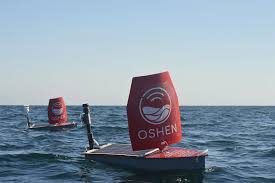
Its C-Stars are small wind- and solar-powered vessels designed to spend months at sea while collecting sensor data and sending it back via satellite. At around 1.2 metres long, they can be deployed by a single person and used in groups to cover large stretches of ocean.
Oshen is already working with the US Navy’s Naval Meteorology and Oceanography Command and the Royal Navy, alongside organisations including NOAA, the Met Office and Météo-France.
The company has also been putting the vessels through some fairly unforgiving tests. Three C-Stars sailed into Category 5 Hurricane Humberto in the Caribbean last September, sending back data from inside the storm every two minutes. Oshen said they were the first uncrewed surface vessels to collect and transmit data from inside a Category 5 hurricane.
Defence work includes a UK Defence and Security Accelerator-backed project exploring the use of C-Stars as a distributed passive acoustic network alongside ZeroUSV and MarineAI. The vessels have also been autonomously deployed at sea from an uncrewed mothership.
Oshen now needs to build them much faster. It took three years to produce its first 15 C-Stars; the Plymouth operation can now turn out 15 every six weeks, with another 100 vessels on order.
The company has also expanded from seven employees in September 2025 to almost 30.
“We’re making the ocean’s eyes and ears, and we need a lot of them,” said CEO and co-founder Anahita Laverack. “70% of the planet is ocean and we can barely see any of it in real time.” Competitors include the likes of Saildrones and Open Ocean Robotics.
Companies like Kraken, which hit “unicorn” valuation status in July 2026 when it raised $175 million, points to the need in the market right now for more autonomous technology for marine environments. In cases where navies are looking to keep watch over submarines, subsea cables and increasingly busy stretches of ocean, Oshen is betting that part of the answer lies not in another handful of expensive platforms, but in putting many more small ones in the water.