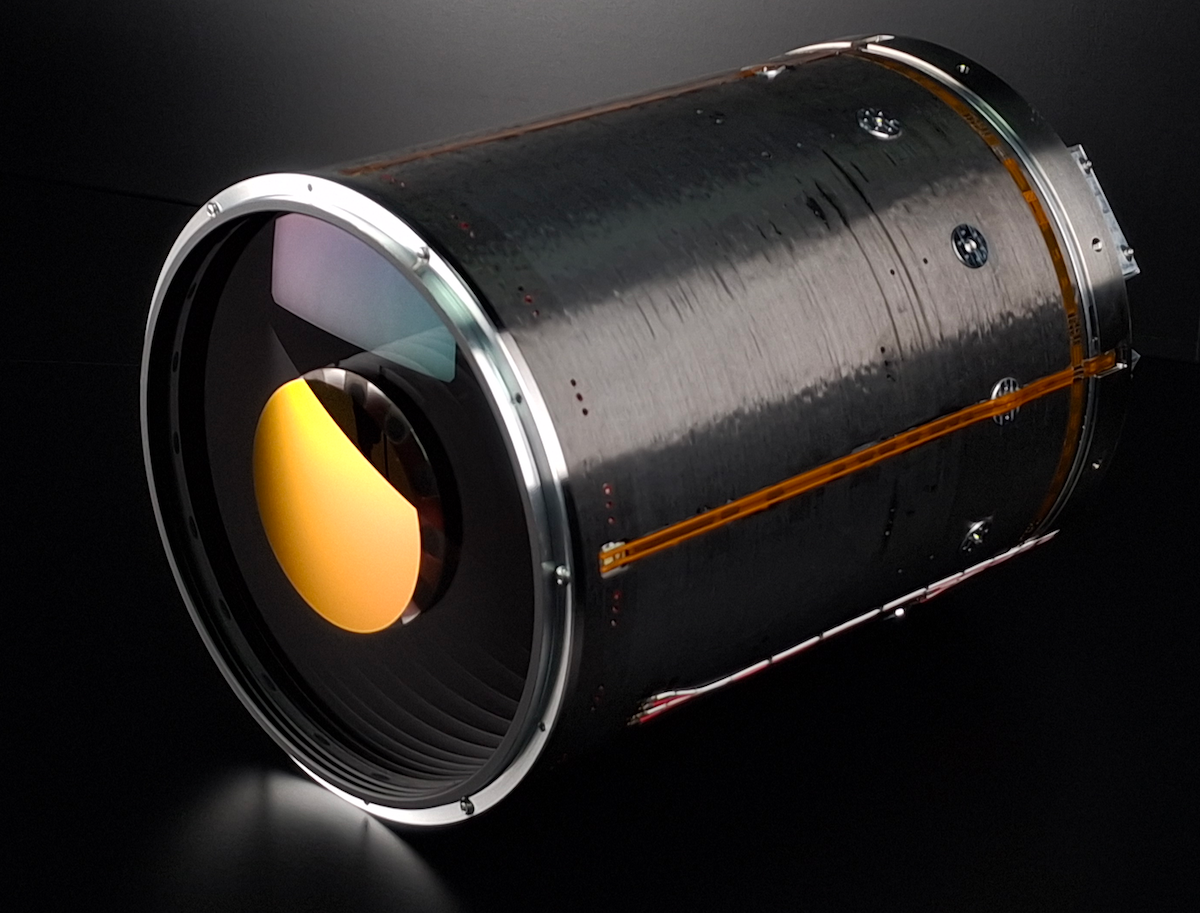
Belgium-based Simera Sense is pushing further into the space market with the xScape200 Dual-Use, a new version of its compact Earth observation camera designed to serve commercial, government, security, and defence customers with the same basic platform. The xScape200 Dual-Use provides a 1.5-metre ground sampling distance from an altitude of 500 km, while the entire payload weighs just 9.3 kg and fits within a 12U volume. This means it can capture tiny details from low Earth orbit using a camera system housed in a package about the size of a standard toaster.
The xScape200 Dual-Use is based on Simera Sense’s existing xScape200. The previous model offered the same 1.5-metre resolution, but its detector came with end-use restrictions that prevented military applications. The new system uses a US-made detector without that restriction, allowing the same platform to serve both commercial and military customers.
The goal is to bring high-resolution imaging to smaller satellites that have historically depended on heavier and larger imaging systems. Because they are not primarily military-focused the cameras can be used by nearly every industry.
“[The camera] has a wide range of applications for a wide range of industries, from defence to environmental monitoring. It gives operators much more flexibility than they have been used to. Operators can now use the same compact platform across commercial, government and security applications without compromising on its 1.5 m resolution,” said Johann du Toit, CEO of Simera Sense.
Simera Sense has replaced parts of the structure with carbon fibre, increased vibration tolerance, added shielded electrical connectors, removed magnetic structural materials, and improved electromagnetic compatibility and interference performance. The company also sees the payload as particularly useful for constellations, where operators can distribute imaging capability across many smaller satellites rather than relying on a few large spacecraft.
With this approach, satellite makers can use smaller spacecraft equipped with capable high-resolution cameras. This allows imaging capacity to be spread across a larger constellation instead of concentrated in a small number of expensive platforms.
Larger constellations can observe the same areas more often, giving operators access to newer imagery when conditions change quickly. Individual satellites can also be replaced, or additional units launched, without requiring major changes to the rest of the system. Finally, remote focusing allows for more nuanced pitcures and video. All of this is especially useful for intelligence, surveillance, and reconnaissance missions, where getting a recent image can be just as important as getting one at very high resolution.