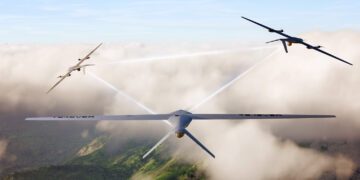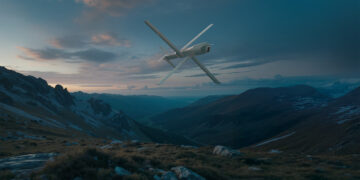
Former Ukrainian Defense Minister Mykhailo Fedorov has launched Army of Robots, a private-sector initiative intended to accelerate the development and battlefield deployment of robotic systems.
“Our bet is on the robotization of warfare,” Fedorov wrote on LinkedIn. “The mission of the Army of Robots is to save lives.”
There is, so far, not much detail on whether this is primarily an investment vehicle, or a roll-up business, or a little bit of both. The homepage for Army of Robots includes both a callout looking for engineers and a CTO/tech lead as well as connections with existing robotics companies. The site describes its mission as a “Manhattan Project for physical AI.”
Army of Robots follows Fedorov’s announcement in late August that he planned to start a broader defense-tech investment venture focused on battlefield robotics, interceptor drones and AI-guided missiles. We have contacted Army of Robots to ask for clarification on whether it is connected to the investment venture, as well as other details on who is financing it.
“Humanoid robots should evacuate the wounded and deliver ammunition,” Fedorov noted in the LinkedIn announcement. “Lay and clear mines. Conduct reconnaissance. Defend positions. Strike targets. Be the first to enter places where today we put our service members’ lives at risk.”
A promotional concept video for the initiative depicts a wide range of battlefield robots: humanoids,UGVs, spider-like crawlers, and quadrupedal “dogs” (one of which is depicted running under a vehicle and detonating a mine).
The video also highlights the importance of sensor networks to the robot warfare concept, depicting small microphone arrays and cameras.
Why robots?
Ukraine faces severe manpower constraints across all parts of the front, with understaffed units and shortages of reservists, coupled with an unpopular conscription policy. This leaves personnel exposed to prolonged periods of combat and increasing cumulative fatigue.
Robots, of course, do not experience psychological combat fatigue and the logic is that, when a robot is destroyed, a new one can be built. A human by contrast cannot be replaced.
“We will invest in defense tech companies, launch our own technology projects, build R&D capabilities, test solutions alongside the military and scale as quickly as possible whatever proves effective on the battlefield,“ Fedorov noted in his Linkedin post.
Challenges remain, however. Russia has learned to copy and scale the military innovations it encounters on the Ukrainian battlefield. Weaponized FPV drones, pioneered at scale by Ukrainian forces, were subsequently adopted in enormous numbers by Russia, which has used its larger industrial base to mass-produce them. Moscow has also imitated Ukraine’s innovations in force structure.
Robotics is an opportunistic bet for Fedorov’s first outing into the private market after his departure from public office.
One of the notable initiatives in Ukraine’s defence forces when Fedorov was still a minister (at the time of Digital Transformation) was the “Army of Drones” project that transformed a UNITED24 subproject into a major state programme for the development of national UAV production — increasing the number of drones at the front tenfold. These days, there is arguably an oversupply of drone companies, if not drones themselves, which are being produced in the millions annually due to the attritable nature of most of them.
Ukraine’s UAV sector has now matured into an industry of hundreds of manufacturers – with hundreds more outside of the country also vying for business. There is still a lot of investment being made into these companies – to the tune of billions collectively, as the most popular investment category in defence tech. But increasingly that is now getting accompanied also by consolidation and a push toward domestic component production. Recent examples include Ukrainian-founded Swarmer’s agreement to acquire UGV manufacturer Ratel Robotics for up to $224 million, while German drone maker Stark has acquired autonomous-navigation startup Pleno and manufacturing specialist AeroMass Technologies.
Robotics, by contrast, remains considerably less mature. That could leave greater room for investors to back new platforms — rather than another entrant in an already crowded UAV market.
“Robotics is one of the areas where we see an opportunity to achieve the next technological breakthrough,” said Fedorov in his LinkedIn post.
Milestones
Even at this early stage, Fedorov appears to be tying the initiative to measurable milestones.
Army of Robots aims to achieve its first confirmed kill with a humanoid robot within six months, he noted. Within a year, it plans to conduct an assault in which robots perform the most dangerous tasks without direct infantry involvement.