100 investors to watch 2026 100 investors to watch 2026 100 investors to watch 2026
Tuesday 6 October, 2026
[email protected]
Resilience Media
  • News
    • Events
    • Interview
    • Startups
    • Venture
    • Weekly Digest
  • Resilience Conference
    • Resilience Conference London — Oct 2026
    • Resilience Conference Copenhagen — May 2026 (PAST)
    • Resilience Conference Warsaw — Apr 2026 (PAST)
  • Launch
  • About
  • Guest Posts
    • Author a Post
  • Subscribe
No Result
View All Result
  • News
    • Events
    • Interview
    • Startups
    • Venture
    • Weekly Digest
  • Resilience Conference
    • Resilience Conference London — Oct 2026
    • Resilience Conference Copenhagen — May 2026 (PAST)
    • Resilience Conference Warsaw — Apr 2026 (PAST)
  • Launch
  • About
  • Guest Posts
    • Author a Post
  • Subscribe
No Result
View All Result
Resilience Media
No Result
View All Result

USEUCOM builds new ‘front door’ for European defence tech

The US military command is building a clearer route for startups, investors and new technologies into experiments – and ultimately the Pentagon

Carly PagebyCarly Page
October 6, 2026
in News
Share on Linkedin

US European Command is reshaping how it finds, tests and champions new technology in Europe, after acknowledging that startups have historically had no obvious route into the organisation.

You Might Also Like

Buntar Aerospace raises $16M led by Freedom Fund

GCHQ head warns AI advances are exposing Britain’s legacy systems

NATO can’t wait for a sovereign European AI stack

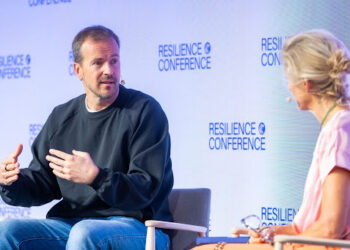
Speaking at the Resilience Conference this week, Sally Pfenning, director of Requirements and Resource Integration at USEUCOM, described how the command is building a more structured approach to working with industry, investors, and organisations such as NATO DIANA.

Pfenning, who joined USEUCOM in her current role around two and a half years ago, said one of the first questions she faced was who within the command was engaging with European industry and startups.

“I just looked at her and said, ‘I don’t know,’” Pfenning recalled. She then asked colleagues across the command the same question. “And the answer was, ‘I don’t know.’”

That prompted discussions across the Pentagon, including with the Defense Innovation Unit, about how USEUCOM could provide a clearer entry point for companies unsure where their technology might fit.

The command is now organising that work around four areas spanning mission engineering and analysis, requirements, experimentation and capability innovation.

Part of the aim is to give USEUCOM better evidence when it takes capability requirements back to Washington. Pfenning said the command wants modelling and simulation tools that allow technologies to be assessed virtually before moving into physical experimentation.

“At the end of the day, what I want to do is I want to walk into the Pentagon and […] throw down a ‘you can’t say no to this solution’ on the table that makes sense to everybody,” she said.

Europe itself also offers an unusual environment for putting technology through its paces. Pfenning pointed to electronic warfare activity on Finland’s borders as one example, describing Europe as a “test experiment range that exists nowhere else in the world like this”.

But the answer is not simply to run more trials. Pfenning said USEUCOM wants to better understand and streamline experimentation already taking place across the theatre, recounting one conversation in which she was told: “We probably got into too many things, and maybe not the most valuable things.”

The command is also rethinking how it engages with investors. Pfenning admitted her initial reaction when somebody suggested doing so was: “I can’t do that. That’s impossible.”

“We had to kind of break through that mindset internally,” she said, noting that USEUCOM already routinely works with contractors and companies.

Rather than relying on large industry events, Pfenning said the focus should be on identifying specific technical problems and assembling smaller groups of relevant companies, investors and military operators to work through them.

That includes taking classified operational problems and, where possible, reducing them to a level that can be discussed with industry.

“How can we help you point you in the right direction for experiments?” Pfenning asked. “How can we help you if you think you’re onto something that we haven’t thought about?”

Getting successful technology through acquisition remains another challenge. Pfenning highlighted the US Army’s acquisition presence in Europe as a model she wants other services to follow.

On wider Pentagon acquisition reforms, however, she was more cautious. “I think with the PAEs versus PEOs, that still remains to be seen how much power those individuals will actually be given,” she said. “The theory is fantastic.”

For USEUCOM, the immediate task is more practical: make it clearer where companies should go, concentrate experimentation on the problems that matter, and build a stronger case when promising technology needs Pentagon backing.

Tags: Resilience ConferenceUSEUCOM
Previous Post

NATO can’t wait for a sovereign European AI stack

Next Post

GCHQ head warns AI advances are exposing Britain’s legacy systems

Carly Page

Carly Page

Carly Page is a freelance journalist and copywriter with 10+ years of experience covering the technology industry, and was formerly a senior cybersecurity reporter at TechCrunch. Bylines include Forbes, IT Pro, LeadDev, The Register, TechCrunch, TechFinitive, TechRadar, TES, The Telegraph, TIME, Uswitch, WIRED, & more.

Related News

Buntar Aerospace raises $16M led by Freedom Fund

Buntar Aerospace raises $16M led by Freedom Fund

byFiona Alston
October 6, 2026

Buntar Aerospace -- a Ukrainian company that has developed an intelligence, surveillance, and reconnaissance (ISR) platform and corresponding reconnaissance drone...

GCHQ head warns AI advances are exposing Britain’s legacy systems

GCHQ head warns AI advances are exposing Britain’s legacy systems

byCarly Page
October 6, 2026

Britain's legacy technology is already being exposed by rapid advances in AI, GCHQ director Anne Keast-Butler has warned, as the...

NATO can’t wait for a sovereign European AI stack

NATO can’t wait for a sovereign European AI stack

byCarly Page
October 6, 2026

NATO does not have time to wait for Europe to build a fully sovereign technology stack before preparing for a...

Auterion launches vendor-agnostic vertical drone launcher

Auterion launches vendor-agnostic vertical drone launcher

byJohn Biggs
October 6, 2026

German defence software company Auterion has introduced a modular vertical launch system designed to deploy several types of drones from...

Helsing’s chief scientist says defence startups can snag top tech talent

Helsing’s chief scientist says defence startups can snag top tech talent

byIngrid Lunden
October 5, 2026

The driving force of AI in defence tech has been well-documented: autonomy, predictive intelligence, systems used to break through (or...

Terra CEO Nathan Nwachuku with Dominion Dynamics CEO Eliot Pence on stage at Resilience Conference

Terra cuts China from supply chain in push for ‘parallel’ Global South defence ecosystem

byPaul Sawers
October 5, 2026

Nigerian defence startup Terra Industries is building a network of suppliers and technology companies across the Global South. Its mission...

Taavet Hinrikus: the procurement shift in Europe is happening too slowly

Taavet Hinrikus: the procurement shift in Europe is happening too slowly

byStanislaw Naklicki
October 5, 2026

European governments are adapting to the outpour of defence start-ups on the continent, but are doing so too slowly, said...

Auterion and Airlogix take Ukraine’s defence production model global

Auterion and Airlogix take Ukraine’s defence production model global

byCarly Page
October 5, 2026

Auterion and Airlogix are looking to replicate their German manufacturing partnership across Europe and North America, as the companies race...

Load More
Next Post
GCHQ head warns AI advances are exposing Britain’s legacy systems

GCHQ head warns AI advances are exposing Britain's legacy systems

Buntar Aerospace raises $16M led by Freedom Fund

Buntar Aerospace raises $16M led by Freedom Fund

Top stories

Dark digital map of north-western Europe
European Defence

State of Defence Tech 2026: European defence startup funding to quadruple to $10.5B

October 5, 2026
Matrix movie still
Cyber

Exclusive: Osavul snaps up $10M to expand its hybrid threat detector tech to more users

October 1, 2026
The London Defence Tech Week programme is here
Events

The London Defence Tech Week programme is here

September 17, 2026
Two drone startups team up to demonstrate connected autonomy at sea
News

Two drone startups team up to demonstrate connected autonomy at sea

September 29, 2026

Resilience Media is an independent publication covering the future of defence, security, and resilience. Our reporting focuses on emerging technologies, strategic threats, and the growing role of startups and investors in the defence of democracy.

  • About
  • News
  • Resilence Conference
    • Resilience Conference Copenhagen 2026
    • Resilience Conference Warsaw 2026
  • Guest Posts
  • Subscribe
  • Privacy Policy
  • Terms & Conditions
  • Mission Statement & Code of Practice
  • Press

© 2026 Resilience Media

No Result
View All Result
  • Home
  • About
  • Subscribe
  • Events
  • Guest Posts
  • Interview
  • News
  • Resilience Conference London 2026
  • Resilience Conference Copenhagen 2026
  • Resilience Conference Warsaw 2026

© 2026 Resilience Media

This website uses cookies. By continuing to use this website you are giving consent to cookies being used. Visit our Privacy and Cookie Policy.