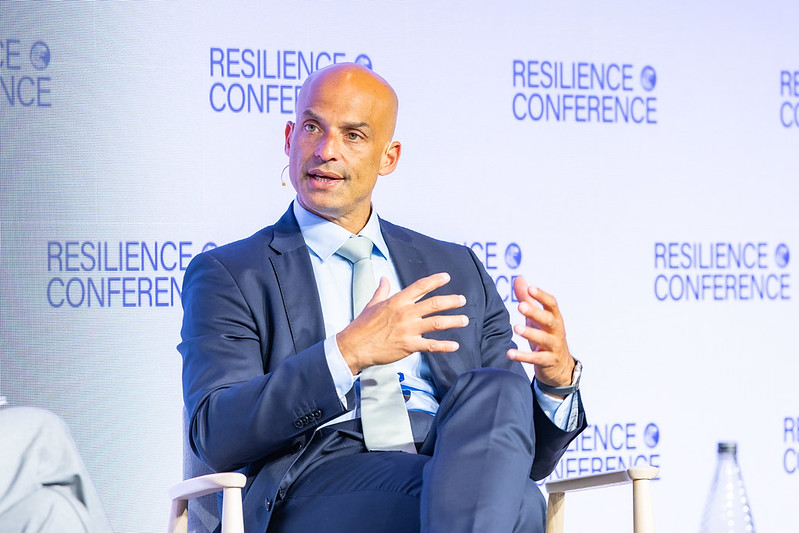
NATO does not have time to wait for Europe to build a fully sovereign technology stack before preparing for a potential conflict with Russia, according to James Appathurai, the Alliance’s deputy assistant secretary general for strategy and policy, cyber and digital transformation.
Speaking at Resilience Conference on Monday, 5 October, Appathurai said the Alliance is having to work to two different timelines: getting the best available AI and data into the hands of warfighters now, while building a more sovereign and resilient architecture for the future.
“We have direction to be ready to fight a defensive war soon, and that timeframe, very frankly, has been brought forward because of the circumstances in which we find ourselves,” Appathurai said.
NATO therefore needs to ensure warfighters and decision makers have the technology to be “ready to fight tonight”, he said, even as member states pursue greater technological sovereignty.
Russia is driving the urgency, which Appathurai said has built a war economy and oriented much of its society toward conflict. NATO commanders consequently want a functioning transatlantic warfighting cloud capable of moving data “from sensor to shooter and across borders”.
But the reliance on American technology required to make that happen is causing unease in Europe.
“There are concerns in European countries about a kill switch, about over reliance on the US tech stack,” Appathurai said.
NATO is responding by deliberately building a federated architecture rather than relying on one country or system. The Alliance has adopted Palantir’s Maven Smart System within its command structure, but Appathurai stressed it would sit alongside technology from multiple countries on both sides of the Atlantic.
That provides political reassurance but also resilience if infrastructure is attacked. “In the event of combat, things are going to be targeted, and that includes data centres,” he said.
Building an entirely European alternative in the meantime is not realistic, however.
“In the timeframes that we have to be able to fight effectively, there is not going to be a sovereign European tech stack that can replace all the capability,” Appathurai said. “We need to do this in a transatlantic way.”
Ukraine has already demonstrated why NATO believes it cannot hang around. Appathurai said the debate over whether AI should be used on the battlefield had been “totally overtaken by reality”, with extensive jamming pushing warfare towards a “post-GPS environment” increasingly dependent on AI, optical sensors and mesh networks.
Appathurai also said the emergence of frontier AI models had given NATO’s responsible AI principles new relevance, particularly in cybersecurity.
“These frontier models are starting to do things that we didn’t necessarily expect them to do,” he said. NATO is running them on its networks “in very controlled ways”, including to help patch vulnerabilities quickly.
Principles including transparency and reversibility were therefore proving useful for controlling how such models are deployed, he added.
The next problem is turning a booming defence technology ecosystem into companies capable of supplying those systems at scale.
Appathurai, who previously served as managing director of NATO’s DIANA defence innovation accelerator, said the Alliance had helped “1,000 flowers to bloom”, but militaries increasingly need “trees”.
“They just cannot contract with 10,000 companies,” he said.
For NATO, that means the next phase is not simply finding promising AI startups, but helping them scale, merge where necessary and work with established defence companies to make their technology “ready for war fighting.”