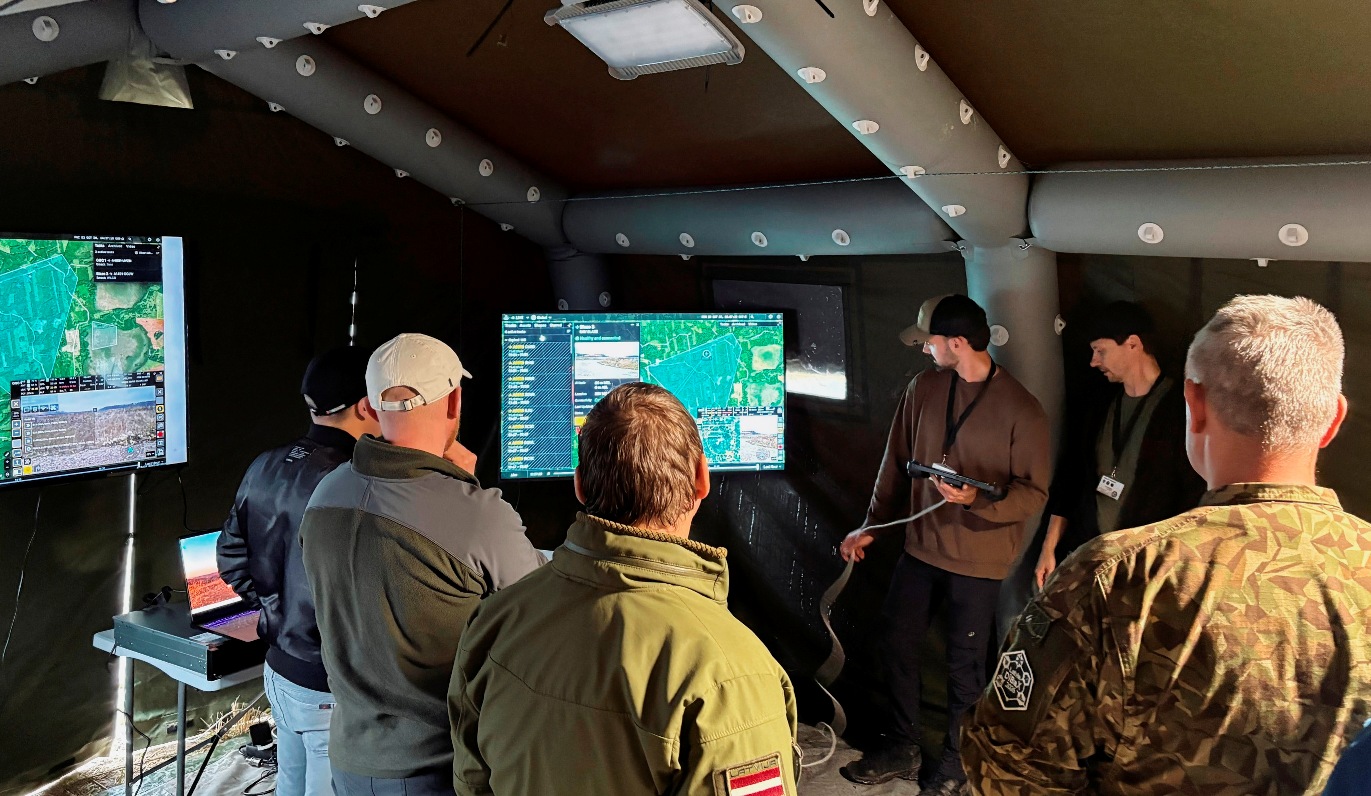
Some six weeks after first announcing plans to integrate their counter-drone and command-and-control systems, Latvian robotics company Origin and US defence tech giant Anduril have confirmed the first fruits of the partnership, demonstrating the combined capability to senior Latvian military leadership.
As Resilience Media reported in late September, the two companies signed a memorandum of understanding (MoU) in Los Angeles, during a Latvian business trade mission to the US accompanying President Edgars Rinkēvičs’ official visit. The agreement centred on integrating Origin’s Blaze interceptor with Anduril’s Lattice command-and-control platform.
At the time, the companies said they would carry out joint testing and demonstrations to see how the systems could work together as part of a broader air-defence setup.
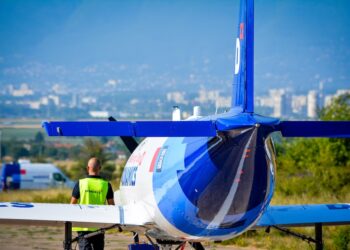
According to a press release issued to Resilience Media, they completed that first demonstration at the end of October at an unnamed military training facility in Latvia, with Blaze connected to Lattice alongside an existing radar system already used for Latvian air defence.
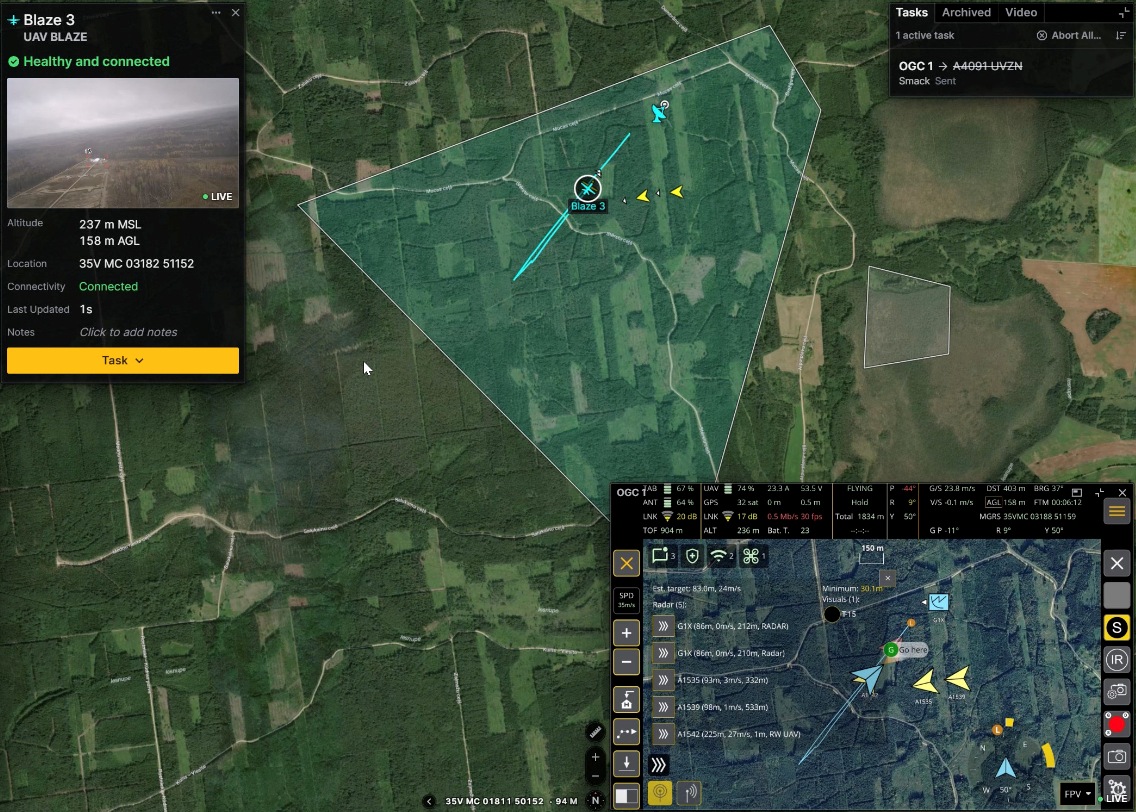
Origin commercial director Mārtiņš Marenis tells Resilience Media that the demonstration involved a live airborne intercept, with a ground-based radar detecting the target before Lattice passed the track to Blaze. The interceptor then engaged the drone in the air, with a human operator remaining in the loop throughout.
“The demonstration took place in normal daytime conditions using a standard military training target drone with a wingspan of approximately 2 metres,” Marenis says.
Brian Moran, vice president of Anduril Europe, says the technical integration took just four days, culminating in a live engagement that linked the radar, Lattice, and Blaze.
“Lattice gave us the foundation to integrate different capabilities, fuse their data, and present operators with a single, coherent picture,” Moran said in a statement.
Latvia’s counter-drone urgency
For Latvia, the ability to detect and stop hostile drones has become an immediate defence concern. Back in May, several drones entered Latvian airspace from Russia, with two coming down in the country and one crashing into an oil storage facility. The episode prompted questions over Latvia’s ability to identify and intercept small airborne threats close to its eastern border.
That pressure sits within a wider push across NATO’s eastern flank, where countries closest to Russia are putting more money into defence and emerging military technologies, as Resilience Media reported last week. Latvia is spending close to 5% of GDP on defence in 2026, while counter-drone technology has become one of the region’s fastest-growing areas for investment. Companies across the region have also been securing orders from military customers and testing technology against lessons emerging from Ukraine.
Latvia has been investing in infrastructure around that effort, too. In October, its defence ministry and UniLab launched a programme backing 12 local defence and dual-use startups, several working on drone detection, interception and autonomous systems. And earlier this week, LMT Group, Latvia’s Institute of Electronics and Computer Science and NestAI launched AlliedTechLabs, a new international centre intended to give NATO, allied operators and industry a place to develop and test defence and dual-use technology in realistic conditions.
That makes the Origin-Anduril tie-up particularly pertinent to what Latvia and its NATO neighbours are striving to achieve: connecting sensors, command software and interceptors so that an incoming threat can be detected and engaged through the same system.
For now, however, the demonstration has yet to produce an order, though it is still early in the process. “No procurement commitments have been made at this stage,” Marenis says.
That leaves procurement and configuration decisions with prospective military users, while Origin and Anduril continue testing the combined setup.
“From a technical perspective, the systems could be fielded together immediately,” Marenis adds. “Further work would mainly focus on integrating additional sensors and effectors depending on the specific operational requirements of the end user.”