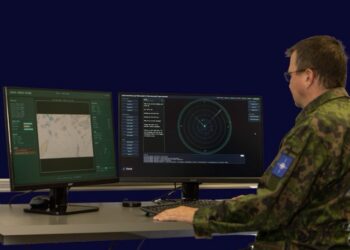
“Innovation” has become one of the most casually abused terms in defence circles. It appears in speeches, strategies, and budget justifications as if its mere invocation confers virtue. But innovation is not a branding exercise; it is a hard, often uncomfortable operational requirement. Ukraine and Russia are experiencing this truth at tremendous cost.
In a world where technological diffusion accelerates, adversaries iterate faster than Western bureaucracies, and battlefield advantage is measured in hours, innovation is a matter of survival. Nations that fail to adapt at speed will be outpaced, out-learned, and ultimately outfought. In a multinational coalition, those that fail to keep pace become a liability to the entire Alliance.
A New Battlespace Reality
The global security environment has shifted from predictable, industrial age competition to a fluid, multi domain contest where commercial technology, data, and autonomy shape outcomes as much as traditional force structure. Adversaries are not waiting for Western procurement cycles to catch up. They are exploiting open-source tools, dual use technologies, and rapid iteration to compress decision timelines and impose dilemmas on a scale never seen before. In this environment, innovation is not about gadgets or slogans; it is about organizational behavior, decision velocity, and the ability to translate ideas into operational advantage.
Perverse Incentive Structures
Peacetime militaries rarely innovate effectively because their institutional DNA is fundamentally at war with the behaviors that innovation demands. Bureaucracies do not optimize for lethality or agility; they optimize for predictability, compliance, and risk elimination. In the quiet interwar years, the primary directive shifts from defeating an adversary to defending the budget line. While this may be an uncomfortable truth, Western military forces are currently neither incentivized nor empowered to make the changes necessary to keep pace with the changing character of war
This systemic inertia is driven by three perverse incentive structures:
- The Compliance Personnel Engine: Career Management Systems do not reward the disruptive iconoclasts required to pioneer new concepts of operation. Instead, they promote the programmatic steward, officers who master the art of “doing no harm” and keeping multi-billion-dollar legacy programs on life support. Conformity becomes a prerequisite for promotion. In the past, innovators were court-martialed and punished for thinking outside the box.
- The Tyranny of the Requirements Process: The defence acquisition system operates on a glacial timescale. It privileges rigid adherence to decades-long procurement cycles over technological relevance. By the time a capability survives the bureaucratic gauntlet of a nation’s requirements process, the threat it was designed to counter has already evolved, rendering the final product an expensive monument to yesterday’s problem.
- The Luxury of Slow Adaptation: Historically, military organizations are deeply conservative institutions that only truly innovate when the alternative is annihilation. It takes the shock of battlefield failure or an unmistakable existential threat to shatter bureaucratic comfort. Absent that external catalyst, “innovation” becomes a buzzword, a superficial veneer applied to the existing status quo rather than a structural overhaul.
The hard truth is that Western militaries are currently trapped in an incumbency mindset. They are neither culturally incentivized nor structurally empowered to execute the radical pivots required by the changing character of war. Until the ministries of defence penalize bureaucratic cowardice more than they penalize calculated, creative failure, well-intentioned innovation initiatives will continue to be smothered by the very systems meant to foster them.
Ukraine’s Wartime Learning Model
Ukraine offers the clearest contemporary example of wartime innovation despite what pundits have argued. Under existential pressure, Ukrainians innovated out of sheer survival. They collapsed decision cycles, empowered junior leaders, fused commercial technology with military operations, and iterated in real time under fire. The Ukrainian experience fundamentally dismantles the Western illusion that modernization is synonymous with exquisite, expensive hardware.
It serves as a brutal reminder that true innovation is not a procurement process, it is a behavior. It is a cultural willingness to accept immense risk, tolerate failure, and prioritize immediate battlefield utility over bureaucratic perfection.
The Western Challenge: Wartime Speed Without Wartime Loss
The defining strategic dilemma for Western militaries is as urgent as it is paradoxical: How do you replicate the frantic velocity of wartime adaptation without first suffering the catastrophic verdict of a bloody opening broadside? To win the next war before the first shot is fired, the West must find a way to manufacture the urgency of an existential crisis within the rigid confines of peacetime governance.
The answer is deceptively simple, yet institutionally terrifying: hand the keys of innovation back to the warfighter. While acquisition bureaucrats, compliance lawyers, and program managers have a necessary role in sustaining the enterprise, they cannot be allowed to steer the vanguard. Security review boards and innovation management offices do not win wars; operators adapting to an asymmetric threat do.
NATO’s Eastern Flank Deterrence Initiative Breaks the Pattern
This is where NATO’s Eastern Flank Deterrence Initiative (EFDI) represents a genuine break from past practice. It is forcing the Alliance to behave less like a peacetime bureaucracy and more like a learning organization under pressure. The initiative is not another rhetorical commitment to readiness. It is a structural shift in how Allied Command Operations postures, senses, decides, and acts along its most exposed geography. It demands continuous adaptation rather than episodic modernization, and it is driving innovation as a daily operational necessity.
A New Architecture for Land Warfare
The operational reality unfolding across the European theater has made one truth undeniable: the traditional, industrial-age math of symmetric attrition is dead. The focus on deploying ubiquitous sensors, expendable unmanned systems, novel kinetic and non-kinetic effectors, and the resilient software networks that bind them reflects a fundamental, paradigm-shifting overhaul in NATO’s approach to land warfare.
Rather than attempting to match a mass-mobilized adversary platform for platform, hull for hull, the Alliance is moving away from the legacy obsession with heavy iron. Instead, it is building a distributed, software-defined warfighting architecture designed to secure a decisive asymmetric advantage along its Eastern flank.
This is the exact operational logic that Ukraine utilized to blunt, fracture, and dismantle a numerically superior Russian army. What was born out of raw desperation on the battlefields of the Donbas is now being adopted deliberately, systematically, and institutionally across the Alliance, spearheaded by Allied Land Command (LANDCOM). NATO is finally realizing that the future of deterrence does not lie in building a thicker shield, but in fielding a faster, more elusive, and highly adaptable network.
The Eastern Flank Deterrence Initiative is the first effort in decades that aligns NATO with this reality. It represents the first comprehensive operational effort in a generation that aligns the Alliance’s defensive posture with the frantic, volatile realities of modern conflict.
In doing so, it replaces an obsolete, two-step learning model – where a military forces an artificial pause to absorb lessons before slowly programming a response into the next budget cycle – with a philosophy of continuous readiness. This is deterrence predicated not on permanent infrastructure, but on an institutional capacity for rapid learning, real-time adaptation, and immediate technological exploitation.
Conclusion: The Proving Ground for a Fast-Learning Alliance
If NATO can sustain the friction and velocity of this trajectory, EFDI will achieve something far more profound than a localized fortification of European soil. It will become the definitive proving ground for a fundamentally new model of peacetime innovation, one that replaces bureaucratic rhetoric with battlefield results and transforms a historically slow-moving alliance into an agile, fast-learning institution.
For too long, Western defence modernization has been a performance art characterized by glossy strategy documents, hollow slogans, and boutique technology labs that rarely field capabilities at scale. EFDI cuts through that noise. It offers a blueprint for how a multinational coalition can shed its institutional sclerosis and adapt at the speed of relevance, even without the immediate catalyst of a hot war.
Its ultimate success will not be measured merely by the number of battalions arrayed in the East or the sophistication of the sensors deployed along the frontier. It will be measured by the cultural rewiring of the Alliance itself. By proving that NATO can out-think, out-pace, and out-learn its adversaries in peacetime, this initiative builds a framework for an entirely adaptive alliance. It sends a definitive message to autocrats everywhere that the West is no longer tethered to the slow cycles of industrial-age bureaucracy. Instead, it is forging a modern, data-centric warfighting enterprise—one capable of evolving under fire, dominating the cost curve, and securing a free and stable international order for decades to come.
The blueprint has been drawn, the laboratory is live, and the stakes could not be higher. Now, the Alliance must find the institutional courage to execute.
Matthew Van Wagenen is a retired major general in the U.S. Army, previously served as the Deputy Chief of Staff for Operations (DCOS OPS) in the NATO Supreme Headquarters Allied Powers Europe (SHAPE). Arnel P. David is a colonel in the U.S. Army currently serving as the director of the Digital Lethality Branch in the NATO Supreme Headquarters Allied Powers Europe (SHAPE). The views and opinions expressed are those of the authors and do not reflect any entity or organization of the US Government or NATO.