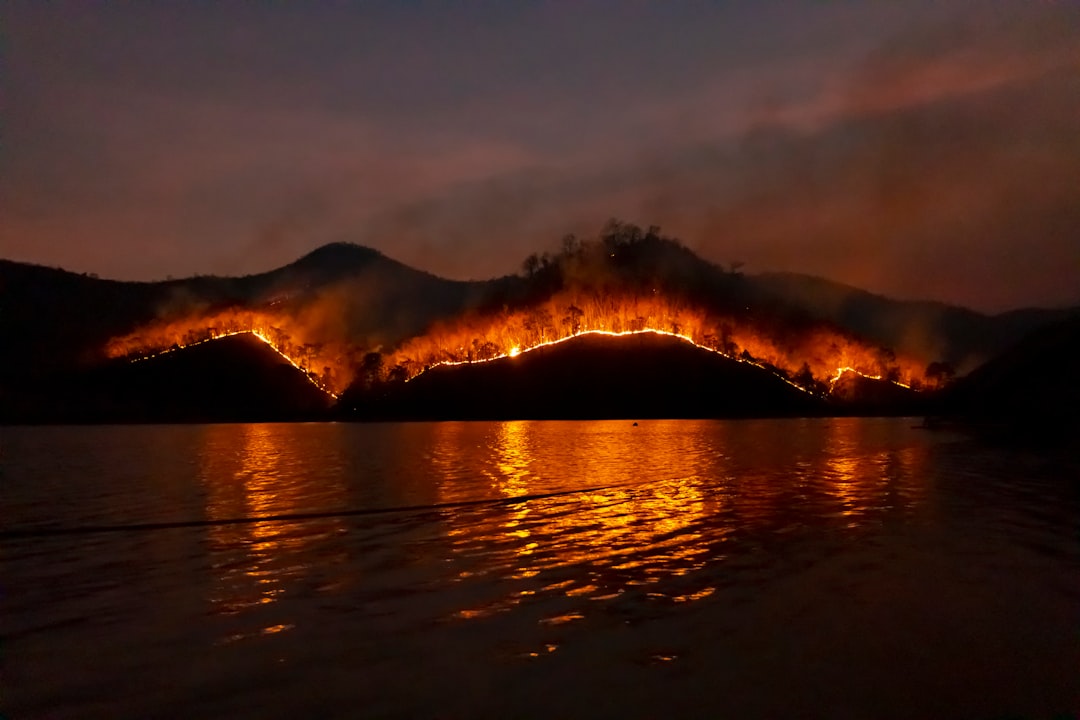
Europe is now recovering from its worst fire season on record — blazes in Cyprus, Greece, Portugal, Spain, and Turkey that were all made more likely by climate change, according to reports from the World Weather Attribution service, a joint program between Imperial College in London, Royal Netherlands Meteorological Institute, and the Red Cross Red Crescent Climate Centre.
While the readiness of the European Civil Protection and Humanitarian Aid blunted the potential death toll from the historically severe events, the fires still displaced tens of thousands in Spain and Portugal alone.
But the impact of these fires extends beyond civilian and economic ramifications. There are significant military consequences if Europe fails to address the new reality appropriately, as the former Bulgarian Minister of Environment and Waters, Julian Popov, recently warned.
“Europe’s security is no longer confined to conventional threats like tanks, missiles or cyberattacks. This summer’s record-breaking heatwaves have exposed a new reality: climate is a threat that can be weaponised,” according to Popov.
“Wildfires don’t just burn forest; they can paralyse societies, overwhelm hospitals and force military deployments. As the threats are equally real whether triggered by global warming or saboteurs, the line between environmental crisis and national security is blurring — and Europe is ill-prepared.”
Popov’s warning is exactly why a clutch of early-stage companies are redoubling their efforts – and raising new capital – to develop early warning systems to increase the efficacy of fire prevention technologies.
These companies are applying innovations — originally intended to combat external threats — to internal threats that have already ravaged hundreds of thousands of acres inside their borders. The aim: to blunt global warming impacts, and to blunt the outsized impact that these disasters are having on the European Union and its allies.
Heeding the call
For Dimitrios Kottas, the chief executive officer and founder of Delian Alliance Industries, wildfire monitoring tools were core to the company’s mission from the beginning. Founded in 2021, Delian’s initial work developing fire monitoring networks began after Greece’s last major summer of devastating wildfires.
“We started with early fire detection as our very, very first use case,” Kottas said. “The reason for that is that it is inherent… the climate crisis affects many, many countries in Southern Europe.”
Kottas thinks of his products as “surveillance networks” for various threats – ranging from the geopolitical to the climatological.
In Delian’s case, this means products ranging from the LAST Autonomous Surveillance Tower, which uses machine learning to monitor areas and detect potential threats like wildfires or unauthorised aviation and maritime intrusions from either unmanned vehicles or crewed flights and vessels, to its own aviation and surface vessels.
“A really big market for us is critical infrastructure protection,” he said. And, as the former Bulgarian Environmental Minister noted, climate is a threat that can be weaponised.
“You can think of the climate crisis as an opponent,” said Kottas.”The scale at which it operates has grown [but] the way we fight wildfires has not grown over the last years.”
The Danish startup Robotto is also using drones and remote sensing to transform the way firefighters in Europe monitor and control blazes, even as it develops autonomous solutions for the battlefield.
“All across the globe, we see emergency services come to the realisation that they can’t just throw resources, manpower or helicopters on it,” company co-founder Kenneth Richard Giepel said in an interview.
Building excess aerial capacity is critical given the rising demand for services across Europe, according to Giepel. He pointed to the 2022 Turkish wildfires, which saw the nation run out of aerial assets to respond to all of the fires that had broken out across the country.
“We definitely see this as a market where we can come in and help the firefighters make sure that they have an eye on everything going on.”
Since 2023, Giepel and his team have been working with the elite Catalan firefighting unit GRAF to help it manage controlled burns to help reduce fire risk.
If monitoring fire outbreaks is one approach to making Europeans safer during the next fire season, developing more efficient firefighting technologies is another. That’s the goal for Munich’s Caurus Technologies.
Founder Philippe Telle came from the aeronautics industry and had been living in the South of France for more than a decade when fire seasons began coming more frequently for his community.
Telle and his team at Caurus have developed a solution based on missile technologies to improve the efficiency of water dispersal in firefighting and provide more targeted interventions for aerial firefighters.
Like an after-action report for water bombing, Caurus is testing a service that uses machine learning to analyse water drops in fire zones with firefighters in Germany. The next step for the company is to develop targeted, precision water bombs that disperse water more effectively.
Current techniques for water bombing are rendered less effective by dispersal or releasing payloads too high above a fire. Using Caurus system, firefighters could deliver water or fire retardants closer to fire zones and more effectively extinguish them.
Prevention is the best cure
While new detection and suppression technologies can contribute to controlling the risk from wildfires, some experts argue that the best way to fight fires is simply better land management techniques to prevent them from spreading.
Climate change creates conditions that may increase the frequency of fires and certainly expand fire risks to new areas, but part of the problem is that Europe simply has more forest cover close to former population centers.
Take the Catalonian region. Around the turn of the last century, the region had roughly 17% forest cover, due to having a larger agrarian population and more reliance on timber for fuel and construction. Now, as citizens have moved in and around cities, that forest cover stands at 28%.
With so much ready fuel for feeding a fire, the chances of a small spark turning into an unstoppable conflagration increase dramatically, according to one expert at Fire-Res, a fire prevention program funded under the European Union’s H2020 research and innovation programme.
“So you have this issue of landscape management and spaces of construction,” said one researcher in the Fire-Res program. “And when you have these simultaneous fires, the systems don’t have the ability to protect everybody.”
For researchers at Fire-Res, the critical step is less about any one suppression technology, and more about the coordination and interoperability of systems to manage land effectively and create fire breaks or other natural barriers to keep fires from increasingly dense population centres.
“What you need to do [is] prepare the landscape for when the fire arrives so you can stop it,” the Fire-Res researcher said. “The issue is more about social innovation… find the right way to do this very simple thing… which is removing fuels… [versus simply] managing the fuels and investing in suppression.”