Drones may be the technology that is dominating most conversations about defence tech today, but when it comes to what is coming around the corner, the message from Eurosatory was to look down, not up.
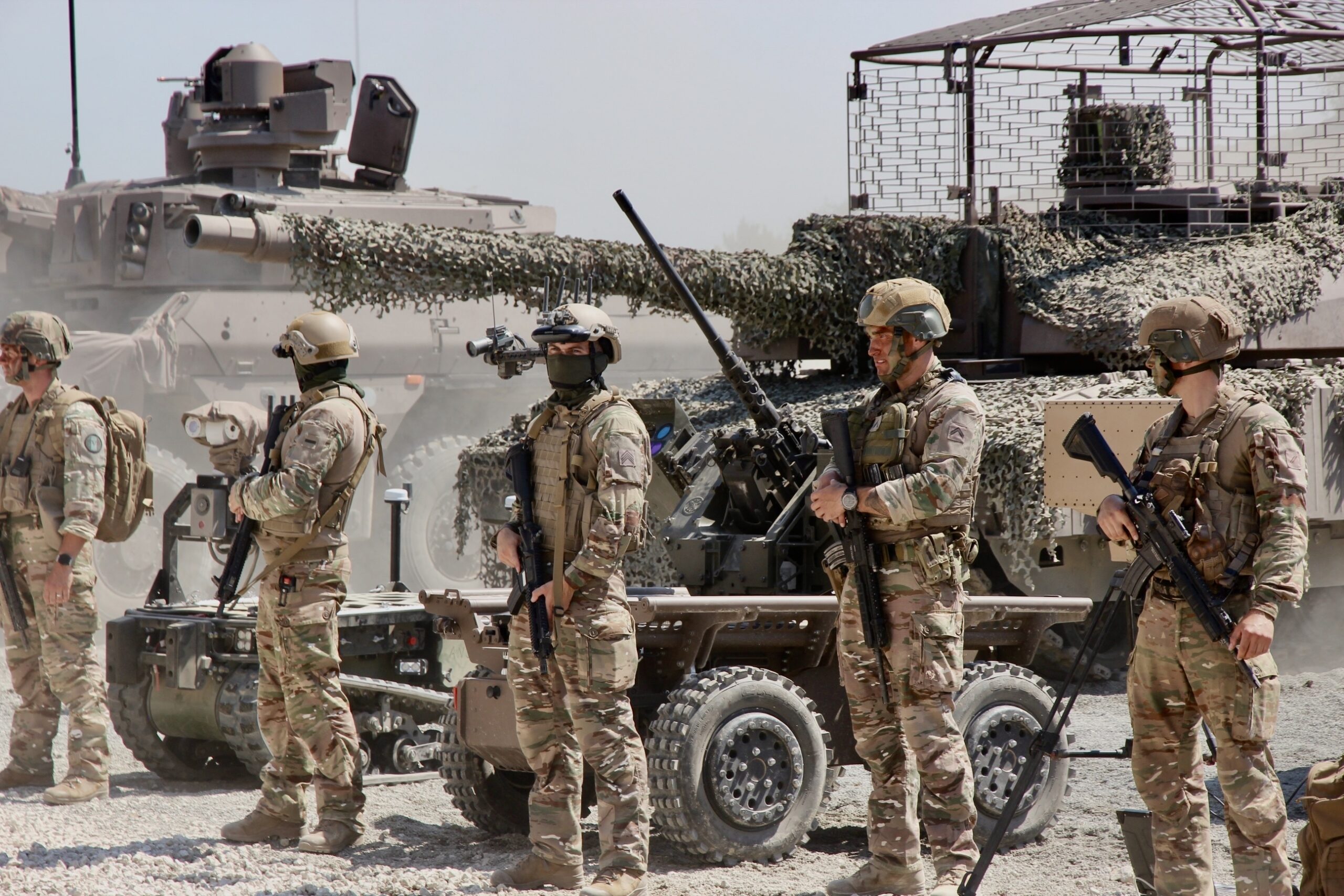
This year’s mega defence show, which took place in the north of Paris, was dominated by Unmanned Ground Vehicles (UGVs) — with everyone from defence giants to small startups showing off self-driving military carriers of all shapes and sizes, from quads to lorries destined to link up into robotic convoys. No steering wheels, nor seats: the next generation of the ground vehicles won’t necessarily have humans in the driving seat; they will be controlled by AI.
“Unmanned Ground Vehicles are the new FPV drones,” said one of the producers at Eurosatory 2026.
This has been a rapid shift, attendees said.
Less than a year ago, DSEI in London, air-based systems were the name of the game, and in terms of what is being produced and acquired, that remains the case. But looking at what defence companies are showing off coming down the pipeline, this points to what is trending in innovation. “There are three times more UGVs on stands here” [than on the floor in London], one person told Resilience Media.
This appears to have been playing out in other arenas, too: Ragnar Sass, the founder of DarkStar, told Resilience Media that he’s observed the same shift to UGVs among defence tech builders in Ukraine.
Indeed, Ukraine currently dominates in UGV capabilities — in large part driven by battlefield demand. The country announced it would contract 25,000 UGVs by the first half of 2026, mainly procured from local producers, but also in tight collaboration with partner countries like Germany. This is a major scale up: for comparison, consider that Estonia’s Milrem Robotics — one of Europe’s industry leaders — currently has only 70 vehicles operating in Ukraine.
Other European armies are beginning to react to breakthroughs emerging from beyond NATO’s Eastern Flank. In Germany, the military commissioned drone maker Quantum Systems to research and eventually build autonomous convoys for the German Army based on Daimler trucks. (That follows an acquisition in December 2025, when Quantum Systems acquired Fernride, to kick-start its ground vehicle strategy.)
As with a lot of other autonomous vehicle efforts (including cars designed for city streets), the Quantum Systems trucks will not be fully autonomous at the start — although that is the eventual destination on the roadmap, the company said. Hence the use of convoys.
“We will start with a relatively basic follow-me function, where you have the lead vehicle still being crewed, followed by uncrewed vehicles,” Quantum Systems spokesperson Paul Strobel told Resilience Media. He said that eventually the goal is to “make these convoys drive from A to B fully autonomously.”
The robotic convoy is currently only being pursued as a research project, but Strobel said the idea is to implement the system in active scenarios.
“By the end of 2027, we hope to have the certification and convoys rolling on German streets,” he said.
French robotics also featured prominently in Eurosatory’s live demonstrations.
The French Armed Forces showcase included an army-developed machine gun-mounted vehicle, while local companies UNAC and CNIM demonstrated a light carrier and a road-clearing robot, respectively. These displays come months after the progress for the country’s Pendragon project — an effort spurred by the AIMAD (the ministry’s “defence AI” unit) to develop robotic ground vehicles. The ultimate aim is to create a fully autonomous army unit by 2027, with UGVs as an integral component of that. To date, the work has been more around concepts; there have been no live deployments yet.
In the Nordics, as part of the TRACKX large all-terrain vehicle project jointly developed by Finland and Sweden, Finnish producer Patria also presented an unmanned concept of the platform at Eurosatory.
The inevitable next step
In some ways, the advent of UGVs appears like the inevitable progression from drones.
UAVs swarming the skies have effectively turned entire frontlines into wider, and sometimes very nebulous, kill zones. This has in turn led militaries to look for ways to advance and hold territory with minimal risk to personnel while allocating resources more efficiently. Enter autonomous ground vehicle innovations.
Ukraine has, predictably, taken a leading step in this area because of the war playing out right now in its country. There, UGVs are already performing battlefield tasks, notably in logistics and casualty evacuation. According to President Volodymyr Zelenskyy, in the first three months of 2026, UGVs conducted 22,000 frontline operations. In one milestone, in 2025, a fully unmanned unit captured a fortified Russian position.
Quantum Systems’ Paul Strobel highlighted the benefits of employing UGVs.
Automated logistics allow armed forces to distribute resources more efficiently. “German armed forces are increasing their logistics fleet from 6,000 trucks to 60,000, and they obviously will not grow in size so that they all of a sudden have 54,000 more truck drivers,” he said.
UGVs can also reduce battlefield risks for human soldiers by “taking them out” of frontline danger, Strobel added.
European armies’ turn towards UGVs comes within a broader context of military robotisation, increasingly seen as necessary to gain an advantage over adversaries. The UK’s Chief of the General Staff recently said that by 2035 the British Army would pivot to a “20-40-40” strategy: 20% manned vehicles, 40% attritable platforms, and 40% cheap, one-way effectors.
Eurosatory showed that UGVs are not only components of larger command-and-control systems that also operate drones and air-defence assets, but can also carry counter-UAS equipment themselves. This is the case with a UGV developed by Shark Robotics, which could in the future carry a laser anti-drone weapon built by French start-up Iris Lab.
However, industry players say that European countries still have a long way to go to match Ukraine’s capacity in ground robotics.
Paul Clayton, director of industrial partnerships at Milrem, said that there is currently more talk than walk in the industry. European countries are “advanced with the rhetoric, but not necessarily as advanced with the procurement,” he said, when it comes to UGV systems. No major orders have yet been placed by the continent’s armed forces that would allow these systems to be tested and deployed at scale.