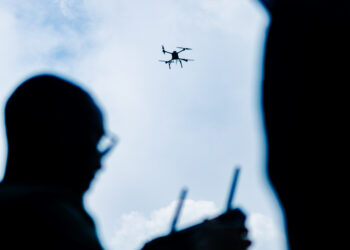
To say that the anti-drone industry is booming may be an understatement. At the 2026 edition of Eurosatory in Paris, counter-UAS was one of the big themes to dominate conversations as well as exhibitor stands. Manufacturers are rushing to enter the field, either by developing products of their own or by signing partnerships with companies that already offer state-of-the-art technology to identify and take down adversaries’ drones.
Similar to the rise of UGVs (reported on here), C-UAV growth is a by-product of just how powerful (and successful) drone programmes have become.
The Ukrainian attack on the Moscow oil refinery, which took place in the middle of the same week as Eurosatory, was just one of many recent examples of how destructive drones can be – not only on the battlefield, but also deep behind enemy lines, where critical infrastructure has become a prized target.
The sceptre of drone incursions has also been a major theme of so-called greyzone warfare. Beyond Ukraine, allied states have struggled to respond to disruptive drone flyovers, and as Europe prepares for the possibility of a high-intensity conflict, civilian targets remain particularly vulnerable.
And even without outright conflict, we’ve seen governments remain on high alert for incursions in high-profile, large public gatherings, such as the World Cup, where the US government said it has given out grants of more than $220 million to set up and run C-UAS systems.
“New defence” companies producing drone interceptors – which either use jamming or spoofing (“soft kill’), or kinetic tactics (“hard kill”), and sometimes a combination – have seen astonishing growth, often within just a few years of their founding. France’s Alta Ares recently secured €50 million from investors, and start-ups such as Quantum Systems and Harmattan AI have reached unicorn status.
And Frankenburg Technologies, the Estonian-Latvian C-UAS startup, is currently raising around $100 million at a $1 billion valuation, sources have confirmed to Resilience Media.
National governments have also recognized the gravity of the threat and are beginning to respond through regulatory changes and new financing mechanisms.
Unsurprisingly, Ukraine has been a pioneer in regulation. In 2025, it approved its crucial energy and defense companies to equip their facilities with electronic warfare systems, according to the Ukrainian MoD. In 2026, Ukrainian C-UAS regulation evolved further, with 30 companies joining a pilot program to purchase and deploy their own air-defences, including interceptors.
Ukraine’s western neighbor, Poland, also revisited its regulations on C-UAS use last year, allowing private security companies to neutralize drones. However, because it kept a ban in place on jammers, inconsistencies with existing legislation have so far rendered the changes ineffective.
France is the latest country to adapt its anti-drone legislation. In June, the Senate gave preliminary approval to an update of the military budget that includes a provision allowing operators of critical infrastructure to independently procure anti-drone systems.
“It’s huge news for us,” Brian Girard, CCO of Cerbair— a French drone detector and jammer producer, told Resilience Media. He added that the company has already adapted its products for the civilian market. During Eurosatory, it was announced that the French Defence Innovation Fund had acquired a stake in Cerbair to help scale the company into a “European champion,” according to Girard.
Alexandre Massonnet Lepoutre of MC2 Technologies also expressed enthusiasm, saying that MC2 is currently preparing civilian versions of their products.
“We cannot reply with the products that we designed for the armed forces, which are very complex, state-of-the-art. And so we’ve started developing a new portfolio of simpler solutions to protect [civilian] infrastructure,” he added.
The initial anti-drone regulatory framework drafted by the Secretariat-General for Defence and National Security (SGDSN) envisioned different categories of authorized counter-UAS systems, extending beyond jammers to include kinetic interceptors, according to reporting by Le Monde in March.
However, the final version of the bill does not specify which technologies critical infrastructure operators will be allowed to purchase. Some French counter-UAS producers remain skeptical that the initial implementation will permit anything beyond jamming systems.
Nicolas Bourliatoux, CEO of Iris Lab, which develops anti-drone laser systems, said he is unsure whether critical infrastructure operators will be allowed to deploy his company’s products.
“There’s not yet a regulatory framework for laser weapons,” he told Resilience Media, adding that safety concerns continue to hinder the deployment of hard-kill solutions.
Florian Audigier of EGIDE, a French start-up developing loitering-munition-based counter-UAS systems, said regulators “will start with soft-kill solutions because they need some return of experience from the French forces on kinetic or warhead-equipped products.”
He added that “it’s a start anyway, because the regulatory environment will be ready” for eventually authorizing larger systems.
Despite the remaining legal hurdles, growing awareness of the drone threat among public officials means that anti-drone systems are likely to become more widely available and deployed on a larger scale across Europe.
Bourliatoux said that Iris Lab’s stand at Eurosatory attracted significantly more interest than expected from national delegations seeking to protect critical infrastructure. Products such as German RWD’s “Urban Drone Defence,” presented at the event, demonstrate that the overlap between civilian and military targets is increasingly becoming a reality – one that governments and manufacturers alike must now address.