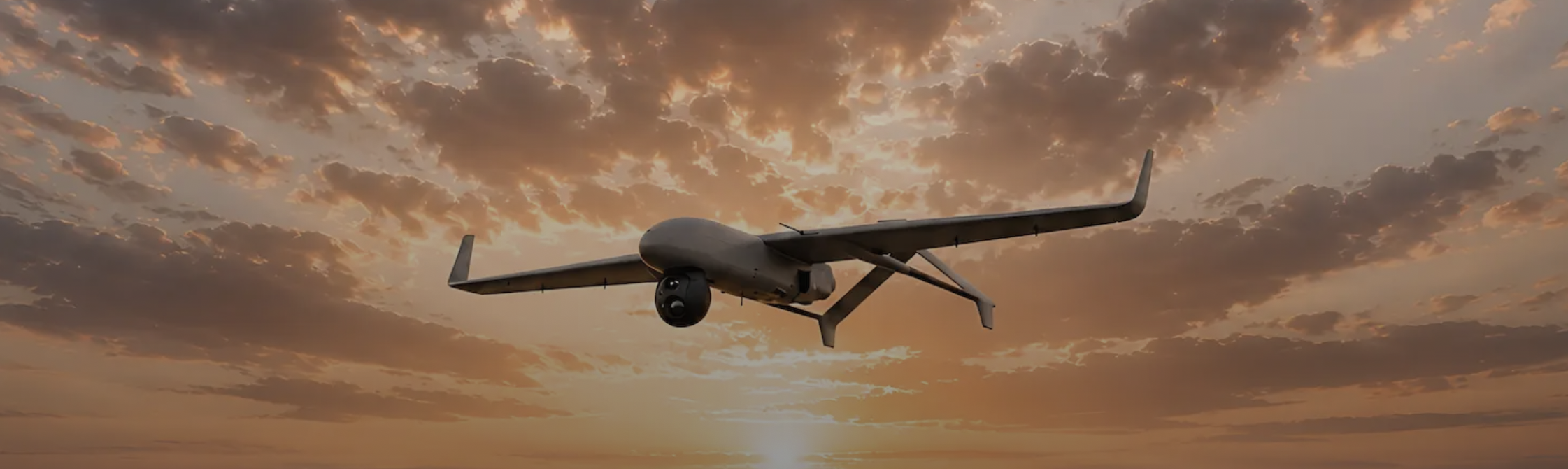
M-Fly – a startup from Estonia and Ukraine making gimbals for drones and other systems to incorporate mounted cameras and lasers that enable stabilised and rotational operations – has raised some money to expand production of its hardware.
MITS Capital – a fund with multinational roots focused on investing in Ukrainian defence tech – is leading the round, with Freedom Fund and Norwegian VC firm Gardar also participating, alongside an undisclosed investor.
M-Fly and MITS Capital would not confirm the size of the round nor the company’s valuation. However, the company’s PitchBook profile notes that it was in the process of raising $3.5 million earlier this year. Before this round, M-Fly had raised $1.4 million from MITS, Freedom Fund, Resist.UA and Borys Shestopalov, after the startup participated in MITS’ accelerator.
“M-Fly has made incredible progress since graduating from MITS Accelerator, and we are excited to see increased demand from NATO nations for its cutting-edge systems,” MITS Capital co-founder and CEO Perry Boyle said in a statement.
M-Fly’s startup story is linked to the war in Ukraine. After the full-scale invasion, Ukraine’s tech talent mobilised in response to apply their skills to the fight. CEO Vladyslav Myhovych was one of them. He founded the startup in 2023 out of work he initially did as part of a volunteer initiative.
M-Fly’s fortunes speak to the trajectory that technology is taking on the battlefield, but it also underscores the market opportunity in hardware right now. The market is very competitive — some might describe it as overcrowded — and so those building drones and other autonomous systems are not only looking for components that work best, but those that are ITAR-free and can help them keep their device costs down. M-Fly aims to address all three areas.
The startup’s focus is gyro-stabilised gimbals and laser-guidance systems. This is a product area where demand has increased in line with the growth of drones and other uncrewed systems with autonomy built into them. Myhovych said that over the past 12 months, M-Fly has doubled its team and increased revenues “severalfold” (without disclosing actual revenue figures).
One specific factor driving growth has been the increasing use of interceptor drones in Ukraine, he added. As interceptors take on a larger share of the counter-UAV mission, demand is growing for relatively inexpensive reconnaissance aircraft capable of providing high-quality imagery without relying on costly imported payloads.
Stabilized electro-optical systems can represent a substantial portion of the overall cost of a reconnaissance drone. Myhovych said a gimbal can account for roughly one-third of a UAV’s cost, while some imported systems can cost several times more than the aircraft carrying them.
“Reliable aerial imaging is critical for the military,” Myhovych said. “Our goal is to keep bringing the overall cost of reconnaissance platforms down by making capable stabilized imaging systems more affordable.”
Denys Gurak, MITS Capital’s co-founder, said M-Fly’s production economics were a major factor behind his firm’s decision to invest again.
“What matters even more than performance is that the company has cracked the unit economics, allowing it to price its products significantly below those of its closest competitors,” Gurak said.
M-Fly is pursuing a vertically-integrated manufacturing model, developing core elements including motors, lenses, cameras and software internally.
This has allowed it to price some products close to competing Chinese systems while reducing Chinese-origin components to less than 6% of the bill of materials.
That supply-chain independence has become increasingly important for Ukrainian defence manufacturers as they seek to scale production while reducing exposure to foreign component restrictions and shortages.
M-Fly’s current portfolio ranges from laser-guidance equipment to stabilized imaging systems for aerial, maritime and ground platforms.
Its RB-220 is a heavy gimbal designed for larger UAVs, helicopters, manned aircraft and naval drones, and can also be configured as a ground-based sensor station for air-defence applications. The smaller RB-150GD combines thermal and daylight imaging channels and is aimed at medium-sized drones. M-Fly is also developing a weather-resistant maritime derivative, the RB-150 Marine.
The company plans to launch the RB-100, its lightest gimbal to date, in the first quarter of 2027.
M-Fly says its stabilization technology has already undergone battlefield testing in Ukraine, including operation on platforms traveling at speeds of up to 350 kilometers per hour.
The company has also redesigned the computing architecture underlying its systems. During 2026, M-Fly moved from a RAM-dependent architecture toward GPU-based processing, which Myhovych said gives engineers greater flexibility to substitute computing hardware when individual components become scarce.
The new capital will primarily be used to expand production capacity and accelerate the adaptation of M-Fly’s products as requirements change.
Myhovych said the company ultimately sees a much larger market emerging around imaging systems for unmanned platforms, estimating that the global drone-camera sector could exceed $100 billion within the next five to seven years.
“New funding will allow us to scale our production facilities and pace of product adaptation to hold a visible share of this market,” he said.