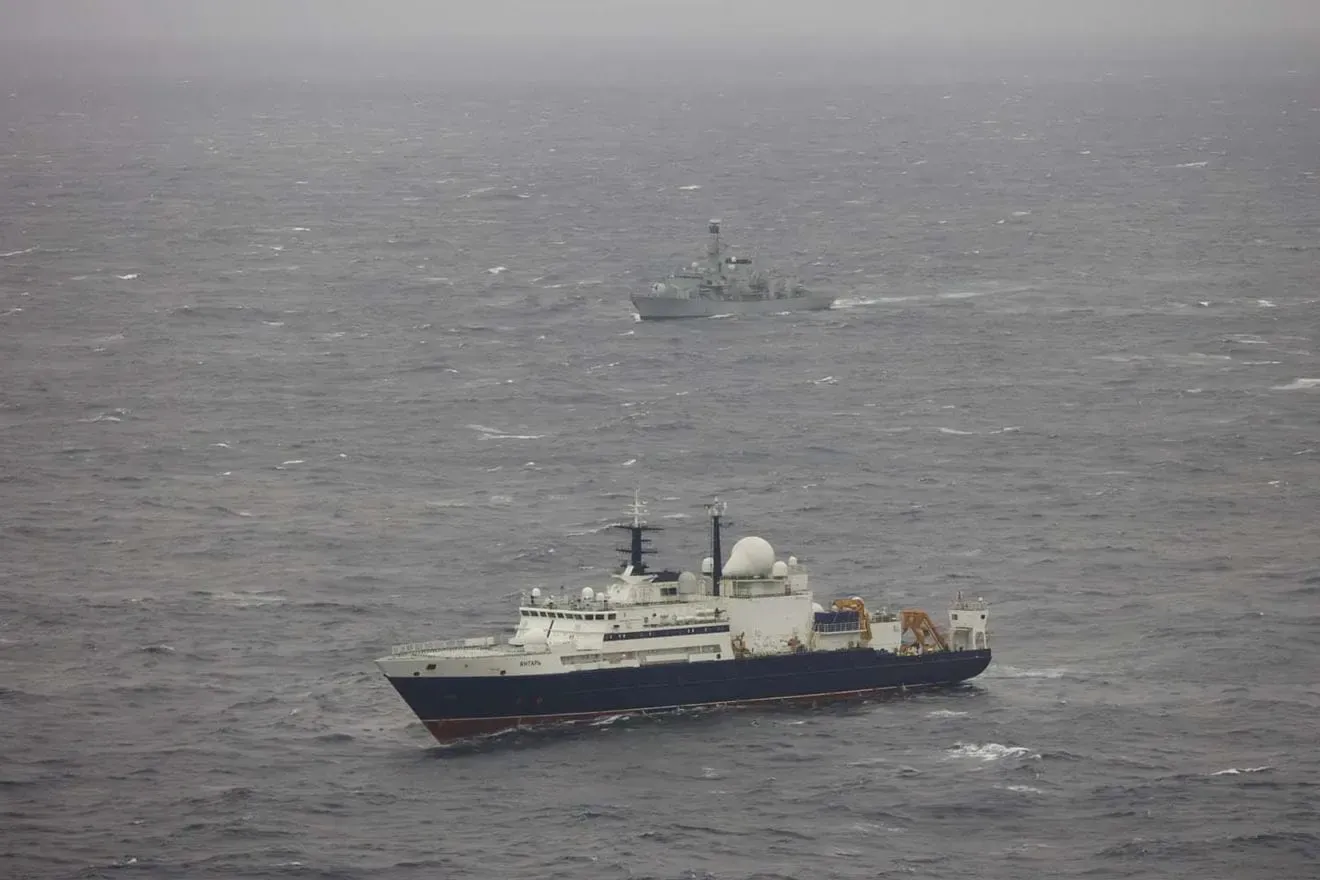
On Wednesday 19 November, according to the UK’s Ministry of Defence, RAF pilots were hit by lasers originating on the Yantar, a Russian vessel that the UK military variously describes as a “research” and “spy” ship.
UK armed forces had been monitoring the Yantar in part due to fears that it was surveilling the country’s subsea cables, a critical part of the country’s energy and data infrastructure. The Yantar is believed to be capable of deploying ROVs (remotely operated vehicles) that can interfere with the cables.
However, that focus was literally and figuratively blinded out by the lasers. Russian military training lasers on Royal Navy soldiers and vessels raises concerns about escalating hostilities between the UK and Russia, and whether the UK can defend itself against the technology.
Government declines to provide details of counter-laser capabilities
The government has to date declined to comment on what counter-laser capabilities the UK military possesses.
James Cartlidge, the shadow defence secretary, secured a debate on an urgent question about the Yantar incident in the House of Commons on Thursday 20 November 2025.
Responding, Al Carns, the Minister for the Armed Forces, said: “We will ensure that the Yantar is not able to conduct its mission unchallenged or untracked.
“But that has not been without difficulties: a laser assessed to be originating from the port side of the Yantar was directed at British personnel operating one of our P-8s in a highly dangerous and reckless attempt to disrupt our monitoring.
“The P-8 continued to monitor the Yantar’s activity. Post incident, when its personnel arrived back safe in the UK, they were medically assessed. No injuries were sustained and no damage was sustained to the aircraft or her equipment.”
The P-8 Poseidon is built by Boeing and is a “multi-mission maritime patrol aircraft used in anti-submarine warfare; anti-surface warfare; intelligence, surveillance and reconnaissance; Maritime Domain Awareness; and search and rescue,” according to Boeing’s website.
During the debate, Conservative MP Sir Julian Lewis asked the government whether steps were “being taken to find methods of protecting our personnel against such laser attacks.”
Carns said: “(On) the specific capabilities – I won’t go into detail.
“But from our perspective there has been no impact on the aircraft and no impact on the crew, and we’ve also expanded and broadened out our rules of engagement to ensure no vessel can oversee our critical national infrastructure without being watched and monitored in the most close and sophisticated way.”
The government’s statement summing up the encounter was clear.
“‘In a clear message to Putin, the Defence Secretary said: “We see you. We know what you are doing. And we are ready,’” it noted.
Defence advocate suggests UK should ‘kick back hard’ by arming Ukraine
DSF founder and president Lady Olga Maitland described the use of lasers by the Russian ship against UK armed forces personnel as “deliberate, and therefore that was an intrusion, and it was dangerous,” she told Resilience Media. “It is basically part of the gray warfare.”
“I think the quandary that all the nation countries are facing is, at what point do you really kick back hard?” Maitland added. “My view is the way of kicking back hard is actually giving Ukraine the weapons to be able to fight the Russians and push them back. But that’s another debate, really.”
She added that Article 4 of NATO’s North Atlantic Treaty should be invoked by the UK and its NATO allies. It notes that “The Parties will consult together whenever, in the opinion of any of them, the territorial integrity, political independence or security of any of the Parties is threatened.”
MOD spin-out already producing counter-laser tech
While the MoD may not comment publicly on counter-laser strategy, there are signs of activity afoot in the UK.
Sentinel Photonics – which was spun out of the MoD – describes its work as “manufacturing state-of-the-art laser detection and protection systems to protect users and equipment from laser threats.”
Dr Chris Burgess, the startup’s CEO and co-founder, explained to Resilience Media that his company’s products are ready for the MoD to start using to detect and counter laser threats.
“The most relevant of our products for the threat/use case is LASERD MAX,” Burgess said. He said that the retail price for the MAX is £55,372.26.
The concept for LASERD MAX was created by Burgess and co-founder/CTO Sean Tipper when they were working within the MoD. Sentinel was spun out in order to enable Burgess and Tipper to make MAX into a product and to bring it to market.
“We’ve had a lot of taxpayer-backed funding via MOD to do this,” Burgess said. The MAX was officially launched in September this year at the DSEI industry show in London. “MAX has therefore only very recently been commercially available.” Sales and evaluations, ha added, have so far been limited to “special” customers within the UK government and the US Department of Defense.
It’s not entirely clear what the Yantar lasers were being used for or could be used for beyond rattling the British forces, but that’s because laser technology has already been deployed across a wide range of applications. These include weapons and systems to counter weapons, as well as reconnaissance, distance tracking, temperature gauging, communications and more.
MAX covers different layers of functionality that speak to that multi-purpose theme. Burgess noted that it autonomously scans for all laser threats; provides real-time alerts of incoming radiation; and it measures laser metadata for each incident, including the wavelength (colour), power, pulse code and position of the threat.
“For aircrew, this is instantly converted into a threat-level assessment, so that they can know in under a second whether a beam poses an eye hazard or not, hence informing in real time whether they can prosecute their mission,” he said.
“Critically, it also autonomously detects and decodes invisible laser threats too,” he noted, since even lasers you cannot see can pose a very serious eye hazard. In fact, he added, invisible lasers are arguably more hazardous, since they don’t trigger a blink or aversion response in humans. “You could be staring at one and have no idea.”
If the RAF P-8 was using a LASERD MAX during the Yantar laser incident, in theory, it would have been able to record a range of useful data points.
It could have gathered information on “accurate metrology of the event, including timestamp, location, direction, imagery showing the laser strike and the point of origin, detailed laser metadata, including the laser’s ‘fingerprint’ and the hazard calculations and accurate data for any other lasers used that the crew cannot see with their eyes,” Burgess said.
He added that Sentinel Photonics’s technology could be used by other organisations to manufacture protective goggles or spectacles to protect people likely to be targeted by lasers, such as pilots.
The protective technology would need to be cheap enough to be disposable, because “you’re only going to wear it in an instant,” after LASERD MAX has warned users of a laser threat, he said.
Counter-laser technology expert urges MoD to ‘do something’
Burgess expressed frustration that the response seemed to lack focus on a solution.
“Do something. Don’t just go, ‘This is dreadful’,” he said.
“What if tomorrow, we do end up in a conflict with [Russia]? We can’t just complain anymore. We’ve got to do something about it. The MoD has put a lot of money into us as a company, in terms of intellectual property, to make something available that can contribute towards addressing the problem.”
For startups out there, there are areas of opportunity around the wider laser threat. “We would never do the laser eye protection ourselves,” Burgess said. “We would work with other people in industry who can make really good glasses, but they would use the data that we provide.”
Further plans include products that bring its technology to more use-cases.
“We want to put a dosimeter in an aircraft, or on a soldier in a trench, to give you that real time assurance and dosimetry,” he said, “but also to give you data that you can then go and do something.”