A new partnership between two startups in Germany and the US hopes to bring the moonshot concept of space data centres one step closer to reality.
Orbital is a Southern California startup that wants to operate a constellation of 100,000 solar-powered satellites to run large-scale computing capacity in low-Earth orbit for AI and other applications. It’s now teamed up with Reflex Aerospace, a satellite maker in Berlin, to design the satellite bus platform that would carry Orbital’s services around the planet.
Building more capabilities for space has become a key part of the concepts of national sovereignty and resilience. The urgency to do more in space is driven in part by the knowledge that other countries are also racing to increase their capabilities there as well.
Space already is a prime domain for communications infrastructure, but it also holds promise for being key to national defence and applications for other industries. These include data centres and material production, areas that today exist mainly as concepts but could potentially be very valuable in future.
“We have a strong belief that space holds the key to scaling AI and that’s why we’ve been heads down working on designs to compete with SpaceX [which also wants to build data centres in space],” Orbital’s CEO and founder Euwyn Poon told Resilience Media in an interview. He said that working with Reflex to build its satellite bus helps it “leap ahead” in that development.
The financial terms of the deal have note been disclosed, but it’s likely a sliding amount based on how far the work gets from concept to launch to scale.
The timing is also not completely set in stone. Orbital’s current plans are to launch its first prototype sometime in 2027 out of the US. A lot will weigh on how far it gets with its own server technology, and also how far along its partners get with their work. That includes what Reflex builds, but also how SpaceX progresses with its Starship concept. This is a reusable rocket that is still a work in progress, but SpaceX’s intention is to sell capacity on it to take heavy loads to space.
Orbital is young: it only announced its first $5 million in funding in June of this year. But its pedigree and current investors are a strong signal that it might easily raise more if it needs to.
Euwyn Poon had no prior experience in space tech before Orbital, but he previously founded an electric scooter startup called Spin that he sold to Ford at the height of e-scooter hype in 2018.
That track record, plus his ambition to audaciously tackle a very big challenge, was an easy calling card into A16Z’s accelerator programme, and the storied VC firm led that $5 million pre-Seed. Given the costs of doing business in space, unsurprisingly, Poon told Resilience Media that more funding is something it’s already formulating.
Reflex meanwhile has raised €59 million in early-stage funding so far. Its trajectory up to now has very much followed that of the space race in Europe overall.
 Walter Ballheimer, the founder and CEO, told Resilience Media in an interview that when he started the company in 2021, he thought that the majority of its business designing satellites for custom uses would be coming from the commercial market, and from primarily US customers. But the full-scale invasion of Ukraine changed everything, he said.
“Right now it’s mostly defence,” he said of its business pipeline. “It’s not only the fact that we have a war going on along our Eastern border but even cooperation with allies [like the US] has become unpredictable,” he said. “Europe understands that to remain independent it has to invest in space.”
Ballheimer described Germany’s €35 billion commitment to boost its operations in the space domain as “mind blowing,” and indeed it has served to put some wind into the sales of Reflex but also its rivals.
A €50 million round that Reflex raised in November 2025 was, at the time, the largest Series A to go into a new space tech startup in Europe. But any size distinction has burned up, so to speak, in the months since, with companies like Isar, Iceye, and just this week The Exploration Company, all pulling in massive rounds to build out their businesses. It leaves the door open for Reflex to raise again, too: Ballheimer said he gets investor calls daily and he’ll ramp up that activity when he needs to.
Slow-moving space
Space production cycles are considerably slower than those of software or even earth-bound hardware companies.
Reflex has launched only one satellite so far, with German space tech company MBS, in 2024, for an undisclosed purpose under strict NDA, said Ballheimer. (The latter company works for government customers.) Other future buses will be used for earth observation, laser communications, 3D imaging… and potentially computing, if Orbital pulls its concept off.
As for its concept, Orbital is tapping into a very hot, but also controversial, area.
Data centres are at the centre of how technology, and specifically AI, are growing. AI inference and training capacity have huge computing demands, so until someone makes a breakthrough in how AI compute works — or demand drops off — there has been a scramble to build bigger and more data centres.
That data centre scramble has become nearly as central to the question of sovereignty and resilience as the AI models themselves. An entity — whether it is an organisation or a nation — that has to rely on a third party for compute capacity, not on its own soil, is inherently less self-reliant. But that comes with an expensive catch. Not only are there shortages of chips, but data centres are big consumers of other resources like energy, water and space, and many communities have started to put their foot down because of the overall costs.
This is where space comes into the picture. In the most idealised view, it represents a whole new piece of unlimited real estate that can be developed without the headaches associated with scaling data centre capacity on earth.
The reality, of course, is considerably more complicated, even putting to one side the usual issue of stiff competition in the market from deep-pocketed rivals (in Orbital’s case the list includes not just SpaceX, but also Amazon and several other startups).
The engineering challenges of how to launch and operate a data centre satellite — much less 100,000 of them — are still being worked out. There remain questions about how these satellites will be maintained once they’re in space. And space data centres may not use the same physics as Earth-bound data centres, but they will still have unique cooling issues.
That is also before considering are a number of environmental factors that have been raised about the influx of more hardware into space. This includes the impact of too much light in the sky; and the ozone impact when debris created from older equipment is at the end of its life and burns up in the atmosphere.
And, there are still owners of the physical assets that may well be private companies or other countries, and so questions of sovereignty remain.
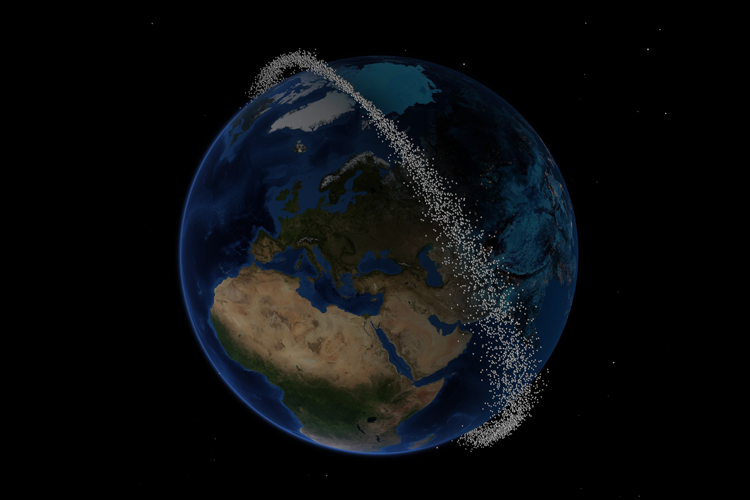
These issues are all still being debated, and arguably, current governments may be less inclined to address them especially when so much of the technology remains conceptual — even as the number of satellites launched is on the rise overall, to currently around 18,000 from just a 2,200 in 2019.
But for Poon, the horizon looks long.
“We see a massive opportunity,” he said. “Millions of satellites will be launched. That will happen.” At that point, he added, “That might need coordination from physical obstruction standpoint and communications interference.”