Good afternoon from Resilience Media.
In amongst a week of venture funding announcements, the UK defence industry waited for the much delayed Defence Investment Plan (known as the DIP). As it was delayed again, the UK’s Defence Secretary John Healey submitted his resignation, accusing both the Chancellor, Rachel Reeves, and the Prime Minister Keir Starmer, of failing to commit the resources needed to defend the UK. Read our coverage here, which we will be updating as the story develops.
In a quietly scathing letter published by the BBC, Healey wrote, “I am being forced to make decisions that would reduce the readiness of our Forces and increase the risk to personnel on operations, and could make the country less safe.”
Healey’s resignation stems from the government’s commitment of approximately £2bn per year to defence, which is embarrassingly inadequate. Compare that with the $1.793 billion in funding that European startups Iceye, Isar Aerospace, Molfar, and British-based Gigaton and PhysicsX announced just this week. Read more about the funding in our Deals section below.
Norwegian investor Erlend Prestgard announced his new fund, Gardar, which launched with €80M to back the most interesting tech being developed on the front lines. Prestgard’s unique investment thesis is nuanced, as Ingrid Lunden examines. Read an excerpt in our Dispatches from Norway section below.
We announced our first speakers for Resilience Conference London. Rafal Modrzewski, CEO of ICEYE, just raised 1bn Euros at a valuation of 10bn Euros. Adam Niewiński of OTB Ventures was one of their first investors. They will share the stage to discuss the journey from early conviction to building one of Europe’s most important and highly capitalised space and defence technology companies. Early Bird tickets are available now and we’re offering a limited time 10% subscriber discount, which you can redeem before midnight BST on 19 July.
Want more of that? Paid subscribers have even more Resilience Conference benefits which we’ll be sharing soon.
Elsewhere on Resilience Media:
- Why defence software still takes years to reach the field
- Quantum Systems expands into medium-altitude aviation with PULSE P19
- Ofcom examines whether telecoms security rules are slowing adoption of AI cyber defences
- Orqa unveils hybrid tactical drone for jammed battlefields
- Helsing expands CA-1 platform with AI-powered Electronic Attack drone
- Middle powers in the age of Anthropic’s Mythos
- Swiss startup Custodia launches offline AI appliance for sensitive workloads
- Ukrainian maritime drone self-detonates near Romanian oil terminal
I’ll be back in your inboxes next week. Thanks for reading.
-Leslie Hitchcock, co-founder and Publisher, Resilience Media
We’re sourcing our next big list
Resilience Media is looking for the investors shaping the future of defence tech; compiling a go-to resource for founders and builders looking to connect with the people actively backing innovation in defence and resilience.
Similar to our 100 Startups To Watch in 2026 feature, this project will spotlight the funds, accelerators, and individuals investing in the next generation of defence, national security, and resilience companies. If you’d like to be considered – or nominate someone – complete this form.
DEALS 💰
Molfar lands €1.5 million lead investment for small drone-detecting radar
- Polish-Ukrainian defence technology company Molfar Defence Technologies has secured the first tranche of a €2 million funding round as it works to develop radar systems designed to detect micro-drones and small unmanned aerial vehicles operating in contested environments.
- The company announced that Swedish defence investor Front Ventures has committed €1.5 million as the lead and first institutional investor in the round.
- The funding will be used to continue the team’s development plan and to integrate their system into real-world systems.
PhysicsX raises $300M at a $2.4B valuation for AI to create and test defence and other hardware
- PhysicsX, the London-based startup that has built an AI platform for hardware designers to run simulations of their work in progress, has raised a large Seres C round of funding to speed up its own expansion.
- It has raised $300 million, at a valuation of $2.4 billion.
- Italian physicist co-founders, Robin Tuluie and Jacomo Corbo, worked on aerodynamics for high-end Formula One race cars in Italy and the UK before spotting an opportunity to build an AI platform to improve the prototyping and simulation process for others.
- Temasek, the investment fund wholly-owned by the Singapore government’s ministry of finance, is leading the round, with participation also from UK’s M&G Investments, Canada’s Intrepid Growth Partners, US semiconductor company Applied Materials, Atomico, General Catalyst, July Fund, NGP, Nvidia, deep tech fund Radius, and Siemens.
Iceye, the Finnish satellite startup, raises €1B at a €10B valuation amid growing demand for space intel
- Iceye, the satellite startup from Finland that has made major inroads into equipping countries with space systems to bolster their national security, has closed just over €1 billion in growth funding.
- The round is led by General Atlantic with fellow Finnish company and industrial comms giant Nokia as an additional investor, among others.
- The round, a Series F, values Iceye at €10 billion and makes it one of the biggest tech startups in Europe.
- The deal is coming on the heels of a very strong run for Iceye, and for space tech in general as part of larger communications and national defence strategies.
Gigaton (formerly Carbon Re) raises $26M Series A led by Plural
- A UK startup called Gigaton has built an AI platform to optimise how cement is manufactured, cutting costs and carbon emissions in the process, and now it has raised a Series A of $26 million to expand its business.
- The company has now raised $35 million and its not disclosing valuation.
- “It’s imperative that we work out how to build and manufacture more, and the base of that is the materials we build with,” Vernon said. “If it [forever] costs less to build in China, then we are royally screwed. We need tech to allow us to more sustainably produce materials here.”
- This is largely what motivated this latest Series A, which is being led by one of the VCs that building a reputation around resilience tech, Plural, with participation from 2150, Semapa Next, and existing investors Planet A Ventures, Cambridge Enterprise Ventures, UCL Technology Fund managed by AlbionVC with UCL Business, and Clean Growth Fund.
Isar Aerospace lands €270M as Europe pushes for sovereign space launch
- German rocket maker Isar Aerospace has raised €270 million as it looks to expand launch operations and scale production of its Spectrum launch vehicle.
- Sources close to the company confirmed that the raise was made at a post-money valuation of around €2 billion.
- The funding is coming at a heady moment for companies working in space tech. Not only is SpaceX expected to go public later this month (potentially within a week), but yesterday another European startup, Iceye, raised a whopping €1 billion at a €10 billion valuation.
- The Series D round was backed by new investors Island Green Capital and Molten Ventures, alongside existing backers including HV Capital, Lakestar and UVC Partners with co-investor KfW Capital.
- Isar said the funding will support international expansion and increase production capacity as it pursues what it describes as sovereign space capabilities for Europe, NATO and allied nations.
DISPATCHES FROM NORWAY 🇳🇴
Gardar, an early-stage defence tech fund out of Norway, taps Ukrainian builders
Ingrid Lunden, Managing Editor
The war Ukraine has changed the face of defence in Europe. But ironically, when it comes to Ukrainian builders, there are actually more innovative ideas being developed and put to use by technologists on the front lines than there are startups in Ukraine productising “systems” and “solutions.” This week, a new fund called Gardar was launched in Norway to tap into that gap.
Targeting “defence technologies operational at the front of Ukraine,” Gardar is starting its mission with €80 million to back defence tech founders and startups in the country.
There is an opportunity to do something here that investors in Ukraine and outside it have not quite been able to do, partly because they are moving slower than defence tech itself.
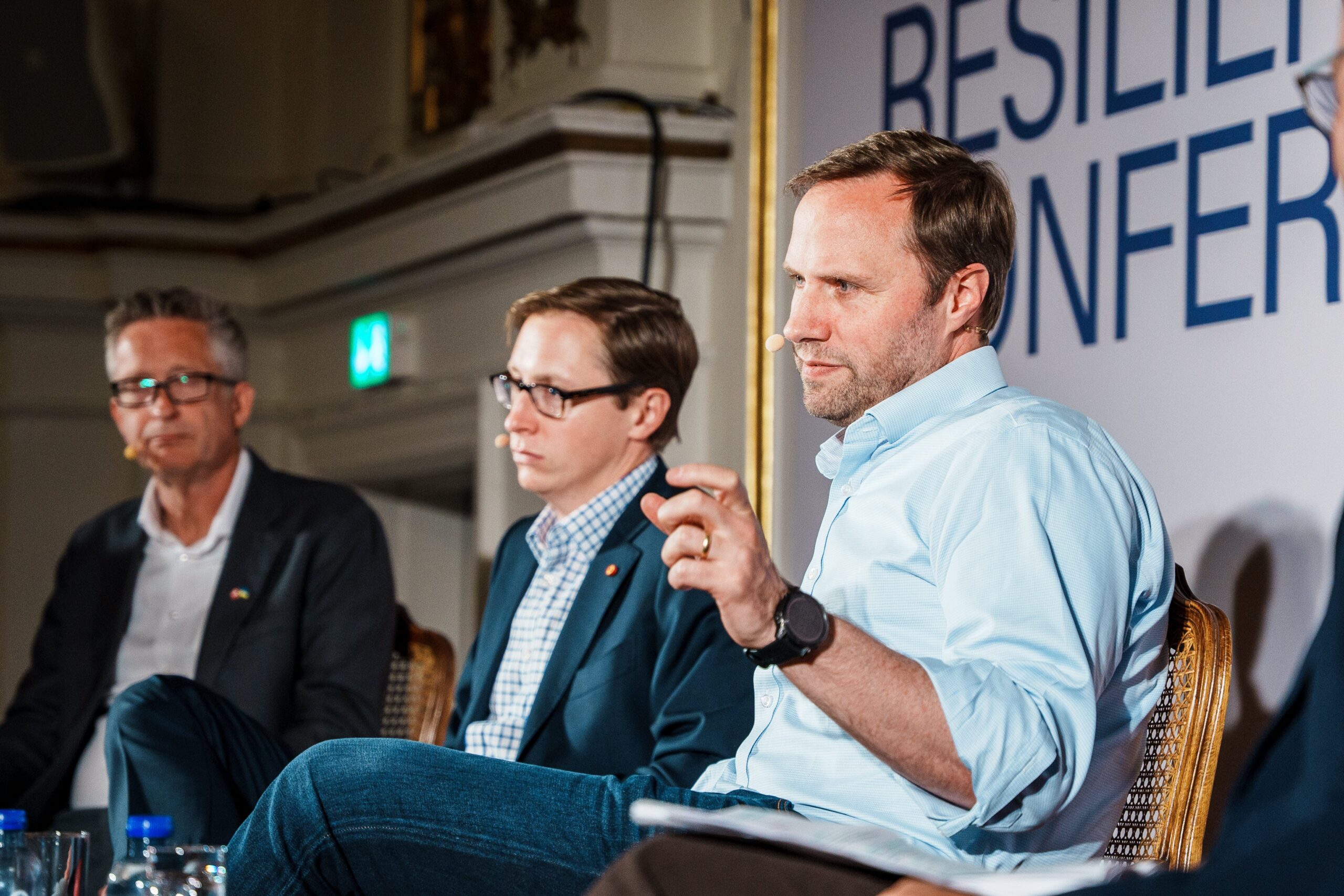
“I think the market is moving faster than the VCs in Ukraine and certainly European VCs are,” said Erlend Prestgard — a managing partner at Gardar and Munkene, one of the partners in Gardar — speaking on stage at the recent Resilience Conference in Copenhagen. “I would actually say [they are] quite bad at moving… I think we have a a big job to do, to increase our own speed and hence even increase the Ukrainian startup speed even further.”
(You can watch the whole session on the New Defence Playbook here.)
Relatively speaking, €80 million sounds downright modest in the scope of defence tech.
Consider the hundreds of millions — even billions — of dollars that several later-stage startups are raising to build hardware and software right now. Yet when it comes to spreading bets across early-stage companies, €80 million is actually a realistic sum to get started with.
On the other hand, there are defence tech operators already profitable in Ukraine on far less VC funding — sometimes, none at all — a product of the uniquely tight ecosystem in Ukraine where equipment is bought and used, right away.
But for every Fire Point (which might actually have raised some outside funding, for all we know: it does keep very quiet on that front).
Gardar is anchored in the war playing out right now in Ukraine against Russia, and specifically in the opportunity for talented Ukrainian technologists to turn into founders as a result of it.