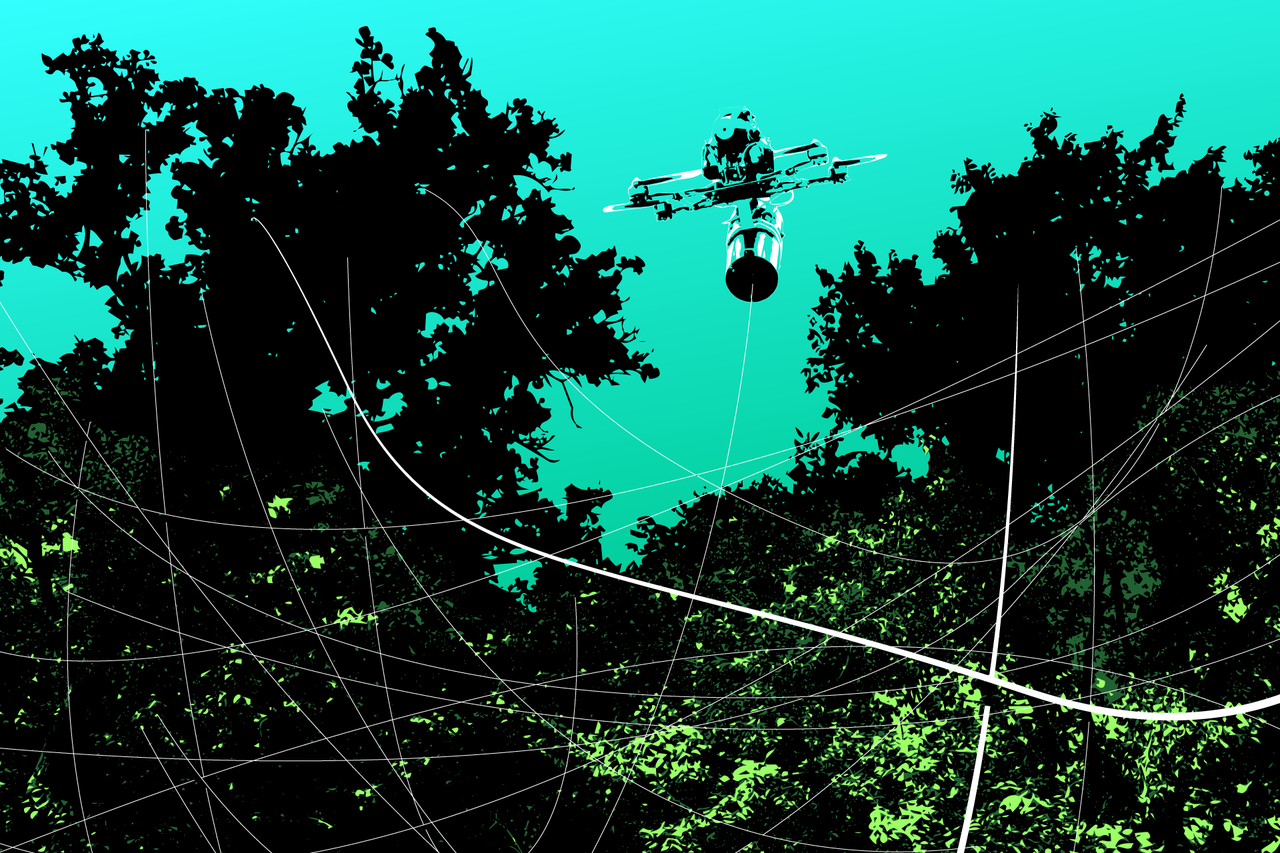
The image is arresting: a once-pristine Ukrainian forest is now strung with plastic fibre-optic cable, gossamer lines spanning trees and brush, like spider webs that will never break down. It depicts a horror of war not often discussed, primarily the destruction of an untouched environment, unexpected and purely collateral damage resulting from modern warfare.
The image also points to something else: the prevalence of drones tethered to fibre-optic cables – simultaneously anachronistic, ridiculous, and, sadly, widespread in the Ukraine war against Russia.
Fibre-optic drones remain a stubborn reality in Ukraine, but the tech may spread further afield unless technology finds a reliable way to prevent electronic jamming on contested battlefields. Otherwise, in the current battle between drone operators and electronic warfare (EW) specialists, the main victims will, in time, be the wildlife surviving in the tangled aftermath of war.
This is not to say that fibre optics are the only culprit. Missiles, kinetic drones, and man-made fires are destroying far more than these thin, endless trails of glass. But fibre optics are an entirely unnecessary result of an entirely unnecessary war.
Consider the birds
Fibre-optic drones landed in Ukraine out of necessity, to solve another technology problem.
Early on in the war, the first drones to enter the battlefield were wireless, commodity drones from companies like DJI. These devices (which DJI eventually stopped selling to Kyiv) depended on open communication protocols that were easily hacked. The solution? Fibre-optic cables that ran from the drone to the operator, allowing unjammable communications across the battlefield.
Fibre-optic drones carry a spool of extremely thin cable that unwinds as they fly. The battery and motors required to use these on the battlefield are . One system from Ukraine’s 3D Tech carries enough cable to operate at distances of up to 20 kilometres. It weighs 1883 grams. This amounts to nearly two kilograms of added weight to a drone already overburdened by payload.
The trade-offs are also disturbing. Drones leave all of that fibre behind them as they fly, and when they return to their operator, there is no sane way to spool it back up for reuse. The drones are simply cut loose, and a new spool is connected to their bellies for their subsequent tours of duty.
The result is a landscape interlaced with plastic fibre that cannot naturally degrade. The material has gotten so prevalent that birds are using it for their nests, an example of nature routing around the damage caused by war.
In fact, researchers at the National Museum of the History of Ukraine in the Second World War in Kyiv have received two nests recovered near the front that contain fibre-optic strands mixed with grass and other natural materials. One remained in the museum’s collection, wrote Reuters, while another went to biologists in the Netherlands to determine which bird species built it and what effect the material could have on wildlife. The goal is to understand, from DNA samples and habitat studies, which birds are best suited to do some of the recycling work for humans.

Yet beyond the whimsical bird nests made of shimmering fibre, the kilometers of cable left behind will remain a problem long after the fighting ends.
A report from the Conflict and Environment Observatory (CEOBS) warned that the cables represent a new form of plastic pollution across Ukraine’s front lines.
The problem is partly the material itself. Drones, the report notes, are likely to use polymer optical fibre, or POF, because it is lighter and more flexible than glass fibre. These cables can contain a polymethyl methacrylate, or PMMA, core surrounded by fluoropolymer materials. They are strong, light, and slow to break down, which is useful for controlling a drone but less useful when kilometres of the material are abandoned outdoors. These cables could “persist in the environment for more than 600 years, posing a substantial long-term threat,” wrote the investigators.
“Wildlife in Ukraine faces a wide range of impacts from the ongoing conflict, many of which will last long into the future,” wrote Charlie Russell, a researcher at the University of East Anglia in the UK in the report. “Fibre-optic cables from drones cover large areas of wooded and edge habitats, forming dangerous webs across trees and clearings that will pose a significant risk of entanglement and death to many species, including threatened birds and bats, for years to come.”
CEOBS compares the problem to abandoned fishing equipment, often called “ghost gear,” which continues to trap animals long after it has been discarded.
There is also a less visible problem. Sunlight, heat, cold, abrasion, explosions, and fires can gradually break the cables apart. CEOBS warns that this process could produce microplastics and nanoplastics that enter soil and water. The fluoropolymer components are another concern because they may contain PFAS, a class of highly persistent chemicals that can remain in the environment for long periods.
Cleaning it up will not be simple. Fibre has already been seen wrapped around vehicle wheels and axles, and abandoned cable could interfere with farm equipment, forestry vehicles, and even machinery used to clear mines. In areas already contaminated with unexploded ordnance, sending workers into fields and forests simply to collect cable may itself be dangerous.
Moving past the line
But fibre-optic drones probably won’t be going away very soon. First, the technology is an excellent last resort for drones in compromised environments.
“We have seen in Ukraine that fibre-optic solutions are one of the highly important tools in the tool chest,” Olaf Hichwa, the co-founder and CTO of US-based drone manufacturer Neros, said in an 2025 interview. “Fibre has a lot of risks associated with it, but for those extremely hardened targets where you need manual precision, there is no match for the EW resistance that fibre offers.”
The biggest threat to autonomous systems comes in the form of signal jamming. Not only can militaries jam telemetry and command data sent to drones, they are now shutting down GPS signals from space, a major concern when attempting to hit specific targets. That said, jammed GPS signals can affect tethered and untethered drones. After all, adding a long fibre-optic cable doesn’t mean that a drone operator will always know where the drone is in space.
New paradigms are taking over, including AI-powered autonomous flight systems that partly or entirely de-couple the drone’s movement from communications with a control and command centre.
Companies like Grid Aero, Acodyne, and Pleno are building UAVs that don’t necessarily need a direct connection to a remote pilot. Companies like TERN.ai are reducing the dependence on global positioning systems but using dead reckoning and visual clues. These drones can fly unaided and unconnected until they reach their destinations using the same tools used by soldiers lost in the field: compasses and landmarks. As GPS access becomes more and more precarious on the battlefield, drone manufacturers are working hard to route their products without any back-and-forth telemetry at all.
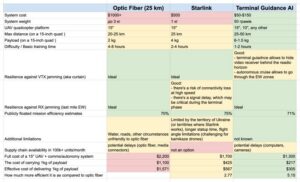
Ironically, financial concerns might end fibre-optic drones entirely. Yaroslav Azhnyuk, founder of Ukrainian drone startup The Fourth Law, wrote that the cost of fibre optics has risen catastrophically over the past year, something that makes even retail Starlink connectivity look affordable.
“Reports are already circulating about fibre-optic prices rising from $4 to $32 per km. Add the cost of the spool itself, and to fly at a range of 20 km with a 25 km spool, you’ll have to pay $800–$1,000 just for the fibre,” he said. “The idea that it might be cheaper to put Starlinks on FPV drones would have seemed absurd a year ago. However, Starlinks cannot be purchased by the tens or hundreds of thousands.”
The company claims that its guidance systems now allow for safe operation, even in jammed areas, something impossible to say even a year ago.
“These systems can be integrated into any drone, solving issues with ‘curtain’ (VTX jamming) and localized electronic warfare. They allow for maximum strike distance while adding only $50–$150 to the cost of the drone,” he said. “While lead times for these components are starting to increase, the situation is significantly better than with fibre optics.”
Bobby Strawbridge, president of radio frequency threat specialist Allen Vanguard, still sees fibre-optic drones as a valuable solution, although not for long.
“In the continual game of cat and mouse that is countermeasure/counter-countermeasure, adaptation has been made with ever-increasing fibre spools,” he said in an interview with Resilence. He thinks that fibre optics won’t go away anytime soon, but the technological and strategic needs of modern drone warfare will eventually render them extinct.
“The FPVs you see used with such effect cannot use fibre given the complex routes and manoeuvres such FPVs take, including twists and turns into dense forestation or buildings,” he said.
That fibre also leaves the launch point vulnerable to location/identification is another reason limiting their use, he added. “At a time when drone pilots are the top targets on the battlefield, cover from view/detection is a key survivability trait.”
“One more point: the enemy is also working on autonomy. The lack of fibre optics will force them to work on solutions even more intensively. Whoever masters full autonomy first will have a significant advantage on the battlefield,” said Azhnyuk.
The bottom line is simple: AI and autonomy are coming for fibre optics. The question, then, is what to do with all the discarded line that has turned Ukraine’s battlefields into an environmental mess. As the war grinds on, no one has time to consider the birds, and so they will continue to pull down scraps and do their best with what they’ve been given.