Good afternoon from Resilience Media.
One month after the ouster of the popular Mykhailo Fedorov, the Ukrainian parliament approved the appointment of Yevhenii Khmara as Minister of Defense. With a background in military intelligence and active service, Khmara was leader of the SBU when it executed Operation Spiderweb in 2025. Whether Khmara will be as tech-centric as Fedorov remains to be seen. Fedorov, for his part, has not gone quietly, calling for presidential elections.
RESILIENCE CONFERENCE: Since 2024, LAUNCH@RC has put some of the most exciting early-stage defence startups on our stage, including Alpine Eagle, Overland AI, Vizgard, Isembard, and Hypersonica.
This year, more than 100 companies applied, including many that had already raised over €10 million. So we created something new: SCALE@RC.
On 5-6 October, LAUNCH@RC and SCALE@RC will put 20 selected founders on stage, from early-stage startups to fast-growing scale-ups, giving investors, military end users, and industry leaders the chance to discover the companies shaping what comes next in defence tech.
Cohorts will be announced soon. Get your ticket today.
DEALS: Terra Industries, LITLIT, and Callosum announced funding rounds, which we unpack in our Deals section below. GALLOS Technologies, a British investor and venture builder with deep connections to the national security services, has announced a £35M first close.
DRONES: A drone crashed during testing at the Test-und Forschungsflugfeld Peenemünde, sparking a fire that burned 6,000 sq meters of open land. The site is one of the few where companies the likes of Quantum Systems, Helsing, Polaris, and others are able to test their technologies, highlighting the need for a wider range of facilities, especially during an unseasonably hot summer like Europe is currently experiencing. Read more from Editor at Large, John Biggs.
I’ll be back in your inboxes next week. Thanks for reading.
-Leslie Hitchcock, co-founder and Publisher, Resilience Media

DEALS 💰
Nigeria’s Terra raises $18M, opens an office in London and facility in Ghana
- Terra Industries, the Nigerian defence tech startup building aerial and ground systems designed for defence of national and critical infrastructure, has raised another $18 million to continue expanding its business, specifically to fire up a second production facility in Ghana and open a new office in London both for hiring a wider pool of talent, and to interface more directly with those who might finance Terra’s growth.
- Terra is not disclosing valuation but in February the company confirmed that it was in the low-hundreds of millions. Terra’s CEO will be speaking at Resilience Conference London in October.
LITILIT secures €8m to develop high-power modular laser system
- Lithuanian laser specialist LITILIT has secured €8 million in financing to develop a high-power modular femtosecond laser system, technology that could ultimately find applications across advanced manufacturing, aerospace and defence supply chains.
- Lithuania’s national development bank, ILTE, will cover most of the €10 million bill with an €8 million loan.
- LITILIT will put in the remaining €2 million as it works towards a FEMODA system capable of reaching 1,000W of average optical power.
- Development began in 2024, with commercialisation targeted for the second half of 2029.
Callosum raises $100M to build an alternative to winner-takes-all in AI
- Neural networks, a model for building computing that mimics what we understand about how the brain works, has long been one of the key concepts to underpin the development of artificial intelligence.
- Now, a new UK startup called Callosum has raised a seed round of $100 million to apply neural concepts to how computing infrastructure is built and operates.
- The goal: to make AI, and other applications that require heavy compute workloads, more efficient — faster, cheaper to run, and less energy- and chip-intensive — than they are today by creating an integration platform that lets multiple vendors work together to power compute and models.
- It’s announcing the funding with a long list of secured partners, including chip companies Rebellions, Cerebras, Axelera AI alongside NVIDIA, AMD and Intel; the server company Supermicro; integration specialist Normal Computing; cloud giant AWS; Furiosa and many more.
ANALYSIS ✍️

Fibre-optic drones: flying in the face of reason
John Biggs, Editor at Large
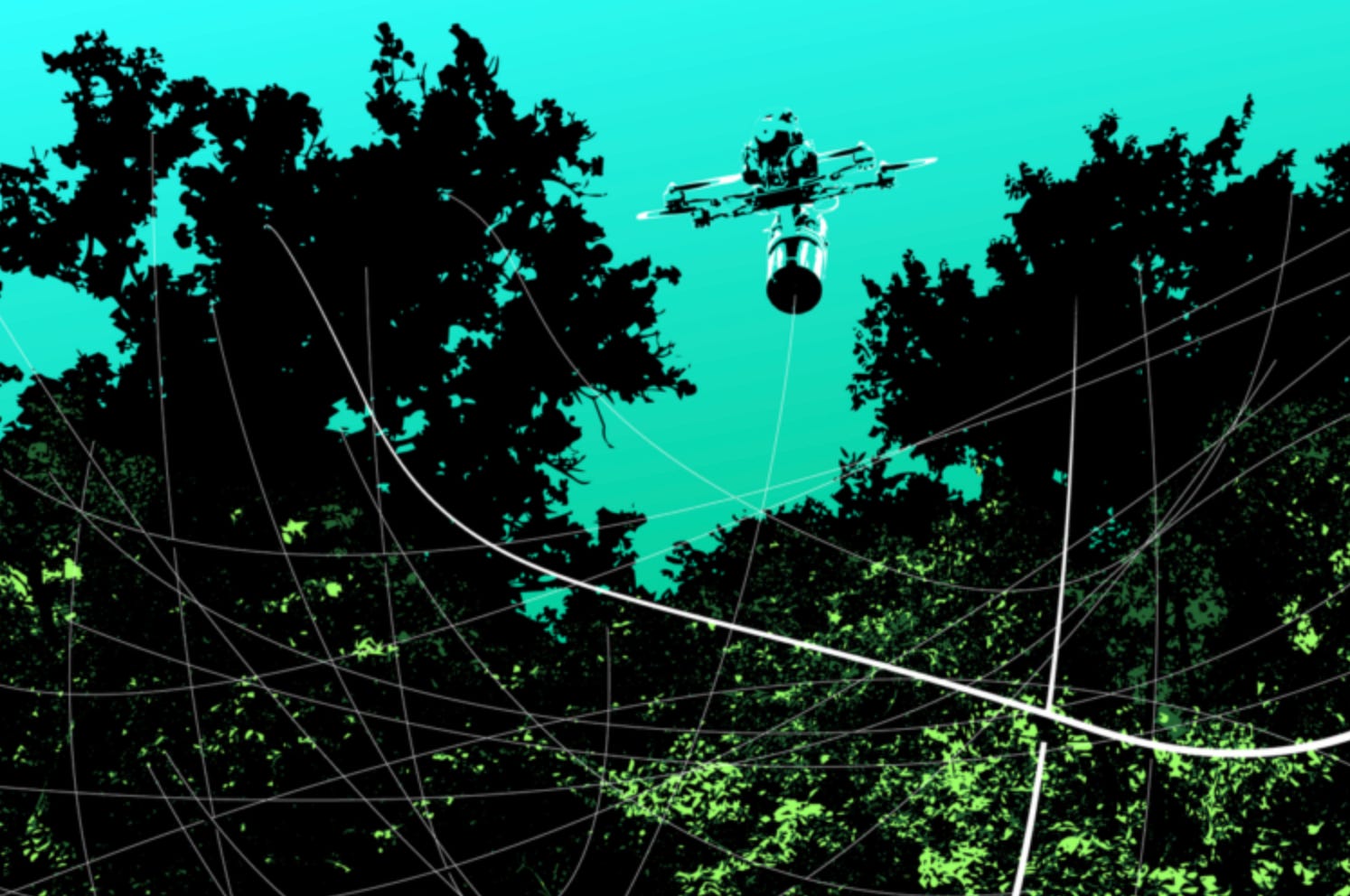
The image is arresting: a once-pristine Ukrainian forest is now strung with plastic fibre-optic cable, gossamer lines spanning trees and brush, like spider webs that will never break down. It depicts a horror of war not often discussed, primarily the destruction of an untouched environment, unexpected and purely collateral damage resulting from modern warfare.
The image also points to something else: the prevalence of drones tethered to fibre-optic cables – simultaneously anachronistic, ridiculous, and, sadly, widespread in the Ukraine war against Russia.
Fibre-optic drones remain a stubborn reality in Ukraine, but the tech may spread further afield unless technology finds a reliable way to prevent electronic jamming on contested battlefields. Otherwise, in the current battle between drone operators and electronic warfare (EW) specialists, the main victims will, in time, be the wildlife surviving in the tangled aftermath of war.
This is not to say that fibre optics are the only culprit. Missiles, kinetic drones, and man-made fires are destroying far more than these thin, endless trails of glass. But fibre optics are an entirely unnecessary result of an entirely unnecessary war.
Consider the birds
Fibre-optic drones landed in Ukraine out of necessity, to solve another technology problem.
Early on in the war, the first drones to enter the battlefield were wireless, commodity drones from companies like DJI. These devices (which DJI eventually stopped selling to Kyiv) depended on open communication protocols that were easily hacked. The solution? Fibre-optic cables that ran from the drone to the operator, allowing unjammable communications across the battlefield.
Fibre-optic drones carry a spool of extremely thin cable that unwinds as they fly. The battery and motors required to use these on the battlefield are . One system from Ukraine’s 3D Tech carries enough cable to operate at distances of up to 20 kilometres. It weighs 1883 grams. This amounts to nearly two kilograms of added weight to a drone already overburdened by payload.
The trade-offs are also disturbing. Drones leave all of that fibre behind them as they fly, and when they return to their operator, there is no sane way to spool it back up for reuse. The drones are simply cut loose, and a new spool is connected to their bellies for their subsequent tours of duty.
The result is a landscape interlaced with plastic fibre that cannot naturally degrade. The material has gotten so prevalent that birds are using it for their nests, an example of nature routing around the damage caused by war.
In fact, researchers at the National Museum of the History of Ukraine in the Second World War in Kyiv have received two nests recovered near the front that contain fibre-optic strands mixed with grass and other natural materials. One remained in the museum’s collection, wrote Reuters, while another went to biologists in the Netherlands to determine which bird species built it and what effect the material could have on wildlife. The goal is to understand, from DNA samples and habitat studies, which birds are best suited to do some of the recycling work for humans.